





In the world of personal finance, few words carry as much weight and stigma as debt. For many, the mere mention of borrowing money conjures images of financial ruin, stress, and endless monthly payments. However, viewing all debt through a negative lens is a significant oversimplification that can hinder your financial growth. To truly master your money, you must move beyond the fear of borrowing and develop a nuanced understanding of how debt works as a tool.
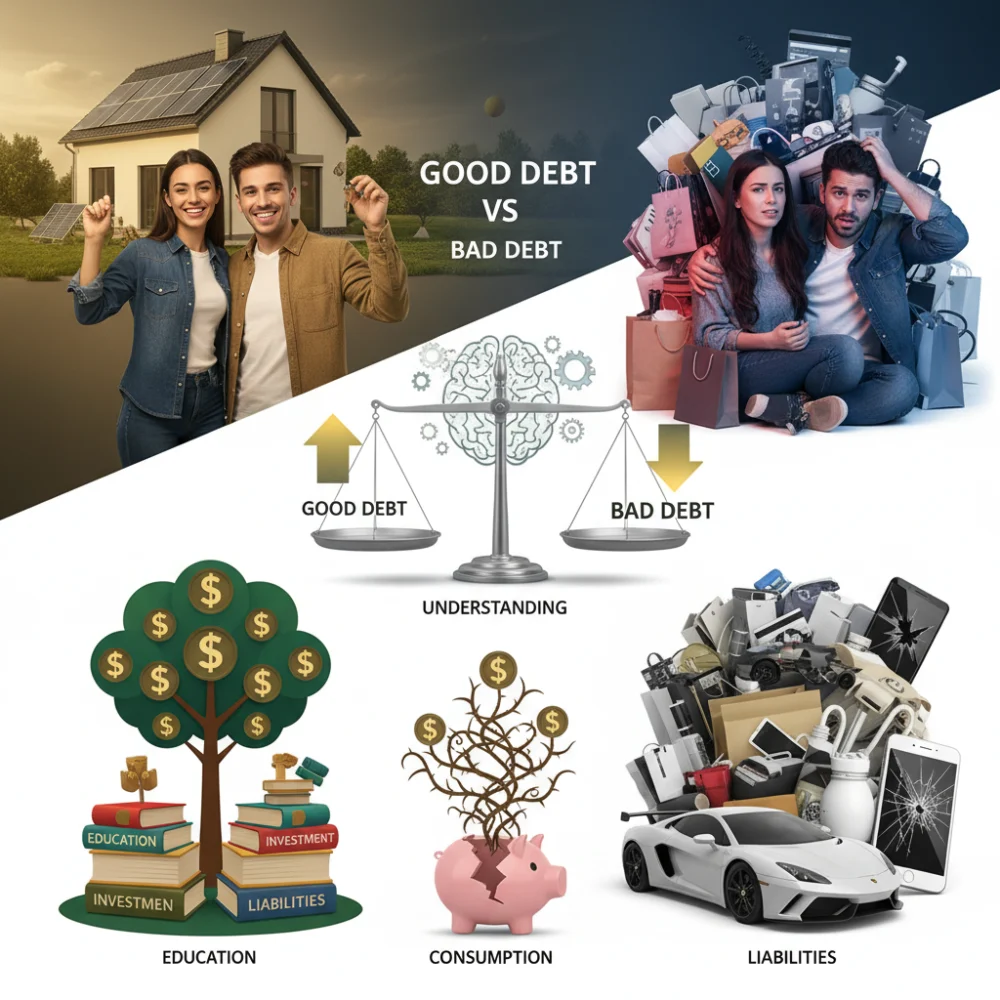
The secret to building wealth often lies in the strategic use of leverage. Wealthy individuals and successful corporations do not shy away from debt; instead, they utilize it to acquire assets that appreciate in value or generate income. Understanding the distinction between good debt and bad debt is the cornerstone of financial literacy. It transforms debt from a burden into a powerful lever for achieving your long-term goals.
Defining Good Debt: The Path to Wealth Creation
Good debt is defined as money borrowed to purchase assets that are expected to increase in value or generate income over time. Essentially, this type of debt pays for itself and eventually contributes to your net worth. The defining characteristic of good debt is that it acts as an investment in your future financial health, often offering tax advantages or lower interest rates compared to consumer debt.
One of the most common examples of good debt is a mortgage. When you borrow money to buy a home, you are securing an asset that historically appreciates in value. Furthermore, unlike renting, paying down a mortgage builds equity—a portion of the home that you actually own. In many jurisdictions, the interest paid on mortgage loans is also tax-deductible, further enhancing the financial benefits of this specific liability.
Another classic form of good debt is a student loan. While the rising cost of education is a valid concern, borrowing money to earn a degree or certification is generally considered an investment in human capital. Statistics consistently show that individuals with higher education levels tend to have higher lifetime earning potential. If the debt incurred leads to a career with a salary that far outweighs the cost of the loan, it is undoubtedly a positive financial move.
Small business loans also fall into this category. Entrepreneurs often require capital to launch or expand their operations. If a business loan allows a company to purchase new equipment, hire staff, or increase inventory, and the resulting revenue exceeds the loan payments and interest, the debt has successfully generated profit. This is the essence of leverage: using other people’s money to make money.
The Trap of Bad Debt: Wealth Destruction
Conversely, bad debt is money borrowed to purchase depreciating assets or to fund consumption. This type of debt does not generate income and the asset purchased usually loses value the moment it is acquired. Bad debt is often characterized by high interest rates and is a primary driver of financial instability. It drains your monthly cash flow without offering any return on investment.
High-interest credit card debt is the quintessential example of bad debt. Using a credit card to purchase clothes, dining, or vacations means you are paying interest on items that have no resale value. If you carry a balance month-to-month, the compound interest can quickly double the cost of the original purchase, trapping you in a cycle of payments that prevents you from saving or investing.
Payday loans and other predatory lending products represent the most dangerous form of bad debt. These loans often come with astronomical annual percentage rates (APRs) and are designed to exploit individuals in desperate financial situations. They provide temporary relief at the cost of long-term financial health, often leading to a spiral of borrowing to pay off previous loans.
The Grey Area: Context Matters
Not all debt fits neatly into the ‘good’ or ‘bad’ boxes; some fall into a grey area depending on your financial situation. Auto loans are a prime example. While a vehicle is necessary for many to get to work (thus facilitating income), cars are rapidly depreciating assets. A low-interest loan on a reliable, modest car could be considered necessary debt, whereas a high-interest loan on a luxury vehicle is almost certainly bad debt.
Similarly, debt consolidation loans can be either good or bad depending on behavior. If you take out a loan with a lower interest rate to pay off high-interest credit cards, it is a smart financial move. However, if you clear the credit cards only to run up the balances again, the consolidation loan simply enabled more bad debt accumulation.
Key Strategies for Managing Debt
To navigate the landscape of borrowing effectively, you must adopt a strategic approach. Before taking on any new debt, calculate the potential Return on Investment (ROI). Ask yourself: Will this purchase increase my net worth over time? Will it generate more cash than it costs to finance? If the answer is no, you should reconsider borrowing for that expense.
- Analyze Interest Rates: Good debt usually comes with single-digit interest rates. If the rate is in the double digits, it is likely bad debt.
- Understand Tax Implications: Look for loans where interest is tax-deductible, such as mortgages or student loans.
- Monitor Your Debt-to-Income Ratio: Lenders use this to assess risk. Keep your monthly debt payments below 36% of your gross income.
- Prioritize Repayment: Use the ‘Avalanche Method’ to pay off high-interest bad debt first while maintaining minimum payments on good debt.
Ultimately, understanding the difference between good and bad debt empowers you to make smarter decisions. By eliminating toxic liabilities and strategically utilizing leverage to acquire assets, you shift your financial trajectory from survival to prosperity. Debt should not be feared, but it must be respected and managed with discipline.