






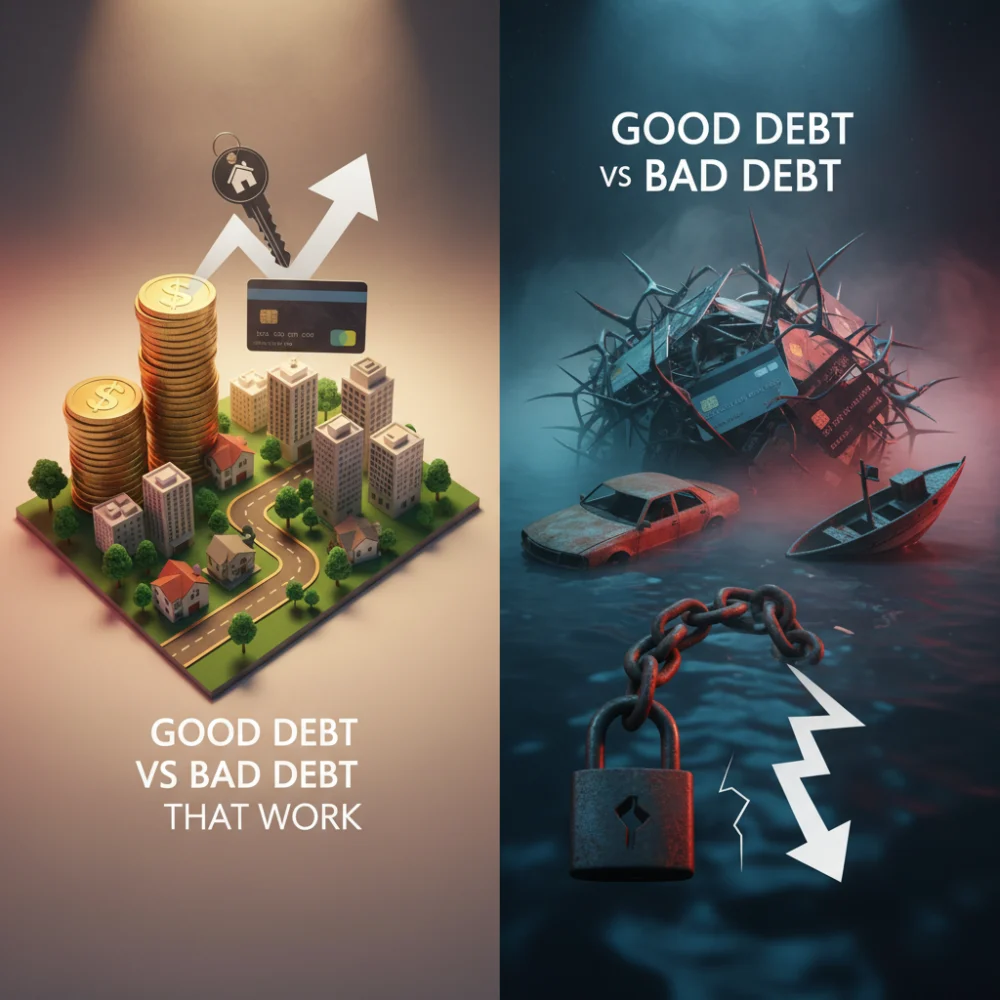
In the world of personal finance, the word "debt" often carries a heavy stigma. Many people are taught from a young age that all debt is dangerous and should be avoided at all costs. However, this black-and-white thinking can actually hinder your ability to build substantial wealth. To truly master your financial destiny, it is crucial to understand the nuanced difference between good debt and bad debt.
Understanding this distinction is not just about semantics; it is a fundamental pillar of financial literacy. Wealthy individuals and successful entrepreneurs use debt as a tool—a lever to lift heavy financial goals that would be impossible to move with cash alone. Conversely, those who misunderstand debt often find themselves trapped in a cycle of payments that erodes their income and future potential.
What Define Good Debt?
Good debt is generally defined as money borrowed to purchase an asset that will appreciate in value or generate income over time. The key characteristic of good debt is that it acts as an investment. Even though you are paying interest, the potential return on investment (ROI) outweighs the cost of borrowing. In essence, good debt helps you build your net worth.
One of the most common examples of good debt is a mortgage. When you borrow money to buy a home, you are securing an asset that historically appreciates in value. Furthermore, unlike rent which is an expense that disappears, mortgage payments contribute to building equity. Tax deductions on mortgage interest in many jurisdictions further enhance the financial viability of this type of debt.
Another classic form of good debt is a student loan. While the rising cost of tuition is a valid concern, investing in your education typically leads to higher earning potential throughout your career. Statistics consistently show that individuals with higher education degrees earn significantly more than those without, making the debt incurred a calculated investment in your own human capital.
Small business loans also fall into this category. Borrowing capital to start or expand a business allows entrepreneurs to purchase equipment, hire staff, or increase inventory. If the business succeeds, the profits generated from these improvements will pay off the loan and continue to generate wealth long after the debt is settled.
The Dangers of Bad Debt
In stark contrast, bad debt is money borrowed to purchase depreciating assets or to fund consumption. This type of debt does not generate income and does not increase in value. Instead, it drains your financial resources through high-interest payments, leaving you with less money at the end of the month and an asset that is worth less than what you paid for it.
The most notorious culprit of bad debt is high-interest credit card debt used for non-essential purchases. Buying clothes, electronics, or paying for vacations on credit without the ability to pay the balance in full immediately is a recipe for financial disaster. The interest rates on credit cards are often exorbitant, meaning you end up paying significantly more for the item than its sticker price.
Auto loans for brand-new luxury vehicles are another common form of bad debt. While a car is necessary for many, borrowing a large sum to buy a new car is financially inefficient because vehicles depreciate rapidly. The moment you drive a new car off the lot, it loses a significant percentage of its value, yet you are still paying interest on the full loan amount.
Payday loans and other predatory lending products represent the worst tier of bad debt. These loans come with astronomical interest rates and fees that trap borrowers in a vicious cycle of borrowing just to pay off previous interest. Avoiding these financial pitfalls is essential for maintaining financial health.
The Gray Area: When Good Debt Becomes Bad
It is important to note that the line between good and bad debt can sometimes blur. Good debt can turn into bad debt if it is not managed correctly or if you over-leverage yourself. For example, taking out a mortgage that is too large for your income puts you at risk of foreclosure. Similarly, accumulating massive student loan debt for a degree in a field with low earning potential may not yield a positive return on investment.
- Risk Tolerance: You must assess your ability to handle payments if your income situation changes.
- Market Conditions: Real estate markets can crash, and business environments can change, turning a good investment sour.
- Interest Rates: Variable interest rates can increase the cost of borrowing, turning a manageable loan into a burden.
Strategies for Managing Your Debt Portfolio
To make debt work for you, adopt a strategy of minimizing bad debt while optimizing good debt. Your priority should always be to eliminate high-interest consumer debt. Strategies like the "debt avalanche" (paying off highest interest rates first) or the "debt snowball" (paying off smallest balances first) can be effective tools for clearing bad debt.
Once you have eliminated toxic debt, you can focus on leveraging good debt to accelerate wealth creation. This might involve refinancing a mortgage to get a lower rate, thereby increasing cash flow, or using a low-interest line of credit to invest in a rental property. The goal is to ensure that the cost of the money you borrow is always lower than the return you earn on that money.
Ultimately, understanding the difference between good debt and bad debt is about shifting your mindset from that of a consumer to that of an investor. By avoiding debt that fuels consumption and embracing debt that fuels growth, you position yourself to achieve long-term financial stability and freedom.