





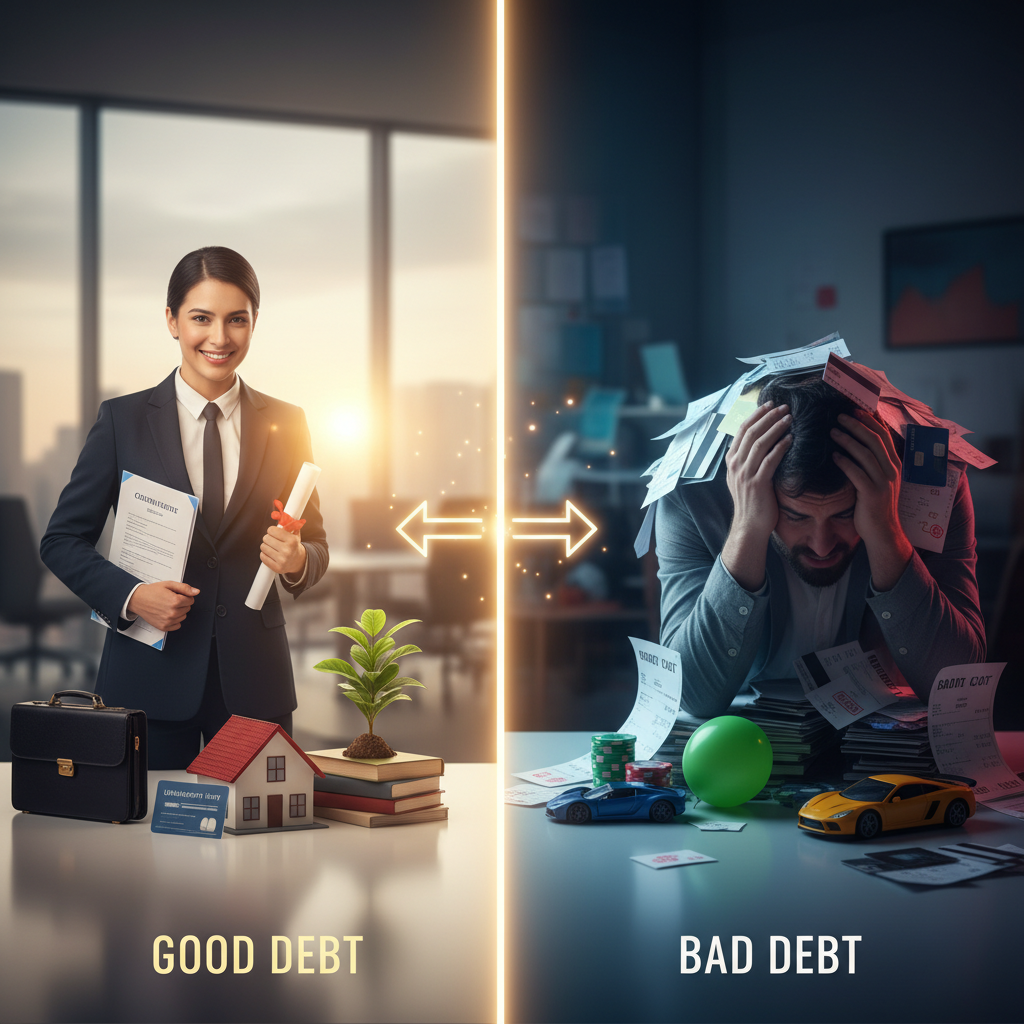
In the world of personal finance, few words carry as much stigma as ‘debt.’ For many beginners, the concept of owing money is terrifying, often associated with financial ruin, stress, and bankruptcy. However, this black-and-white view ignores a fundamental truth used by wealthy individuals and successful corporations alike: not all debt is created equal. Understanding the distinction between good debt and bad debt is one of the most critical steps you can take toward financial freedom.
The primary reason you should understand this distinction is that debt is a tool. Like a hammer, it can be used to build a house or destroy one. By fearing all debt indiscriminately, you might miss out on opportunities to increase your net worth, buy a home, or start a business. Conversely, by being too casual with debt, you can easily trap yourself in a cycle of poverty. This guide will break down the mechanics of borrowing so you can make informed decisions.
Defining Good Debt: The Path to Wealth
Good debt is generally defined as money borrowed to purchase an asset that will appreciate in value or generate income over time. The philosophy behind good debt is ‘leverage.’ You are using other people’s money (usually the bank’s) to acquire something that will eventually be worth more than the cost of the loan plus the interest. Ideally, good debt pays for itself in the long run.
One of the most common examples of good debt is a mortgage. When you borrow money to buy a home, you are purchasing an asset that historically appreciates in value. Furthermore, instead of paying rent which disappears forever, your mortgage payments build equity. Over time, the value of the property rises, and the principal balance of the loan decreases, increasing your net worth. Additionally, in many jurisdictions, mortgage interest is tax-deductible, lowering the effective cost of borrowing.
Another classic form of good debt is student loans. While the rising cost of tuition is a subject of debate, investing in your education is generally considered a sound financial move. A university degree or technical certification often leads to higher lifetime earning potential. If the increase in your future salary significantly outweighs the cost of the loan and interest, the debt is considered ‘good’ because it expands your human capital.
Small business loans also fall into this category. Borrowing money to start or expand a business allows entrepreneurs to purchase equipment, hire staff, or market their services. If the business succeeds, the revenue generated will far exceed the loan payments. This is the essence of using money to make money, a strategy employed by virtually every major company in the world.
Defining Bad Debt: The Wealth Destroyer
In contrast, bad debt is money borrowed to purchase depreciating assets or for consumption. This type of debt does not generate income and the item purchased loses value the moment you buy it. Bad debt is often characterized by high-interest rates, which compounds the financial damage. It essentially steals from your future income to pay for temporary gratification today.
The most notorious example of bad debt is high-interest credit card debt used for non-essential items. If you use a credit card to buy clothes, electronics, or vacations and cannot pay the balance off in full at the end of the month, you are paying significantly more for those items due to interest. Since these items do not increase in value, you are simply draining your financial resources.
Payday loans are the most dangerous form of bad debt. These short-term, high-interest loans are designed to trap borrowers in a cycle of debt. The interest rates can be astronomical, often exceeding 300% or 400% APR. Relying on such loans indicates a financial emergency and a need for immediate budget restructuring, rather than a strategic financial move.
Auto loans for new cars often sit on the borderline but frequently lean toward bad debt. While a car is necessary for transport to work, a brand-new car loses a significant percentage of its value the minute you drive it off the lot. If you borrow a large sum at a high interest rate to buy a luxury vehicle, you are paying interest on an asset that is rapidly becoming worthless. A more financially sound approach is to buy a reliable used car or ensure the interest rate is incredibly low.
The Gray Areas and Context
It is important to note that the classification of debt can sometimes depend on your specific financial situation. For example, a loan to consolidate high-interest credit card debt into a lower-interest personal loan can be a smart move, turning ‘toxic’ debt into manageable debt. Similarly, borrowing to buy a car is ‘good’ if that car is essential for a job that increases your income, provided the car is modest and reliable rather than a luxury status symbol.
Interest rates play a massive role in defining good vs. bad debt. In a high-inflation environment, holding low-interest fixed-rate debt (like a mortgage) can actually be beneficial because you are paying back the loan with money that is worth less than when you borrowed it. However, variable-rate debt can quickly turn from manageable to disastrous if central banks raise interest rates.
The Impact on Your Credit Score
Understanding debt is also crucial for maintaining a healthy credit score. Both good and bad debt affect your credit history. Consistently paying off a mortgage or student loan demonstrates responsibility and boosts your score. Conversely, high credit utilization ratios from maxed-out credit cards can tank your score, making it harder to get approved for ‘good’ debt later, such as a home loan.
Ultimately, the goal for beginners should be to eliminate bad debt as quickly as possible while managing good debt responsibly. Strategies like the debt avalanche (paying highest interest first) or the debt snowball (paying smallest balance first) are effective for clearing bad debt. Once the bad debt is gone, you can focus on using leverage strategically to acquire assets. By mastering the difference between the two, you transition from being a victim of the financial system to a master of it.