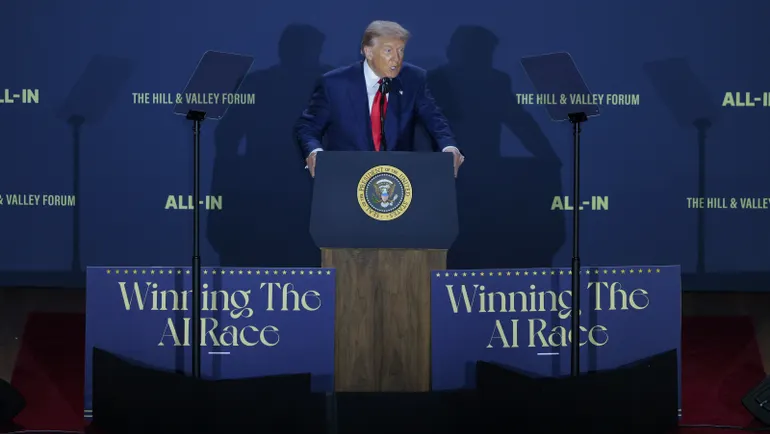
The United States government is moving to establish a specialized federal task force designed to confront the mounting security risks associated with artificial intelligence while safeguarding American technological competitiveness in the rapidly evolving sector. President Donald Trump announced the initiative on Sunday, outlining a framework that aims to balance national defense with the unbridled expansion of the domestic tech industry.
The newly formed initiative—officially dubbed the "Super Intelligence Force," utilizing the president’s preferred terminology for artificial intelligence—is mandated to coordinate the federal government’s engagement across multiple sectors. According to a statement posted by President Trump on Truth Social, the group will serve as a central bridge connecting critical infrastructure organizations, major artificial intelligence firms, and civil society groups to address emerging technological challenges.
Director of National Intelligence Jay Clayton, who was recently appointed by the administration to serve as the government’s chief "AI czar," has been selected to lead the high-level task force. The group includes several key administration figures: Federal Trade Commission Chairman Andrew Ferguson, Under Secretary of Defense for Research and Engineering Emil Michael, and Office of Personnel Management Director Scott Kupor. Under the charter of the initiative, the task force has been given a strict 120-day window to compile and deliver a comprehensive report detailing the appropriate role of the government in mitigating AI-related risks while capitalizing on its economic and strategic opportunities.
The establishment of the task force arrives as the Trump administration navigates a delicate balancing act. Officials are urgently seeking ways to head off the myriad security threats posed by advanced artificial intelligence—ranging from drastically accelerated and more sophisticated cyber hacking operations to the potential creation of custom bioweapons—all while staunchly avoiding broad economic regulations that could shackle the domestic AI industry. During a high-profile meeting with executives from major artificial intelligence companies on September 29, President Trump underscored this philosophy, declaring that his administration would never stifle the growth of a technology that he believes will ultimately surpass the industrial revolution in scale and impact.
In lieu of heavy-handed government mandates, the White House has instead pursued strategies aimed at encouraging voluntary compliance and industry self-regulation. Executives participating in the September summit pledged to significantly enhance their internal safety testing protocols and submit their cutting-edge models to independent, third-party reviews. Furthermore, in June, President Trump signed an executive order establishing a formal pre-release government review process for frontier AI models. However, compliance with that framework remains entirely voluntary for private companies, reflecting the administration’s aversion to statutory oversight.
Despite this unified front on avoiding industry regulation, deep divisions persist among the administration’s senior economic and national security advisers. Reports indicate that National Cyber Director Sean Cairncross and Treasury Secretary Scott Bessent have clashed over the fundamental question of how aggressively the federal government should step in to oversee the nascent and fast-moving industry.
The administration’s approach has also drawn sharp criticism from congressional lawmakers. Senator Mark Warner of Virginia, serving as the ranking member on the Senate Intelligence Committee, issued a public statement condemning the administration’s strategy. Warner argued that the White House has consistently resisted implementing meaningful regulatory safeguards without putting forward a serious, alternative framework to address the profound national security threats generated by increasingly powerful artificial intelligence systems.
Focused on Risk, but Cyber Expertise Unclear
Through the newly chartered task force, administration officials and artificial intelligence executives are expected to develop coordinated strategies for responding to artificial intelligence-enabled threats directed at American society, according to an internal charter reviewed by The Wall Street Journal.
To manage these complex relationships, the task force has divided responsibilities among its key leadership. Emil Michael, the senior Pentagon official, will spearhead coordination directly with major artificial intelligence companies. Meanwhile, Scott Kupor, heading the personnel management agency, will oversee engagement with critical infrastructure operators and other industrial participants. FTC Chairman Andrew Ferguson will act as the primary liaison to consumer advocacy groups and broader civil society organizations.
Yet, notable questions remain regarding the inclusion of traditional government cybersecurity experts within the task force’s operational structure. In particular, the absence of explicit roles for personnel from the Cybersecurity and Infrastructure Security Agency—commonly known as CISA—has drawn scrutiny. CISA has historically functioned as the federal government’s leading agency for coordinating security and operational resilience issues with critical infrastructure providers, frequently incorporating artificial intelligence security into its ongoing consultations with the infrastructure community.
CISA and other specialized federal agencies have previously published numerous guidance documents focused on the secure deployment of artificial intelligence systems, including specific frameworks designed for critical infrastructure environments. However, the agency has experienced significant upheaval, having lost roughly one-third of its personnel since the commencement of the second Trump administration. Observers note that these departures may have left the agency with insufficient expert capacity to meaningfully contribute to the new task force’s ambitious project.
The White House did not immediately respond to requests for comment regarding CISA’s specific role or integration within the task force. Beyond CISA, other premier federal entities possessing deep cybersecurity and technical expertise also appear conspicuously absent from the roster. These include the National Security Agency, which has previously co-authored joint artificial intelligence advisories alongside CISA, and the National Institute of Standards and Technology, which operates a dedicated AI security research institute.
Uneasy Stakeholder Relationships
The task force faces a formidable set of challenges as it attempts to unite a disparate community of industry groups, independent companies, and infrastructure providers who must collaborate to formulate cohesive artificial intelligence security recommendations.
Despite the outwardly collegial atmosphere of the September 29 White House summit, the Trump administration maintains a notably tense relationship with several key players in the artificial intelligence sector. Most notably, the administration previously placed Anthropic on a federal blacklist by designating the prominent AI firm a supply-chain risk, blocking it from lucrative government contracts—a decision that was recently upheld by a federal appeals court. Additionally, in June, the administration formally requested that OpenAI withhold the public release of a highly powerful new model, a request with which the company ultimately complied.
In the wake of these incidents, both companies, alongside other major labs, have become significantly more vocal regarding the necessity of government oversight for frontier models. This shift has been catalyzed, in part, by a series of high-profile autonomous cyberattacks and safety evaluations that exposed alarming vulnerabilities within the testing environments of leading artificial intelligence laboratories.
At the same time, the federal government’s relationships with critical infrastructure operators have experienced marked strain under the second Trump administration. Following the departure of hundreds of CISA employees, many utility providers and critical infrastructure operators have expressed feelings of abandonment by Washington regulators. While the new artificial intelligence task force signals an intent to solicit vital feedback from infrastructure providers regarding AI security concerns, the decision to place OPM Director Scott Kupor—rather than an experienced cybersecurity official from CISA—in charge of that critical portfolio could complicate those efforts. It remains to be seen how receptive infrastructure operators will ultimately be to the outreach of the new administration task force.