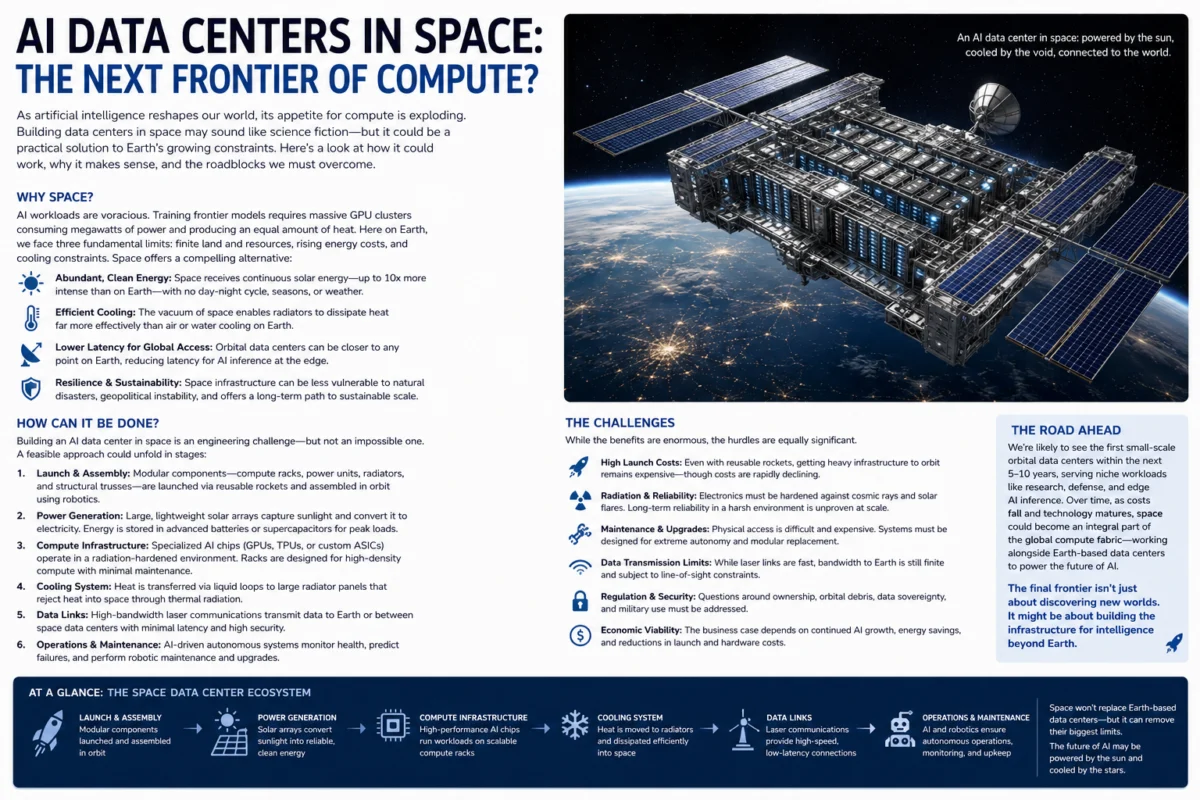
The relentless expansion of artificial intelligence is creating an insatiable demand for computing power that threatens to outstrip terrestrial resources. Every successive generation of large language models and neural networks requires increasingly massive GPU clusters, staggering amounts of electricity, and sophisticated cooling systems. As technology companies race to construct ever-larger AI infrastructure, traditional data centers on Earth are running into fundamental physical and practical constraints. Land availability, rising energy costs, intensive water consumption, and mounting environmental concerns are forcing the industry to look beyond conventional solutions.
This predicament has pushed researchers, aerospace companies, and major technology firms to seriously consider an idea that was once confined strictly to the realms of science fiction: placing AI data centers in orbit around the Earth.
While building and maintaining orbital AI infrastructure remains a formidable engineering challenge, recent breakthroughs in reusable launch vehicles, autonomous robotic assembly, high-bandwidth satellite communications, and space-based manufacturing have transformed the concept from sheer fantasy into a subject of active research. The primary debate across the technology and aerospace sectors is no longer whether orbital computing is theoretically possible, but rather how quickly it can become economically and technologically viable in the decades ahead.
Why Consider AI Data Centers in Space?
Modern hyperscale AI facilities consume immense quantities of power. A single state-of-the-art data center can require hundreds of megawatts of electricity, with future installations projected to demand gigawatt-scale power inputs—equivalent to the output of large nuclear power plants. On Earth, meeting these demands while navigating land restrictions, complex power grid limitations, and strict environmental regulations presents a monumental bottleneck. Space offers unique, profound advantages that directly address several of these terrestrial limitations.
The most prominent advantage is access to virtually unlimited solar energy. Satellites placed in optimal orbits can receive unfiltered sunlight almost continuously. Unlike Earth-based solar farms, which must contend with night cycles, weather patterns, cloud cover, atmospheric filtering, and seasonal variations, orbital solar panels can generate steady, uninterrupted power. Large deployable solar arrays could harvest solar energy with maximum efficiency, making space an exceptionally attractive destination for power-intensive AI workloads.
Another critical advantage lies in thermal management. One of the most common misconceptions regarding space is the notion that "space is cold." In reality, the vacuum of space acts as an extraordinarily poor thermal conductor because there is no atmosphere to facilitate conventional air or liquid cooling. Instead, space serves as a pristine heat sink exclusively through radiation. Without an atmosphere to trap heat, large thermal radiators can continuously and efficiently emit waste heat into deep space via infrared radiation. Future orbital data centers could utilize advanced closed-loop liquid coolant networks coupled with expansive deployable radiator wings, achieving highly efficient thermal regulation without relying on terrestrial water sources or cooling towers.
Furthermore, relocating these massive computational loads off-planet would dramatically reduce the local environmental impact on Earth. Massive terrestrial AI facilities require vast tracts of land, millions of gallons of freshwater for evaporative cooling, and significant local electrical grid upgrades. An orbital facility effectively eliminates land usage pressures and minimizes freshwater consumption entirely, avoiding the ecological disturbances associated with massive data center construction on the ground.
How Could Space AI Data Centers Be Built?
Translating this vision into reality requires synthesizing a diverse array of advanced technologies currently under development across the global aerospace industry. Rather than attempting to launch a complete, fully functioning data center in a single flight, engineers envision a modular deployment strategy. Infrastructure would be divided into specialized, interchangeable modules—including computing units, power generation arrays, thermal radiators, and communication nodes—and transported into orbit over multiple missions by heavy-lift, reusable rockets.
Because human extravehicular construction in space is exceptionally expensive and hazardous, autonomous robotic systems would likely handle the assembly process, interlocking components much like giant orbital structures. These robotic systems would be capable of positioning modules, connecting power lines, aligning thermal systems, and eventually performing routine hardware upgrades and repairs without putting human lives at risk.
The hardware itself, however, would require a radical redesign. Consumer-grade GPUs and standard server components are fundamentally unsuited for the harsh conditions of orbit. Space-based AI infrastructure would necessitate specialized radiation-hardened electronics, advanced fault-tolerant system architectures, and custom AI accelerators optimized for orbital environments where cosmic rays and solar particle events can corrupt memory and degrade silicon over time.
To maintain continuous computing operations during orbital eclipses—when the Earth blocks the sun—large foldable solar arrays would be paired with dedicated energy storage systems, such as advanced regenerative fuel cells or orbital battery banks. Meanwhile, high-speed communications networks would be essential for moving data rapidly between Earth and orbit. Next-generation laser communication systems, which are already being successfully demonstrated by modern constellations, are expected to provide the multi-terabit connectivity required to feed training data to space and return results to terrestrial users.
Which AI Workloads Make Sense in Space?
Not every artificial intelligence application is suited for an orbital environment. Real-time applications that demand ultra-low latency, such as autonomous vehicles, financial high-frequency trading, and interactive consumer services, require proximity that only Earth-based edge infrastructure can reliably provide.
Instead, space-based data centers would naturally gravitate toward heavy computational workloads that prioritize throughput and massive scale over millisecond response times. These ideal use cases include foundational AI model training, large-scale scientific simulations, complex climate modeling, astronomical data processing, and heavy analytical tasks driven by deep space exploration missions. For these intensive workloads, the trade-off of a slight communication delay is easily justified by the sheer availability of boundless energy and efficient cooling.
Major Challenges and Economic Realities
Despite the compelling advantages, significant obstacles must be overcome before orbital data centers become commonplace. Even with the advent of rapidly maturing reusable launch technologies, transporting thousands of tons of sensitive computing equipment into orbit remains extraordinarily expensive. Long-term economic viability will depend heavily on whether launch costs continue their downward trajectory and whether space manufacturing capabilities can eventually utilize in-situ resources.
Radiation remains another persistent hazard. Continuous exposure to galactic cosmic rays and solar flares can cause single-event upsets, corrupt memory, and steadily degrade semiconductor performance. Developing robust shielding and resilient software architectures is vital to ensuring hardware longevity. Similarly, maintenance presents a unique dilemma; unlike terrestrial facilities where technicians can quickly swap out failed server blades, orbital systems must either rely on autonomous self-healing software or robotic servicing vehicles.
Communications latency, while manageable for batch processing and large-scale training, remains an immutable physical barrier governed by the speed of light. Furthermore, the proliferation of orbital debris in Earth’s increasingly crowded orbits means that any massive space-based facility would require sophisticated active collision avoidance systems and carefully managed orbital slots to mitigate catastrophic impact risks.
Ultimately, the future of AI data centers in space hinges on simple economics. Even if every technical hurdle is cleared, orbital infrastructure must compete financially with increasingly efficient terrestrial data centers powered by cheap renewable energy on the ground.
Rather than entirely replacing Earth-based facilities, orbital AI clusters are expected to serve as a specialized complement to terrestrial infrastructure. Ground-based systems will continue handling latency-sensitive applications and everyday cloud services, while space-based compute nodes step in to shoulder the heaviest power-intensive AI training and scientific workloads. As humanity’s collective demand for computational power continues its exponential climb, extending digital infrastructure beyond the confines of Earth may ultimately evolve from a futuristic ambition into a practical necessity.