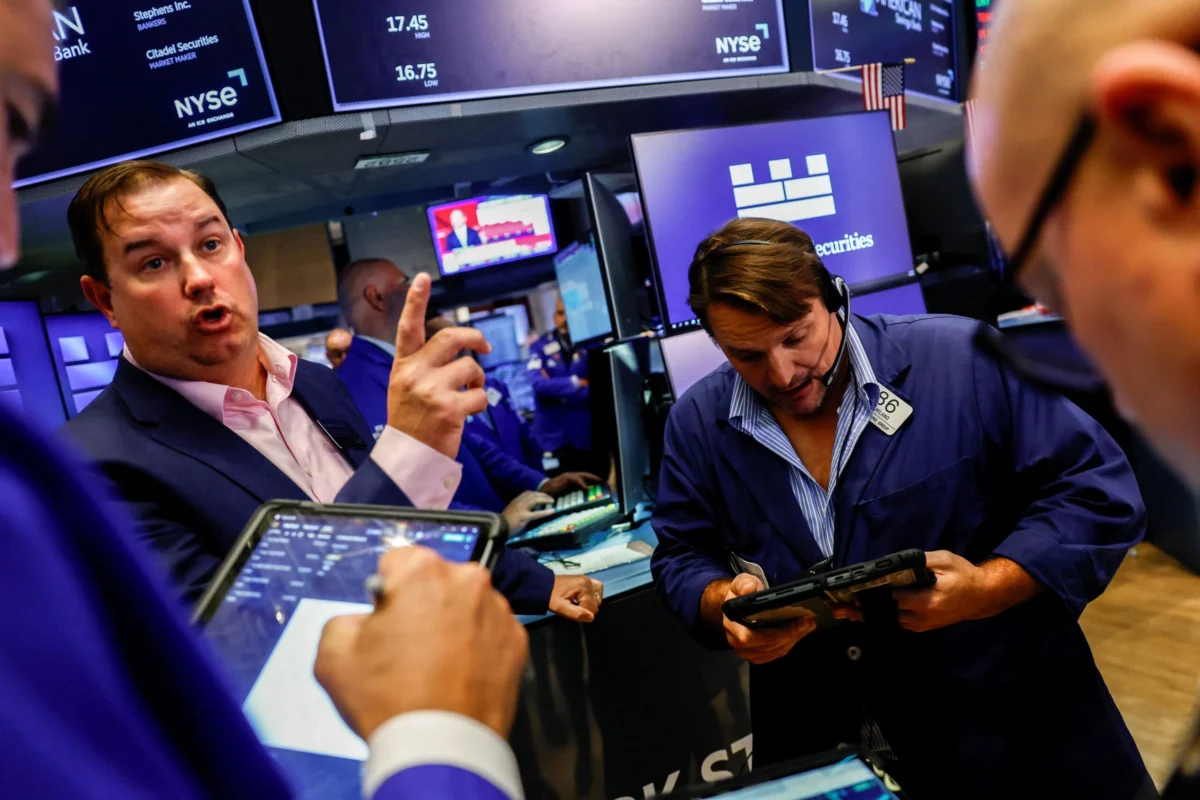
Traders work on the floor of the New York Stock Exchange, Sept. 16, 2026.
Jeenah Moon | Reuters
S&P 500 futures are trading at all-time highs, but an aura of concern is lingering among investors trying to make sense of extremely low breadth in the U.S. stock market. The dichotomy between the headline index numbers and the underlying health of the broader equities landscape has become a central talking point on trading desks. On the New York Stock Exchange on Tuesday, 75 stocks made new 52-week lows, versus just 14 names making new highs, a stark illustration of an index being pulled upward by a concentrated handful of heavyweights while the rest of the market struggles to keep pace.
Despite this narrow market participation, options traders who are piling into bullish positions in both indexes and key stock leaders are sending a clear message to the broader financial community: Just wait. Rather than bracing for a broader market pullback that many technicians might expect given the weak breadth numbers, the options market is aggressively pricing in continued upside momentum driven by marquee large-cap names.
Monday’s rally in stocks was so powerful and swift that there are growing signs even institutional market-makers were caught offsides and forced to scramble, buying upside calls simply to keep pace with the sudden surge in market momentum. According to Barchart data, the volume ratio of calls to puts climbed to its highest level since May. For the State Street SPDR S&P 500 ETF Trust, commonly known as the SPY, the ratio reached its highest mark since the first week of August, underscoring the urgency with which participants sought upside exposure.
The same dynamic played out extensively in the Invesco QQQ Trust, tracking the tech-heavy Nasdaq 100, where the ratio of calls to puts hit its highest level in at least a year. The underlying derivatives pricing reflects immense confidence among aggressive participants. Based on options pricing on the popular trading platform ThinkOrSwim, the probability that the Nasdaq 100 touches a new all-time high by the end of the week is now calculated at more than 67%.
Options pricing in the key technology leaders driving this latest market rally exudes a similar bullish bias. Market-makers are increasingly pricing in new records for high-flying stocks such as Meta Platforms, Intel, and Micron before the end of the year. Financial professionals and sophisticated traders frequently assess these probabilities by examining a given options contract’s delta—its mathematical responsiveness to changes in the underlying stock’s price—allowing them to extrapolate the statistical chance that the security will touch the contract’s strike price before a specified expiration date.
In Meta, where total options volume for the week has surged to upward of four times its normal 30-day average, implied volatility is noticeably higher for calls than for puts across the entire options term structure, according to Barchart data. Detailed ThinkOrSwim pricing indicates there is currently a 52% implied chance that the social media giant’s stock touches $790, which matches its closing high from the previous year, by Oct. 2.
Intel, meanwhile, has emerged as a fascinating focal point for institutional capital. Having surged an impressive 35% over the past month, Intel has established itself as the latest prominent leader of the semiconductor trade. The stock now boasts a hefty implied volatility reading of 69 as options trading activity accelerates heavily in what was previously considered a laggard within the broader artificial intelligence hardware ecosystem. Market-makers are currently assigning roughly a coin-flip probability that the equity reaches above its previous closing high of approximately $140 at some point between now and Oct. 30.
The broader semiconductor narrative received a fresh injection of enthusiasm on Tuesday with a solid 2% advance across memory stocks tracked by the Roundhill Memory ETF. Individual components within the sector participated enthusiastically in the move, as shares of Sandisk climbed more than 6%, while shares of Micron gained more than 3%, reflecting robust demand trends within the memory chip market.
Derivatives markets are reflecting this sector-specific strength through forward-looking pricing structures. Current options pricing points toward a probable new high for Micron by Oct. 23, and a corresponding new high for Sandisk by Dec. 18. Meanwhile, for the Roundhill Memory ETF—whose overall implied volatility has experienced a noticeable plunge since earlier this summer—market-makers are pricing in a more modest 34% chance of reaching a new high by Dec. 18, highlighting how investors are differentiating between individual stock leaders and broader thematic exchange-traded funds.