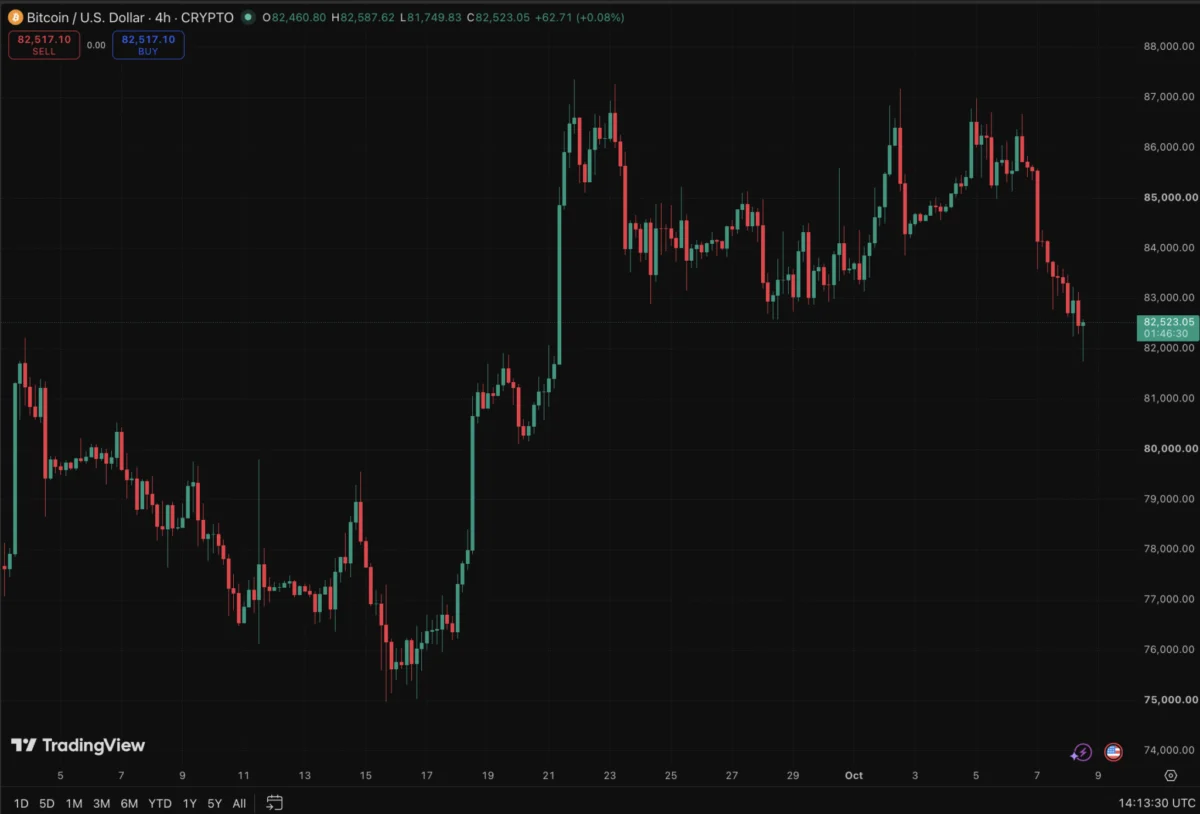
Cryptocurrency markets faced intense macroeconomic headwinds during Thursday morning trading in Asia, as Bitcoin slid below the crucial $83,000 threshold. The downward movement in digital assets coincided with a broader cross-asset selloff driven by soaring energy costs and surging government bond yields.
Brent crude climbed roughly 2% to surpass $102 a barrel, while the 10-year U.S. Treasury yield advanced to 5.31%, marking its highest level in over two decades. The convergence of tightening financial conditions, geopolitical friction, and a wave of forced liquidations placed mounting pressure on risk assets globally, dragging major cryptocurrencies lower alongside traditional equity markets.
The sudden correction in Bitcoin brought prices down to just under $82,800, representing a 2% decline on the day. This price action breached a critical technical support zone previously identified by analysts at FxPro, who noted that a decisive loss of the $83,000 level would confirm that short-term control had shifted firmly to sellers.
The breakdown immediately renewed focus on a potential slide toward the $80,000 region, a conditional downside scenario rather than an absolute prediction. While breached support levels frequently draw heightened attention to subsequent downside targets, market analysts emphasize that technical indicators alone do not guarantee that prices will immediately retrace to those lower levels.

Cross-Asset Pressures and Geopolitical Tensions
The macro environment dominating global financial markets has placed non-yielding assets under severe strain. The U.S. 10-year Treasury yield climbed another two basis points to settle at 5.31%, a level not sustained since 2002. Simultaneously, Brent crude pushed decisively above the $102 mark following a combination of supply disruptions and escalating geopolitical tensions in the Middle East.
Reports surfaced that the White House had requested potential military strike options involving Iran from the Pentagon, though officials emphasized that these reports did not confirm any military action had been authorized or executed. Compounding the pressure on energy markets were localized weather disruptions that temporarily impacted U.S. domestic oil output, alongside reported attacks targeting infrastructure in the region.
These energy and fixed-income developments reverberated through global exchanges. Traditional equity markets in Wall Street and across Asian trading desks drifted lower in tandem, highlighting a synchronized repricing of risk rather than an isolated crypto-specific event. Higher borrowing costs driven by elevated bond yields traditionally diminish the relative appeal of speculative and non-yielding instruments, creating a challenging backdrop for digital assets.
Broader Altcoin Correction and Leverage Unwind
The weakness in Bitcoin quickly spread across the wider cryptocurrency ecosystem, resulting in broad-based losses for major altcoins. Ethereum (ETH) dropped approximately 3% to trade near $2,570, while XRP fell nearly 4% to approximately $1.42. Dogecoin (DOGE) declined by roughly 3% to just under $0.09, and both Solana (SOL) and emerging tokens saw downward pressure exceeding 2%.

Market data indicated that only a few large-cap tokens, such as BNB and TRX, managed to buck the prevailing trend with modest gains of under 1%. The divergence underscored an uneven but pervasive market correction where bullish positioning was rapidly being forced out of the system.
The severity of the pullback was amplified by a substantial leverage flush across derivatives exchanges. Approximately $550 million in leveraged crypto positions were liquidated within a brief window, heavily skewed toward long positions betting on upward price continuity. As prices began to slide, the forced unwinding of these leveraged accounts accelerated the downward momentum.
Market observers note that while these sudden liquidations exacerbate short-term price swings by cascading through order books, they represent structural deleveraging events rather than a fundamental collapse in underlying long-term demand.
Outlook for Crypto and Macro Markets
As trading progresses, market participants are closely monitoring whether the current correction represents a temporary macroeconomic shock or the beginning of a prolonged risk-off cycle. A stabilization or retreat in Brent crude back toward the sub-$100 levels seen earlier in the week could alleviate some of the immediate inflationary and geopolitical anxiety weighing on investors.

Conversely, if energy prices and Treasury yields remain stubbornly elevated, digital assets may continue to face stiff competition from traditional fixed-income instruments offering attractive yields with lower volatility.
The intersection of geopolitical developments, central bank policy expectations, and structural market leverage will likely dictate the near-term trajectory for Bitcoin and the broader digital asset class. For now, the loss of the $83,000 level leaves market participants navigating heightened volatility, with analysts keeping a close eye on how prices react around remaining technical boundaries.