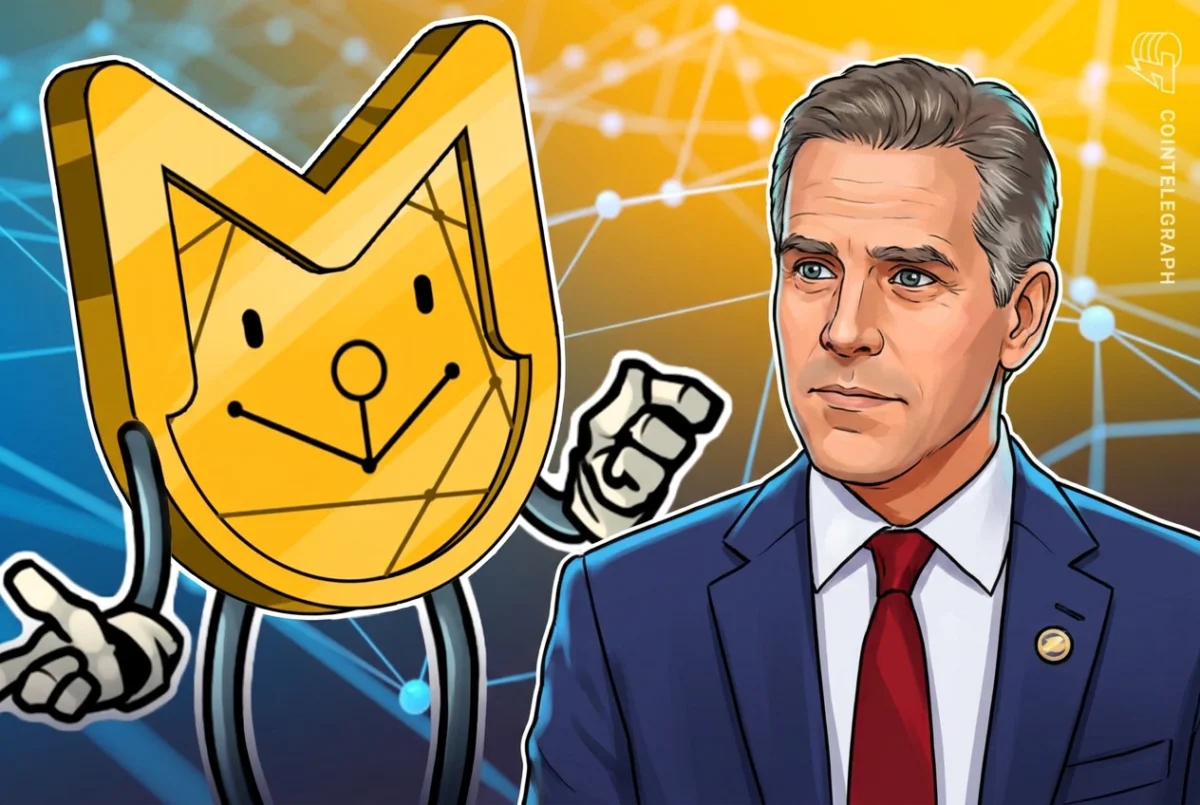
Hunter Biden, the son of former United States President Joe Biden, has released a comprehensive accounting and transparency report regarding the memecoin he helped launch last month, drawing heavily on the infamous narrative surrounding his former laptop.
In a detailed series of posts published on the social media platform X on Wednesday, Biden provided extensive blockchain data confirming that 300 million tokens held in wallets associated with the founders of the $LAPTOP memecoin have remained completely stationary since the project’s official launch.
The public disclosure comes amid a broader cultural and financial debate over the involvement of prominent political figures and their families in the speculative cryptocurrency market. Biden’s latest move is designed to offer a stark contrast to what he perceives as predatory practices within the sector, specifically targeting competing political projects.
According to Biden’s posts, the charts tracking the price performance of the $LAPTOP memecoin "looked like every celebrity rug ever" shortly after its market debut on September 9. He pointed out that the primary beneficiaries of the token’s explosive initial run were not the founders or everyday retail buyers, but rather unnamed market makers. These entities, described in the project documentation as "two professional trading firms" hired specifically to manage liquidity for the launch, reportedly pulled their funds mere seconds after the token reached its peak price of approximately $317.
Data shared by Biden indicates that one of these market makers secured $686,000 in profits from liquidity positions established on decentralized exchanges, while the second firm "took in about $2.18 million more than it spent" directly through trading activity.
Similar transactional data was independently published in a formal "launch report" prepared by the Delaware-based intelligence consultancy Groom Lake. This report, which was hosted directly on the official memecoin website, meticulously tracked the chronology of the token’s dramatic price spike and subsequent crash.
"The money for sellers was pulled right after the peak," stated the Groom Lake report regarding the performance of $LAPTOP. "Eighty-four seconds after the price topped out, Market Maker 1 withdrew its money. The cash available to people trying to sell near the current price dropped from $16,157 to zero."
Expanding on his motivations behind the project, Biden offered a candid explanation for the creation and subsequent management of the token. In his posts on X, he wrote that his goal was to hold a mirror up to the broader ecosystem of highly speculative political tokens.
"Here’s why I did this. Trump’s coin was max extraction, and I wanted to troll every grift like it," Biden wrote. "So we were transparent, committed the team to a lock up and published a MiCA disclosure. And I hoped it could help some charities I care about too."

While Biden originally stated an intention to dedicate 5% of the token supply to charitable causes, he also acknowledged that he was personally incentivized to sustain the project out of spite. He noted that he wanted "just to piss off Don and Eric"—referring to Donald Trump Jr. and Eric Trump, the adult sons of U.S. President Donald Trump—as well as "every Key Opinion Leader who called it a scam because we refused to pay them."
The name and branding of the memecoin directly reference Biden’s laptop computer, an electronic device whose existence, contents, and alleged handover became a massive focal point of media scrutiny and political controversy ahead of the 2020 U.S. presidential election. During that election cycle, the elder Biden competed directly against Donald Trump. The controversial laptop continues to be invoked frequently by conservative figures in political commentary and has served as the subject of multiple privacy lawsuits filed by Hunter Biden.
The release of the accounting report also highlights ongoing political friction surrounding digital assets. Biden has previously emerged as a vocal critic of World Liberty Financial, a decentralized finance project backed by the Trump family. In August, Biden publicly denounced the venture on social media, describing it as "corruption at a scale we’ve never seen."
At the same time, President Donald Trump has faced intense criticism from political opponents and consumer advocacy groups for launching his own memecoin, Official Trump ($TRUMP), shortly before taking office in January 2025. That token has similarly been dogged by allegations of insider extraction, sharp market drops, and potential conflicts of interest.
Despite the controversy surrounding his own token, Biden confirmed that the $LAPTOP founder wallets will remain locked for a mandatory six-month period following launch. Additionally, the project team plans to continue burning unclaimed tokens originating from initial airdrops to manage circulating supply.
President to Host Another Memecoin Event Amid Controversy
Whether Hunter Biden’s entry into the memecoin space was intended as an artistic critique of speculative market manipulation, a satirical joke, or a direct effort to troll the Trump family, the experiment has served to amplify broader questions regarding the intersection of high-level politics and volatile crypto ventures.
The renewed discussion over political memecoins arrives as President Donald Trump prepares to speak at another high-profile event dedicated to his own token holders. Last week, the organizational group behind the $TRUMP memecoin announced that the president will make a personal appearance at his golf club in Washington, D.C., on November 22. He is scheduled to appear alongside three unnamed guest speakers and the top 185 tokenholders for an exclusive private dinner.
The ongoing enthusiasm among certain investors stands in stark contrast to the severe financial losses reported by broader market participants. Public Citizen, a prominent nonprofit consumer advocacy organization, recently estimated that retail investors participating in the $TRUMP memecoin ecosystem have collectively lost approximately $3.2 billion since the asset’s launch in 2025.
As regulatory bodies continue to scrutinize the rapidly evolving landscape of celebrity and politically affiliated cryptocurrencies, developers and public figures alike face mounting pressure to provide verifiable on-chain data and transparent accounting to maintain any semblance of market credibility.