Pickleball has experienced an explosive rise in popularity over the past decade, transforming from a backyard pastime into a nationwide cultural phenomenon. Millions of Americans have picked up a paddle, converting tennis courts and local parks into bustling hubs of athletic activity. However, as participation numbers surge, a parallel trend is playing out in hospital emergency departments across the country. According to a new study conducted by ValuePenguin, pickleball-related emergency room visits have nearly quadrupled since 2018, with older adults disproportionately bearing the physical and financial consequences of on-court accidents.
The comprehensive study provides a closer look at how players are getting hurt, the types of injuries that are most frequently diagnosed, and how health insurance policies can help alleviate the sudden financial shock that often follows an unexpected trip to the hospital.
Key Findings
The rapid expansion of pickleball has introduced a new class of recreational injuries into the American healthcare system. While the sport is widely praised for being accessible, low-impact, and highly social, the sheer volume of new participants has led to a dramatic escalation in acute medical incidents requiring emergency intervention. Experts caution that while individual accidents are standard risks of recreational sports, the macro-level trend carries significant implications for healthcare utilization and insurance claims.
Pickleball-Related Emergency Room Visits Nearly Quadrupled Between 2018 and 2025
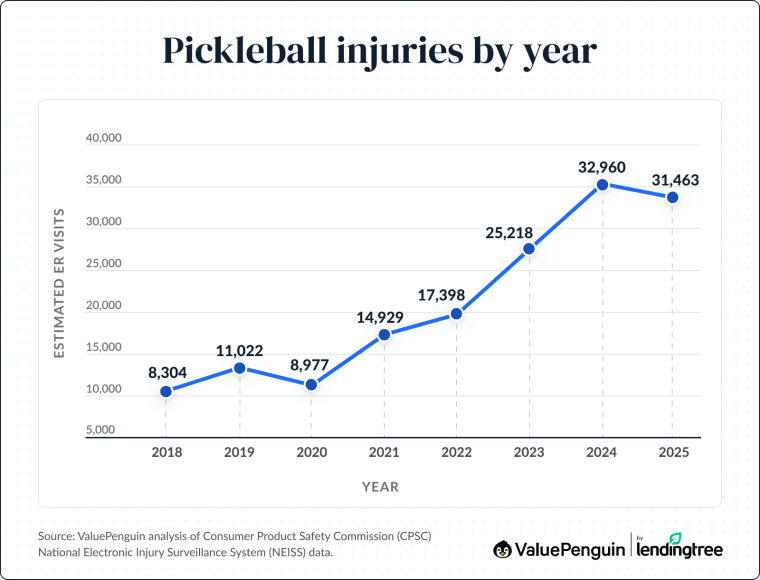
Statistical tracking reveals a steep upward trajectory in emergency medical care associated with the sport. U.S. pickleball injuries treated in emergency rooms rose from an estimated 8,304 incidents in 2018 to 32,960 incidents in 2024. This represents a nearly fourfold increase over a six-year span before experiencing a slight dip to 31,463 visits in 2025.
It is important to contextualize these figures within the broader boom of the sport itself. Because this research specifically captures injuries treated in emergency rooms, and because comprehensive data tracking the total number of active players or total hours played annually remains incomplete, analysts note it is difficult to determine whether individuals are getting hurt at a higher frequency per hour played, or if the rising injury totals simply reflect a much larger overall population taking up the sport.

Nevertheless, from a health insurance perspective, Cate Deventer, a health insurance expert at ValuePenguin, emphasizes that a broader rise in sports-related injuries warrants close attention from consumers and policyholders alike.
"Patients who get hurt playing pickleball or other recreational sports may be more likely to be faced with deductibles, copays and coinsurance when they visit the doctor, because going to the doctor more often usually means you have to pay more," Deventer notes. She adds that while individual accidents and isolated injuries are not likely to directly influence personal insurance premiums, a sustained, broader increase in these types of medical claims across the population could eventually push market rates upward.
Older Adults Accounted for the Majority of Pickleball-Related ER Visits
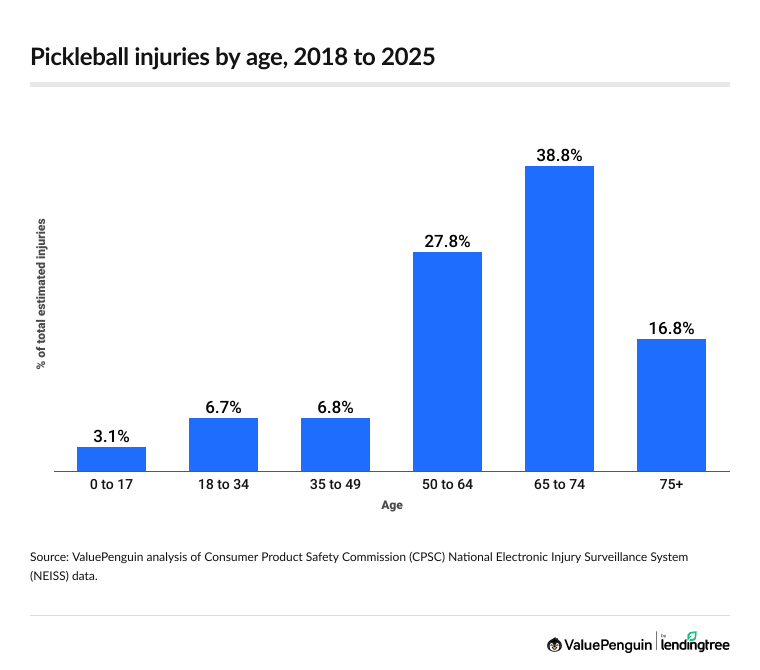
While players of all ages have embraced the sport, the demographic breakdown of emergency room patients reveals a stark concentration among older populations. Adults aged 50 and older accounted for an estimated 125,287 emergency room visits between 2018 and 2025. This older demographic represents a striking 83.4 percent of all pickleball-related emergency visits recorded during the study period.
A more granular breakdown of the age data shows that adults between the ages of 65 and 74 made up the single largest share of injuries at 38.8 percent. They were followed closely by individuals ages 50 to 64, who accounted for 27.8 percent of visits, and adults aged 75 and older, who represented 16.8 percent.
By comparison, younger age groups were far less represented in emergency room data. Adults between the ages of 18 and 34 accounted for just 6.7 percent of injuries, while those aged 35 to 49 made up 6.8 percent. Children and teenagers younger than 18 years old accounted for a minimal 3.1 percent of overall emergency department visits.
For older adults, navigating the financial aftermath of an injury requires a clear understanding of coverage rules. Deventer points out that health insurance considerations are especially vital for this demographic.
"For seniors on traditional Medicare, coverage is a little more straightforward," she explains. "Traditional Medicare generally covers medically necessary services, but you’re still responsible for deductibles and coinsurance unless you have a Medigap plan."
For beneficiaries enrolled in Medicare Advantage plans, the coverage landscape can be significantly more complex. Deventer stresses that it is especially important for older adults to carefully review how their specific policies handle emergency medical care and unexpected injuries, noting that Medicare Advantage plans operate more similarly to traditional commercial health insurance, meaning coverage rules, provider networks, and out-of-pocket costs can vary substantially between different plans.
Age is not the only demographic variable influencing hospital visits on the court. Statistics indicate that men were slightly more likely to seek emergency hospital treatment for a pickleball-related injury than women, registering 53.3 percent of visits compared to 46.7 percent, respectively. This breaks down to an estimated 80,082 emergency room visits among men, contrasted with 70,162 visits among women over the seven-year study window.
Falls Were the Most Common Cause of Pickleball Injuries
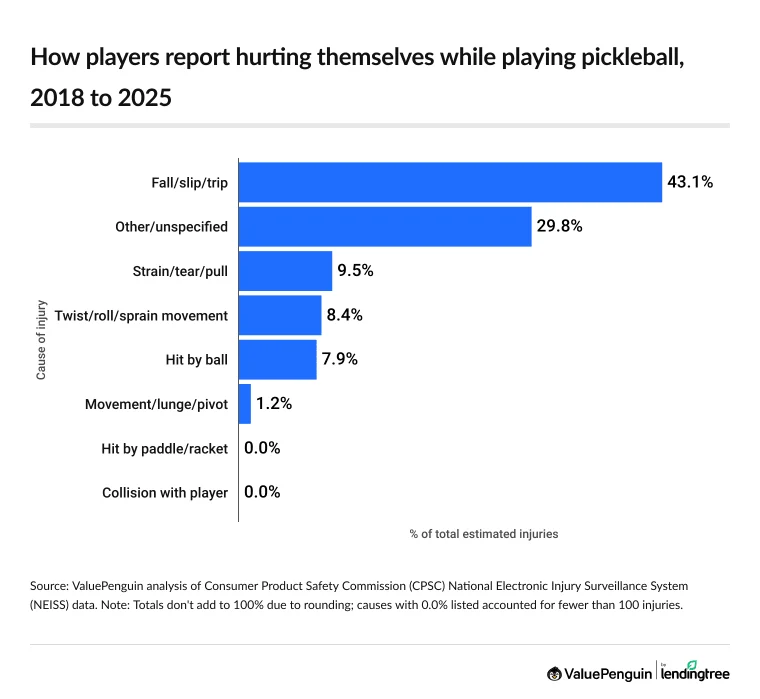
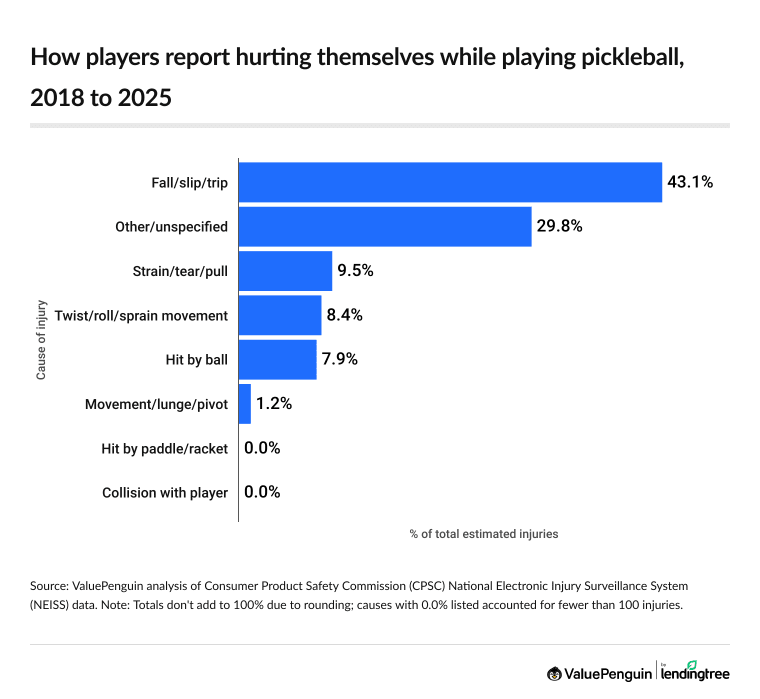
The physical mechanics of how players sustain injuries on the court point to mobility and court conditions as primary risk factors. Falls, slips, and trips were the leading cause of injuries by a wide margin, accounting for an estimated 64,753 emergency room visits between 2018 and 2025. This specific mechanism of injury represents 43.1 percent of all recorded pickleball-related incidents. Unspecified injuries ranked as the second most common category, registering 44,762 visits or 29.8 percent of the total, while strains, tears, and pulls placed third, accounting for 14,232 visits or 9.5 percent.
Deventer notes that the vast majority of these sudden recreational injuries are handled under standard health insurance policies in the same manner as other unexpected medical events.
"Most health insurance plans cover injuries from recreational activities the same way they cover other accidents and health issues," she says. "You may also have a copay when you go to the doctor, urgent care or emergency room. You’ll also pay toward your deductible, if you haven’t already met it. If you’ve already met your deductible, you’ll split the bill with your insurance company, which is called coinsurance."
When seeking treatment outside of an immediate, life-threatening emergency, insurance policyholders must also remain cognizant of provider networks. Deventer advises that patients should verify which physicians and medical facilities participate in their plan’s approved network to avoid unexpected out-of-network billing, keeping in mind that many plans strictly require in-network care for non-emergency medical services to secure full policy benefits.
Most Pickleball Injuries Aren’t Serious, But Financial Impacts Remain
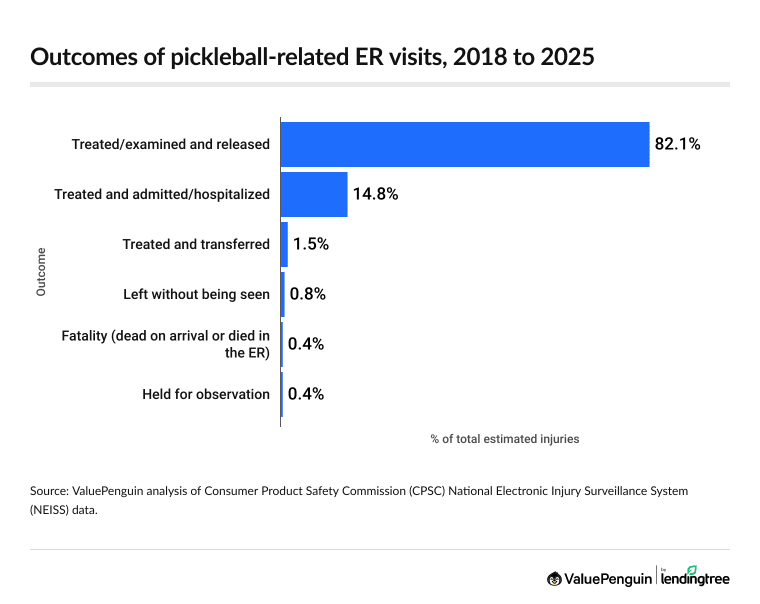
Despite the alarming increase in raw emergency room numbers, the vast majority of pickleball-related injuries treated in hospital settings are ultimately classified as non-life-threatening. Cases where patients were treated and subsequently released home accounted for an estimated 123,417 visits, representing 82.1 percent of all pickleball-related emergency room encounters from 2018 through 2025. Another 22,182 visits, or 14.8 percent of the total, resulted in formal hospitalization or admission for more intensive medical observation and care.
A minor fraction of patient outcomes involved specialized transfers or critical conditions. Patients treated and transferred to another medical facility accounted for 1.5 percent of visits, while those who left the emergency department without being seen made up 0.8 percent. Patients held strictly for observation represented 0.4 percent of the total. Tragic fatalities, which included patients who arrived at the hospital without vital signs or who ultimately succumbed to their injuries in the emergency room, accounted for an estimated 574 visits, or 0.4 percent of all recorded cases.
Regardless of the clinical severity of the injury, emergency medical care remains inherently costly, even for insured individuals. Deventer highlights that copays, deductibles, and coinsurance can quickly accumulate.
"Patients may have to pay a flat fee, called a copay, on top of a deductible or coinsurance," she notes. "They may also see various charges from specialists who work in the emergency room, such as a radiologist who takes X-rays. The exact amount they have to pay depends on their specific health plan, whether they’ve met their deductible and what kind of healthcare they needed during the visit."
Fractures and Strains Lead the Diagnosis List
An examination of specific medical diagnoses resulting from court-related accidents reveals that bone breaks and soft tissue damage are the primary drivers of emergency intervention. Other or unspecified injuries topped the diagnostic categories with 44,497 visits, representing 29.6 percent of the overall total. Fractures ranked closely behind in second place, accounting for 35,935 emergency visits, or 23.9 percent. Strains and sprains closely followed as the third most common diagnosis, registering 33,258 visits, or 22.1 percent.
Conversely, more severe internal trauma and surface-level abrasions were recorded at significantly lower frequencies. Internal injuries accounted for 12,676 visits, or 8.4 percent of the total, while contusions and abrasions rounded out the documented diagnoses with 8,650 visits, or 5.8 percent.
Methodology
To compile these findings, researchers at ValuePenguin utilized annual data files released by the Consumer Product Safety Commission via the National Electronic Injury Surveillance System covering the years 2018 through 2025. Pickleball injury cases were identified by applying a uniform text-screening methodology across all evaluated years. A medical record was formally included as a pickleball-related injury if the narrative supplied by the reporting hospital explicitly contained references to "pickleball," "pickle ball," or common typographical variations including "pickelball," "pickel ball," "picklball," "picleball," or "picle ball."
The analytical approach did not rely solely on standardized product codes because pickleball is not captured under a fully distinct, standalone product code across the entirety of the study timeline. The text narrative screening ensured consistent identification of candidate cases across all years. Final national estimates of emergency room-treated visits were subsequently calculated using the established NEISS statistical weighting variables associated with each candidate case.