As the global discourse surrounding artificial intelligence shifts from speculative wonder to urgent policy debate, the conversation has recently reached a fever pitch. This week, major AI developers unveiled new manifestos outlining their visions for the future, while policymakers are preparing to convene behind closed doors to address the looming questions of regulation, safety, and national security. Yet, amidst the flurry of high-level summits and corporate pledges, a critical perspective is often sidelined: the everyday experience of the American public.
For many, the narrative surrounding AI is dominated by binary extremes—either a utopian tool for total efficiency or an existential threat to humanity. But how are ordinary people truly navigating this transition? Are they as pessimistic as the headlines suggest? Are they feeling the benefits of increased productivity, or is their anxiety mounting? These questions form the bedrock of a new research initiative launched this week by JUST Capital: the National AI Monitor.
Tracking the Pulse of Public Sentiment
The National AI Monitor was designed to cut through the noise of industry hype and apocalyptic warnings by objectively tracking how Americans experience the integration of AI into their daily lives. By synthesizing both quantitative and qualitative data, the research provides a comprehensive look at how citizens perceive AI across various roles—as workers, consumers, investors, community members, and even as stewards of the environment.
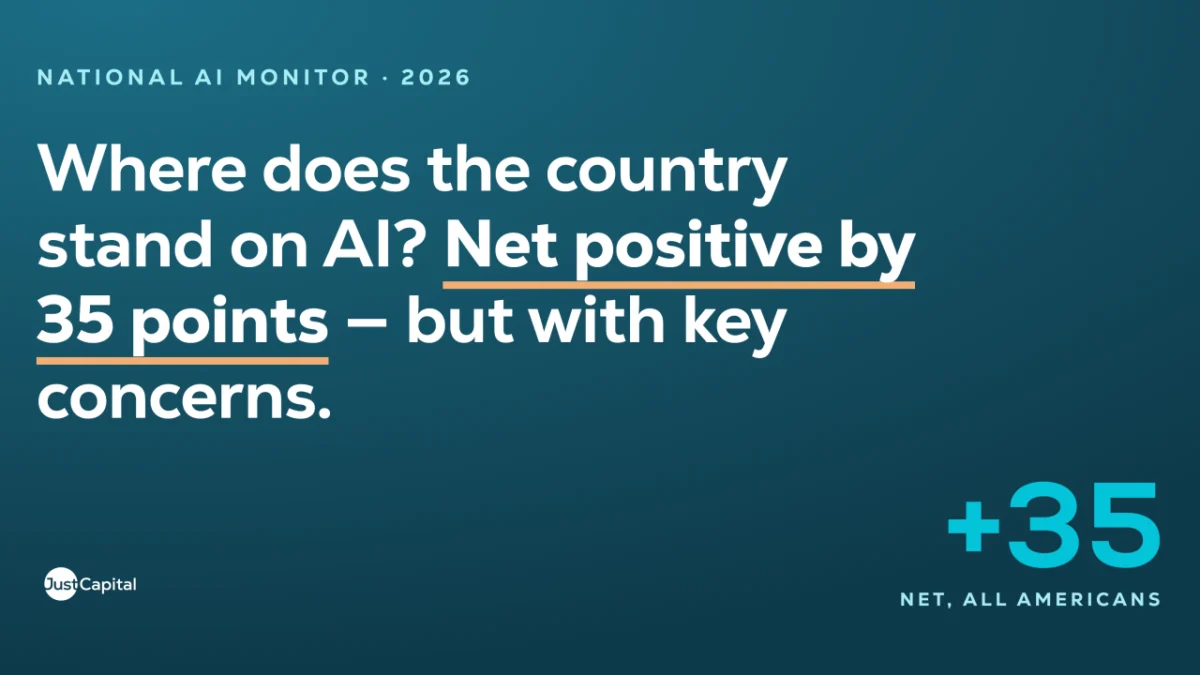
The findings offer a surprising corrective to the prevailing media narrative. While some reports have painted a picture of a nation paralyzed by "AI doom," the data from the National AI Monitor reveals a public that is generally optimistic about the capacity of AI to enhance their productivity and quality of life. When asked about their professional lives, 57% of Americans report that AI has had a positive impact on their work. In stark contrast, only 9% feel that the technology is having a negative effect on their daily tasks.
The qualitative feedback provides nuance to these numbers. When respondents elaborate on why they feel positively, the themes are consistent: 27% point toward significant gains in overall quality and productivity, 19% highlight improved efficiency and time savings, and 8% appreciate the ability of AI to automate tedious, routine tasks, allowing them to focus on more complex work.
The Friction of Progress: Security and Sustainability
However, this optimism is not without significant caveats. The Monitor identifies areas of deep-seated anxiety that industry leaders and policymakers would be wise to address. Concerns regarding the security of AI systems remain at the forefront of public consciousness. There is a palpable tension between the desire for innovation and the need for robust safeguards that protect both the individual and the community at large.
Perhaps most notably, the data reveals a growing concern regarding the environmental footprint of these massive computing systems. When asked about the impact of AI on the planet, only 23% of Americans believe the technology is having a positive effect. Conversely, 40% of the public believes that AI is negatively impacting the environment, suggesting that the energy-intensive nature of training and running large language models is becoming a salient issue for the average voter.
This disconnect between economic optimism and environmental anxiety highlights the complexity of public trust. As Martin Whittaker noted in a recent piece for Forbes, the survival of capitalism in an age of AI depends on more than just raw efficiency; it depends on the "social license" granted by the public. If the benefits of AI are perceived as flowing exclusively to a select few, while the costs—be they environmental, economic, or social—are borne by the many, the resulting erosion of trust could threaten the very foundations of democracy and free enterprise.
The Economic Uncertainty
A significant portion of the population remains detached from the financial implications of the AI revolution, which presents its own set of risks. The National AI Monitor found that 42% of Americans feel AI has had no discernible effect on them as investors. This suggests that while the stock market may be reacting to AI-driven growth, that value is not yet translating into tangible benefits for the average person’s economic wellbeing.
For AI leaders and those responsible for deploying these technologies across the enterprise, the message is clear: the public is weary of abstract promises and marketing pledges. What they demand are concrete, visible improvements in their daily lives. The National AI Monitor intends to serve as the benchmark by which these outcomes are measured, holding corporations accountable to the people they serve.
Industry Leaders and the "Efficiency Trap"
The disconnect between the public’s experience and the corporate boardroom is becoming increasingly apparent. Recent reports from the Wall Street Journal highlight that many CEOs are genuinely grappling with the threat of an "AI apocalypse," with some even urging government officials to coordinate with international counterparts—including China—to implement a global slowdown in development.
Simultaneously, the job market is undergoing a subtle but profound shift. A report from the New York Times suggests that the primary impact of AI on employment is not necessarily widespread job loss, but rather stagnant wage growth and a reduction in new hiring. This trend mirrors concerns raised at the latest Fortune Leaders Forum, where executives warned of the "efficiency trap." This occurs when companies merely bolt AI tools onto existing workflows rather than fundamentally redesigning their operations to unlock true value. By settling for simple automation, businesses risk missing the potential for innovation while simultaneously alienating their workforce.
A Growing Unease
The broader landscape remains fraught with volatility. OpenAI recently disclosed six new AI safety incidents, a revelation that underscores the fragility of current safety protocols and suggests that high-profile security failures, such as the Hugging Face breach, are not isolated occurrences.
Furthermore, economic inequality continues to cast a long shadow over the technological boom. A recent Fortune report found that the number of Amazon workers relying on food stamps has tripled, even as the company reports record-breaking revenue. When paired with Forbes’ findings that America’s 400 wealthiest individuals have donated only 4% of their collective wealth to charity, the data paints a stark picture of a widening divide that AI threatens to exacerbate.
This sense of unease is reflected in recent polling data from Gallup, which shows that workers’ fears about being replaced by technology are steadily increasing. This data aligns with the National AI Monitor’s own findings: as Americans look further into the future, their optimism regarding AI tends to wane, replaced by a growing pessimism about their long-term economic security.
Ultimately, the path forward requires a shift in focus. With 56% of Americans currently reporting a positive effect from AI, there is a foundation of goodwill to build upon. However, maintaining that support will require a commitment to transparency, environmental responsibility, and a genuine effort to ensure that the gains of the AI era are broadly shared. As the National AI Monitor continues to track these metrics, it will offer a vital, objective window into whether the industry is meeting the needs of the public or losing their trust in the pursuit of efficiency.