YouTube has firmly established itself as the world’s largest and most expansive video library, serving as a global stage where more than 500 hours of content are uploaded every single minute. While this unprecedented abundance of choice represents an extraordinary blessing for global knowledge and entertainment, it has concurrently introduced a modern paradox of overwhelming digital abundance. When users turn to the platform with a specific, highly targeted query—such as searching for instructions on how to start investing in stocks—they are rarely greeted with a single, cohesive, and definitive answer. Instead, they are met with dozens, if not hundreds, of distinct videos, each characterized by its own unique style, duration, production value, and level of depth.
Navigating this vast sea of information often requires considerable time and effort. Some videos stretch on for far too long with unnecessary introductions and tangents, while others remain frustratingly shallow, offering little more than surface-level insights. Consequently, viewers find themselves trapped in a repetitive cycle of skimming progress bars, skipping disruptive advertisements, and opening multiple browser tabs or clips just to piece together the comprehensive answer they sought from the outset. This friction highlights a persistent gap between the vastness of YouTube’s repository and the immediate, granular needs of the individual consumer.
However, a transformative shift may soon be on the horizon. Imagine a future where YouTube, supercharged by Google’s latest and most advanced breakthroughs in artificial intelligence, could fundamentally rewrite the rules of digital video consumption. Picture a scenario where, based entirely on a user’s specific search prompt, Google’s AI could dynamically cut, stitch, and curate video segments pulled from multiple independent creators into a single, cohesive, tailor-made video. This vision promises a deeply personalized viewing experience designed to deliver precisely the right information in a seamless, uninterrupted format without requiring manual searching and editing by the end user.
While this concept might initially sound like science fiction or a distant peek into the digital horizon, it represents a remarkably logical evolution of YouTube’s core value proposition. Over the years, the platform has steadily improved how it helps users find content, moving from basic keyword matching to sophisticated machine learning recommendations. Taking the next step toward dynamic, on-the-fly content generation addresses the fundamental friction of media consumption. To understand where this technology is heading, it is valuable to examine the underlying mechanics of how such a system might operate, the profound benefits it could unlock for both audiences and creators, and the formidable technical and logistical challenges that lie along the path to implementation.
The Concept: AI-Powered Video Stitching
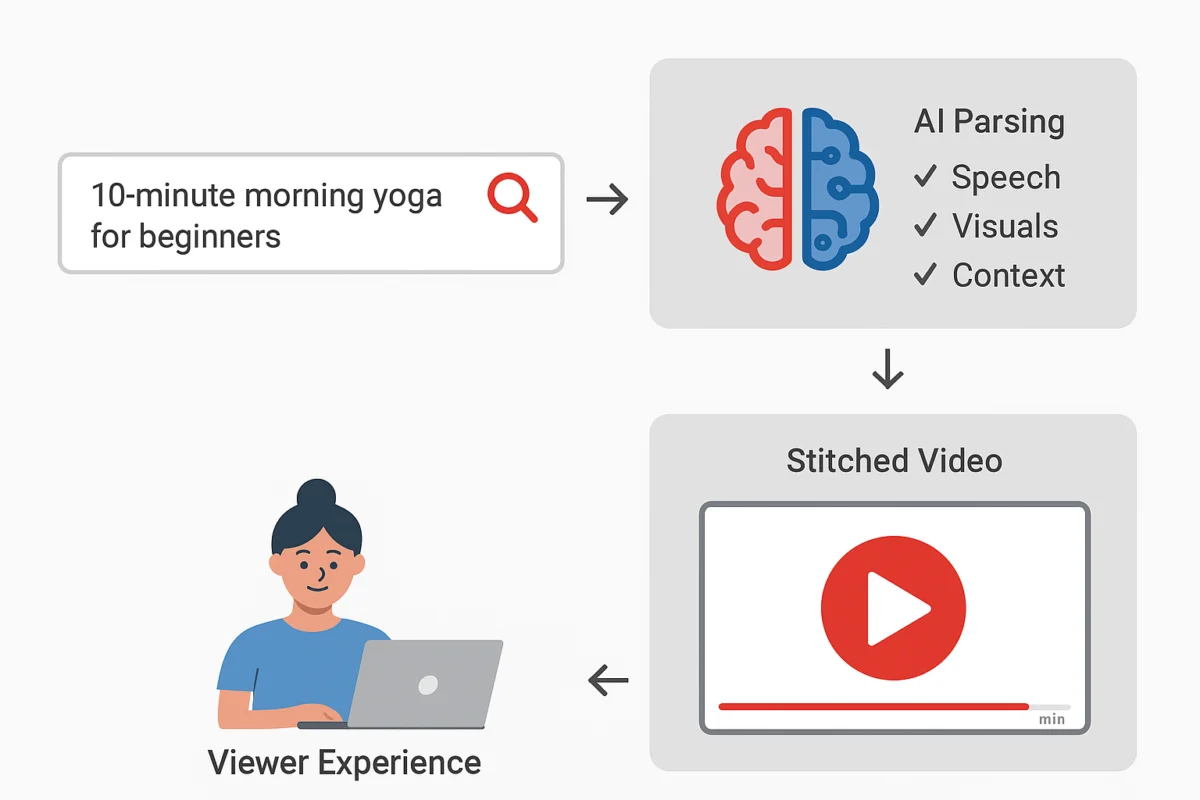
At present, Google already relies heavily on artificial intelligence across the YouTube ecosystem to power automated video recommendations, generate accurate closed captions, and enforce strict content moderation policies at scale. The next technological frontier would require enabling these sophisticated AI systems to understand the deep semantic meaning of video content at an exceptionally granular level. This goes far beyond merely indexing titles, tags, and descriptive metadata; it entails comprehending actual spoken dialogue, analyzing visual cues, tracking transitions, and interpreting the underlying context of every frame.
Consider a practical everyday scenario, such as a user searching for a ten-minute morning yoga routine tailored specifically for absolute beginners. Instead of forcing the user to browse through dozens of individual instructor channels to find content that matches their pace, a capable AI system could instantly evaluate hundreds of existing yoga videos across the platform. It could isolate a precise segment featuring a gentle breathing exercise from one creator, seamlessly transition into a beginner-friendly spinal twist demonstrated by another, and conclude with a relaxation posture from a third.
The resulting output would not be a static upload from a single channel, but rather a completely custom video crafted entirely from existing YouTube content that perfectly matches the user’s exact search intent, duration preferences, and skill level. This dynamic assemblage would represent a massive leap forward in how digital information is packaged and delivered to audiences worldwide.
Why This Matters for Users
The daily experience of navigating modern video platforms is defined by several persistent pain points that have frustrated users for years. Chief among these are content fragmentation, where a single coherent topic is scattered across dozens of different uploads; time-wasting friction, marked by the need to watch long introductory sequences, sponsor messages, and irrelevant chatter before reaching the core point; and a lack of customizability, which forces viewers to constantly adapt to content rather than having content adapt to them.
AI-stitched videos would directly resolve these primary user frustrations by streamlining the discovery and consumption process. Instead of forcing viewers to watch four separate twenty-minute tutorials to gather a complete understanding of a complex subject, the platform could deliver a single, precision-crafted ten-minute video answering every facet of the original query. By eliminating redundant introductions, off-topic discussions, and repetitive explanations found across multiple independent clips, AI-curated experiences would maximize educational and entertainment efficiency for the viewer.
Benefits for Creators
Whenever disruptive AI technologies are proposed within creative industries, creators understandably voice concerns regarding potential negative impacts on their viewership, visibility, and bottom lines. At first glance, independent creators might worry that AI-stitched compilation videos could cannibalize direct traffic, pulling eyes away from their individual channels and reducing their overall organic reach. However, a properly designed Google ecosystem could turn this paradigm into a powerful engine for discovery and fair economic reward, ensuring that contributors are duly compensated for their intellectual property.
Under a forward-thinking attribution model, Google could ensure that every creator whose footage is utilized within an AI-stitched video receives proportional credit, visibility, and financial compensation. If an AI system pulls a thirty-second clip from a channel, the system could automatically attribute that segment, provide prominent clickable links back to the original source video, and factor the view duration into the creator’s revenue-sharing metrics.
To illustrate this dynamic, imagine a specialized cooking channel renowned for its expert knife skills. Under an AI-stitched framework, that creator’s specific segment on the precise technique of chopping onions could be dynamically inserted into thousands of unique AI-generated recipe compilations requested by users searching for diverse culinary ideas. Even if those viewers do not navigate to the creator’s full-length video, the channel benefits tremendously from widespread micro-exposure, expanded audience reach, and continuous monetization earnings derived from their foundational contribution to the broader ecosystem.
Monetization Opportunities for Google
From Google’s corporate and strategic perspective, the introduction of tailor-made, AI-stitched videos opens up vast new horizons for advertising and platform engagement. Traditional pre-roll and mid-roll advertisements are tied directly to specific uploads, but dynamic content generation allows for entirely new paradigms of ad placement and targeting. Advertisers could sponsor specific thematic segments within custom-curated videos, aligning their products with precise micro-topics rather than broad channel categories.
Furthermore, premium subscription models could be enhanced by offering advanced AI curation features. Subscribers could enjoy even greater control over their custom video parameters, such as requesting specific difficulty levels, pacing, or presentation styles tailored to their personal preferences. In essence, AI stitching could evolve to become an entirely new foundational layer of YouTube, sitting comfortably alongside traditional long-form uploads, bite-sized Shorts, and live-stream broadcasts, thereby solidifying the platform’s dominance in the digital media landscape.
Technological Challenges
Building and deploying a system of this magnitude is by no means a trivial engineering task. Several complex technological hurdles must be successfully cleared before tailor-made video experiences can become a reliable everyday reality for billions of users. Among the most critical challenges are maintaining strict continuity in audio and visual quality across clips sourced from entirely different creators, ensuring precise legal compliance regarding copyright and fair use, and preventing the generation of misleading or factually incorrect narrative stitching.
Merging footage recorded with different cameras, lighting conditions, microphones, and aspect ratios into a smooth, watchable narrative requires advanced generative AI models capable of audio normalization, visual color grading, and context-aware transition blending. Additionally, the platform must institute robust safeguards to prevent AI hallucinations from misrepresenting a creator’s original words or placing statements entirely out of context. Fortunately, Google already possesses much of the necessary foundational architecture in place, including industry-leading speech-to-text engines, sophisticated computer vision analysis tools, and robust, enterprise-grade ad-revenue distribution systems. Seamless video stitching represents the next logical extension of these existing technological capabilities.
Parallels in Other Media
The concept of AI-driven personalization and dynamic content generation is not entirely unprecedented, as similar evolutionary trends are already reshaping other corners of the broader media and entertainment landscape. In the music industry, algorithmic recommendation engines and smart radio stations have long moved beyond static playlists to dynamically curate continuous listening experiences tailored to an individual’s shifting moods and activities. Similarly, modern news aggregation platforms and digital publishing networks frequently synthesize information from multiple disparate sources to provide readers with unified summaries of developing global events.
In the realm of video streaming, platforms have experimented extensively with interactive narratives and personalized recaps, though these efforts have largely been constrained to pre-scripted branching storylines. Bringing AI-driven video stitching to long-form user-generated video content would simply represent the natural translation of this broader personalization trend into the world’s largest video library, transforming how humanity interacts with recorded knowledge.
The Future: Beyond Stitching
Looking far into the long-term horizon, Google could potentially take this transformative concept significantly further than mere editorial curation. Beyond simply cutting and pasting existing clips together, advanced generative AI models could eventually bridge visual gaps with synthetic narration, generate real-time visual aids, or dynamically adapt the complexity of an explanation on the fly based on interactive questions asked by the viewer while the video plays.
Imagine an interactive viewing experience where a user pauses a historical documentary segment to ask the AI for more background on a specific figure, prompting the system to instantly generate or curate an explanatory side-segment before seamlessly returning to the main narrative thread. Such advancements would fundamentally transform YouTube from a historically passive content library into an active, intelligent learning companion capable of dynamically teaching, entertaining, and informing users in real time.
Conclusion
YouTube has already redefined how the global population consumes, shares, and interacts with video media, yet the platform still leaves users bearing much of the heavy lifting when it comes to manual searching, skipping, comparing, and filtering content. By leveraging cutting-edge advancements in artificial intelligence to dynamically stitch together relevant clips into cohesive, tailor-made videos, Google has the potential to eliminate daily friction, dramatically improve informational efficiency, and unlock an entirely new layer of intrinsic value for both viewers and content creators alike.
The ultimate result of such a technological leap would be a reimagined YouTube experience where the act of searching is no longer merely about finding a pre-existing video, but rather about collaboratively creating one on the fly, custom-tailored to suit an individual’s exact needs. In an increasingly fast-paced age defined by AI-driven personalization, this transition may well prove to be the most natural and impactful step forward for the future of digital video.