For millions of Americans, particularly younger demographics and low-income households, wireless mobile services are much more than a convenience—they represent the absolute sole means of communication, digital access, and everyday connectivity. Yet, even as the underlying telecommunications market becomes fiercely competitive and base service prices steadily drop, government-imposed taxes, fees, and surcharges continue an upward trajectory that threatens to counteract these consumer savings.
According to new calculations, a typical American household utilizing a shared plan with four mobile phones and paying $100 per month for taxable wireless services will face approximately $345 per year in government taxes, fees, and surcharges by 2026. This represents a noticeable increase from the $330 projected for 2025, continuing a longstanding fiscal trend that consistently drives up end-user consumer bills across the nation.
Over the past two decades, the broader wireless telecommunications market has undergone a dramatic transformation. Increased competition among providers has triggered steady, long-term declines in average prices for consumers. Historical industry data indicates that the average monthly revenue per wireless line has fallen significantly from $50.64 down to $33.14 over the past twenty years. Unfortunately, these hard-fought price reductions achieved by the market have been partially swallowed by rising government exactions. Over that same timeframe, the total tax burden on wireless services has surged from 16.2 percent to a staggering 28.8 percent of a typical monthly bill.
The latest spike in wireless levies pushes overall tax burdens to their highest level in history. This record high is primarily propelled by another federal Universal Service Fund (FUSF) surcharge rate increase, coupled with incremental bumps in state and local taxes. Specifically, the average state and local tax burden climbed from 14.25 percent to 14.42 percent, while the federal FUSF surcharge rate jumped from 13.26 percent to 14.39 percent.
With nearly 600 million active wireless subscriber connections currently operating across the United States, the collective financial impact is massive. Based on the tax rates calculated for 2026, wireless subscribers nationwide are expected to pour approximately $11.4 billion directly into the coffers of state and local governments.
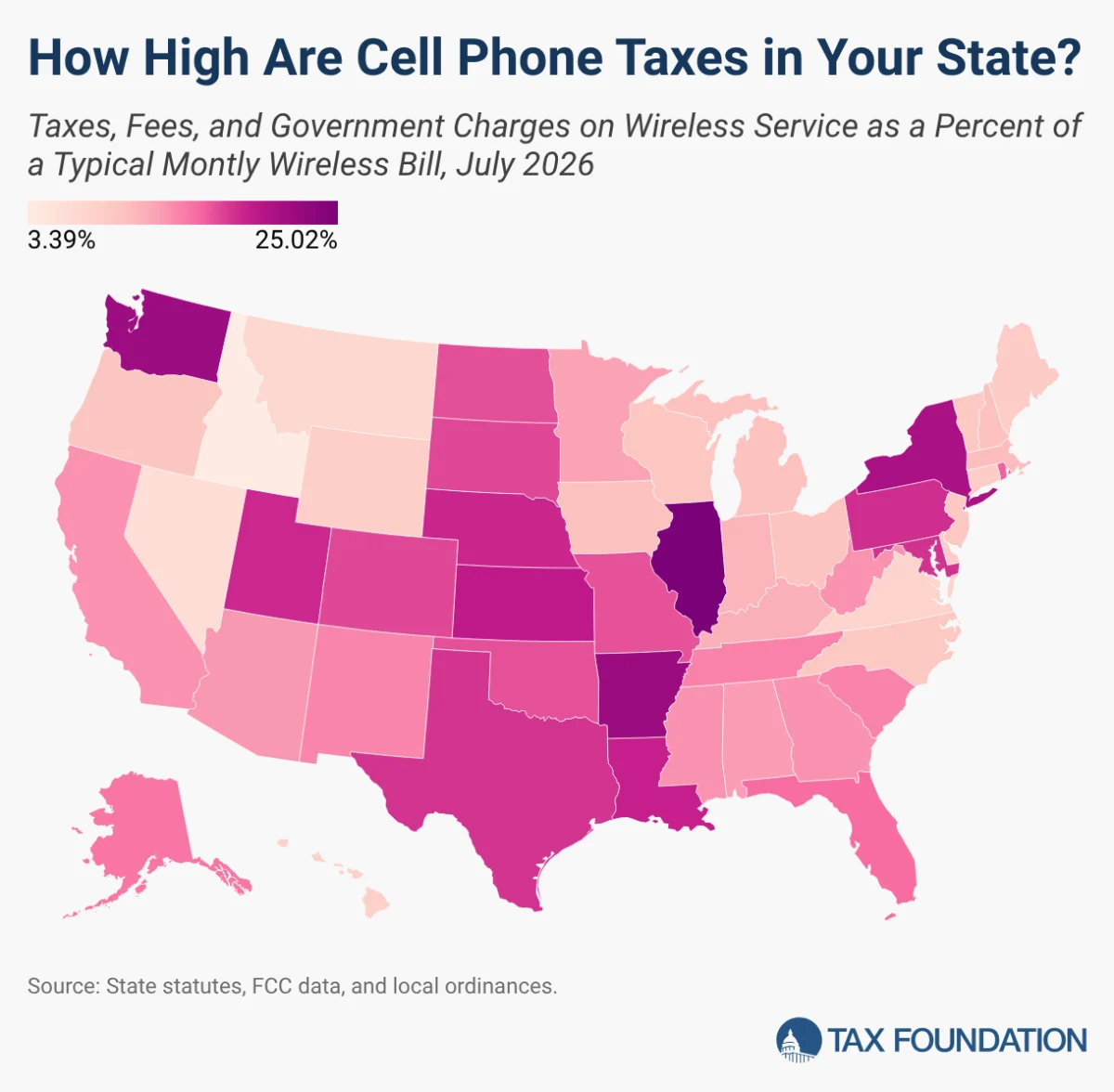
The geographic distribution of these tax rates reveals stark disparities across state lines. Illinois currently maintains the highest wireless taxes in the entire country, with combined state and local rates exceeding 25.0 percent. Following close behind are Arkansas at 22.0 percent and Washington state at 21.9 percent. Conversely, the lowest wireless tax and fee burdens are found in Idaho, where the rate sits at a modest 3.4 percent, followed by Nevada at 6.1 percent and Montana at 7.1 percent.
To evaluate these figures, analysts compare the percentage rates of all taxes, fees, and government surcharges imposed on taxable wireless services. Flat-rate impositions—such as a fixed $1.00 per month per line dedicated 911 fee—are systematically converted into percentage equivalents using the average monthly industry revenue per line tracked by the Cellular Telecommunications and Internet Association (CTIA).
Despite these heavy state and local impositions, wireless consumers do enjoy one major federal statutory protection. The Permanent Internet Tax Freedom Act explicitly prevents state and local governments from levying taxes directly on internet access services, which includes wireless internet access. Industry experts note that without the legal shield provided by this federal law, the exceptionally high excise tax rates currently applied to traditional taxable wireless services could easily be extended to cover internet access, driving consumer tax burdens to even more punishing heights.
Beyond standard sales and telecommunications taxes, consumers face a patchwork of specialized funding fees embedded within their bills. Most state and local governments impose a flat, per-line tax designed to fund the capital and operating expenses of public emergency 911 dispatch systems. These fees vary wildly depending on jurisdiction. For example, most counties across Missouri levy a 911 fee of zero dollars, whereas the city of Chicago assesses a hefty $5.00 per line every single month.
Additional financial layers have also emerged in recent years. In 2021, telecommunications customers began seeing a new line item on their bills following a Federal Communications Commission (FCC) mandate designating 988 as a nationwide, three-digit phone number for suicide prevention and mental health crisis hotlines. Congress authorized states to implement specific 988 taxes to help finance the creation and operation of these crisis response centers. Virginia became the pioneer state in 2021 by imposing a 988 tax of $0.12 per line per month, a move quickly replicated by 10 additional states that have since enacted their own 988 wireless consumer fees.
Furthermore, nearly half of all states levy their own state Universal Service Fund (SUSF) charges on wireless services. These state-level funds provide consumer subsidies for many of the same remote and high-cost connectivity purposes as the federal FUSF. While federal law structures the FUSF as a percentage of interstate revenues, states have traditionally structured their funds around intrastate revenues. Recently, however, a number of states have shifted away from percentage-based calculations toward flat, per-line SUSF impositions, shifting a disproportionately large share of the overall funding burden onto families and businesses utilizing multi-line wireless plans.
When looking at the broader structural landscape, 13 states enforce specific wireless taxes that either sit on top of regular sales taxes or completely replace them with significantly higher targeted rates. Relief does occasionally surface in state legislatures, such as in Maine, where lawmakers voted to repeal the state’s Service Provider Tax, which had previously subjected wireless services to a much higher tax rate than general retail goods.
Public policy experts and economists increasingly warn lawmakers to exercise extreme caution before expanding or creating new wireless taxes, fees, and government surcharges. This caution is rooted in two core arguments. First, wireless taxes are inherently regressive, exerting a disproportionate and painful financial impact on low-income consumers. Excessive fees artificially inflate the cost of keeping connected at a time when millions of Americans rely exclusively on wireless mobile devices as their solitary telecommunications lifeline to the modern world.
Second, discriminatory and excessive taxation risks slowing down critical private investment in advanced wireless infrastructure. Empirical evidence demonstrates that robust investments in modern wireless networks generate sweeping economic benefits across the entire macroeconomy. Vital sectors—including transportation, health care, energy, education, and public administration—rely heavily on robust wireless networks to drive productivity and operational efficiency. The vital importance of this infrastructure was underscored during the COVID-19 pandemic, as wireless networks successfully sustained remote workforces and allowed students to continue their educations from home.
As these technological trends persist in the post-pandemic era, continuous capital investment in network infrastructure remains essential not merely for individual consumers and commercial enterprises, but for the growth and resilience of the entire American economy.
While applying a traditional, broad-based consumption tax like a general sales tax is entirely appropriate for telecommunications retail sales, excessive targeted taxation of wireless services lacks the foundational economic justifications of a fair user-pays system or the proper internalization of social costs. Ultimately, these heavy-handed excise models only succeed in inflating consumer costs and discouraging the continuous network investments upon which modern society depends.