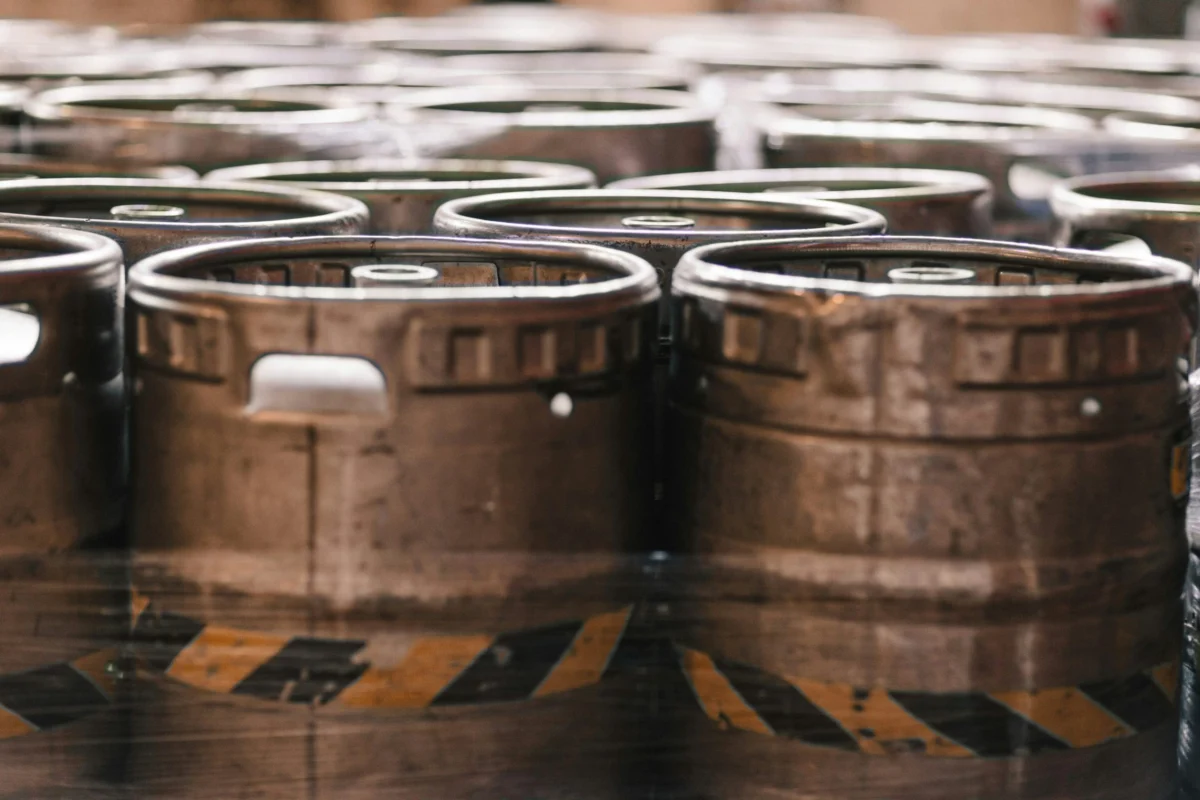
How many gallons are in a barrel? While this seems like a straightforward mathematical conversion, the answer is that it actually depends. The number of gallons in a barrel varies based on what is contained inside the barrel—such as alcohol or fuel—and crucially, on the specific jurisdiction in which the barrel is located.
Across the United States, many state and local governments levy taxes on liquids on a per-barrel basis to fund vital public services and infrastructure. However, a handful of states define a "barrel" quite differently than the standard federal measurement. This landscape of unharmonious units creates significant complexity and heavy compliance costs for businesses that must navigate these taxes across multiple state lines.
This needless complexity arising from states’ barrel nonconformity is economically detrimental and potentially unconstitutional. Yet, this has not prevented six states from defining barrels within their own jurisdictions to be non-standard volumes, creating a regulatory patchwork that frustrates interstate commerce.
A Brief History of Barrels
To understand modern complications, it helps to look at the origins of these measurements. It should be noted that an oil barrel and a beer barrel are two distinct units of measurement that contain different standard volumes of fluid. Historically, for both units, volume standardization was introduced specifically to facilitate more efficient commerce in these critical commodities.
In the early days of the American oil industry, container sizes were entirely inconsistent, varying wildly from producer to producer. This made trade, shipping, and accounting remarkably complicated. Recognizing the inefficiency, petroleum producers in the prominent oil region of Pennsylvania gathered together in 1866 and agreed upon a standard oil barrel size of 42 gallons. This particular size of barrel was small enough for a single person to handle manually while still remaining large enough to transport petroleum efficiently. The Petroleum Producers’ Association officially adopted this standard in 1872.
Today, the Code of Federal Regulations still explicitly defines a standard barrel of oil as 42 gallons.
The story of beer measurement followed a similar trajectory. The first federal tax stamps for beer in the United States were issued in 1866, though duties on alcohol had existed long before that era. Those initial tax stamps were manufactured for various irregular barrel sizes. It was not until later that concerted efforts were made to standardize the units nationwide. This standardization made both the beer trade and beer taxation much more consistent, reliable, and predictable for merchants and tax collectors alike.
The standard beer barrel in the United States holds 31 gallons, a definition that is formally codified in the Code of Federal Regulations.
These standardized volumes for oil and beer were designed to facilitate smooth transactions and predictable taxation of these commodities throughout the entire country. Unfortunately, a select group of states do not conform to these federal standards, adding unnecessary administrative burdens and compliance costs for interstate businesses that simply want to operate efficiently.
Barrel Nonconformity Creates Compliance Challenges
For each of these primary units—oil barrels and beer barrels—there are precisely three states that stubbornly refuse to conform to the standard measurements established by federal guidelines and industry norms.
Indiana, Kansas, and Missouri all define a barrel of oil in their respective state statutes to be 50 gallons rather than the nationally recognized 42 gallons. Meanwhile, Arkansas, Connecticut, and Virginia define barrels of beer to be entirely different volumes within their state statutes.
Arkansas levies taxes per barrel of 32 gallons of beer, which is just slightly off the standard volume. Elsewhere in the state statutes, however, a barrel of beer is properly defined to be 31 gallons, creating internal statutory contradictions. For instance, state rules for beer festivals carry a specific tax rate of $7.507808 per barrel for each barrel of 31 gallons of beer provided for a festival when the product is not otherwise licensed or registered within the state. This intricate tax rate calculates out to the millionths decimal place, exemplifying the dizzying specifics businesses must track.
Connecticut levies its beer taxes per barrel, but the state defines the container as having at least 28 but not more than 31 gallons. This flexible range of allowable volumes means some manufacturers bear a slightly higher tax burden per gallon if they happen to use smaller-than-normal containers. At least manufacturers that utilize standard units do not need to make entirely special accommodations just for Connecticut, though the variance remains a nuisance.
Virginia code takes a different approach entirely, defining any container with a volume greater than 43 ounces, or 0.336 gallons, to be a barrel, while any smaller container is legally defined as a bottle. Because these statutory terms are so unusual, the state’s alcoholic beverage taxes are levied in convoluted ways, such as "per gallon per barrel," per bottle for bottles less than 7 ounces or between 7 and 12 ounces, and "per ounce per bottle" for bottles greater than 12 ounces.
This effectively means Virginia’s taxes are ultimately levied per gallon, rendering the statutory "barrel" definition not particularly relevant for actual volume calculation. However, the state’s licensing fees are still levied according to the number of barrels a brewery produces per year, keeping the non-standard term alive in administrative code.
Indiana defines a barrel of oil as 42 gallons for its petroleum severance tax, but then flip-flops and defines a barrel as 50 gallons for the per-barrel petroleum products inspection fee. That specific fee on gasoline inspection taxes gasoline at $0.50 per barrel of 50 gallons in the state of Indiana, which breaks down to 1 cent per gallon.
Similarly, Kansas and Missouri both levy their respective gasoline inspection fees on a per-barrel basis, defining that operational barrel to be 50 gallons.
These non-standard definitions of what are typically standardized units introduce layers of additional complexity and compliance hurdles. Interstate businesses are forced to jump through hoops to accurately account for their operational costs and remit the proper tax amounts to state treasuries.
These discrepancies also make tracking and comparing tax burdens across different state lines needlessly difficult for analysts and economists. The Energy Information Administration is a federal government entity responsible for collecting, analyzing, and publishing all manner of energy-related information and data, including comprehensive state fuel tax records. Last year, the EIA actually had to revise previously published tax figures simply because of non-standard "barrel" provisions. For example, Kansas’s petroleum inspection fee is levied per a localized "Kansas barrel" of 50 gallons instead of the much more common 42-gallon barrel utilized everywhere else.
This sort of needless complexity is precisely what is avoided by having uniform standards of measurement in a national economy. If even a specialized federal agency like the EIA struggles to keep track of these state-level quirks, everyday interstate businesses are virtually guaranteed to face significant additional compliance costs.
Beyond adding unnecessary administrative complexity, legal experts note that states likely do not possess the constitutional authority to legislate different volumes of barrels in the first place. When the various states ratified the United States Constitution, they delegated a strictly limited set of defined powers to the federal Congress. Among those explicitly enumerated powers is the authority to "fix the Standard of Weights and Measures."
The federal government is explicitly granted the sole power to define measurements across the nation, and it has clearly done so in the case of both barrels of oil and barrels of beer. There is little practical need, and likely no constitutional authority, for individual states to attempt to define either barrel differently for tax or inspection purposes.
States defining the humble barrel to be non-standard volumes is only slightly less ridiculous than Indiana’s infamous historical attempt to codify a misguided proof of squaring the circle, which would have statutorily defined the mathematical constant pi to equal 3.2.
Ultimately, states should simply conform to established federal barrel measures to minimize unnecessary economic complexity, reduce compliance costs, and make doing business across state lines as smooth as possible. There is simply no valid reason that the fundamental answer to the question of how many gallons are in a barrel should depend on arbitrary geographical jurisdiction.