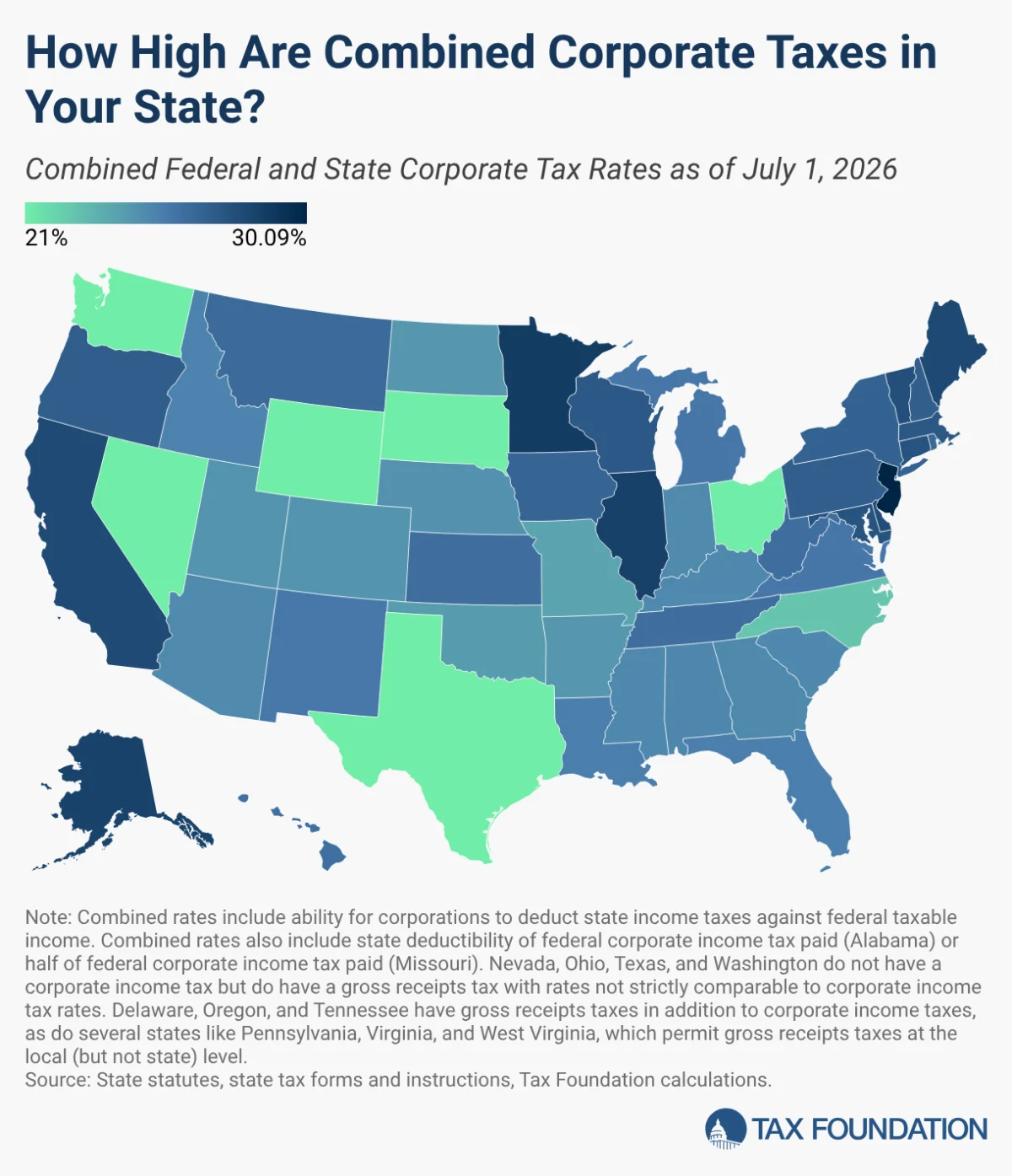
When assessing the true financial and operational tax burdens confronting American businesses, looking solely at federal mandates provides only a fraction of the picture. Corporations operating within the United States are subject to a multi-layered tax environment where federal requirements intersect with a diverse, often complex array of state-level policies. At the center of the federal system is a standard corporate income tax levied at a flat rate of 21 percent. However, the overall tax liability for any given enterprise is frequently shaped by whether the state in which it operates imposes its own corporate income taxes, gross receipts taxes, or a combination of both.
Understanding the broader national tax landscape requires examining how state policies interact with federal structures. Forty-four states, alongside the District of Columbia, levy direct taxes on corporate income. Within these jurisdictions, top marginal rates vary significantly, ranging from a modest 2.0 percent in North Carolina to a high of 11.5 percent in New Jersey. The structural design of these state taxes also differs widely across the country. Thirteen states implement graduated corporate income tax structures, where rates increase as a company’s taxable profits rise, while 31 states and the District of Columbia opt for a flat rate across all corporate income tiers.
Beyond standard corporate income taxes, several states utilize alternative mechanisms to extract business revenue. In Nevada, Ohio, Texas, and Washington, corporations are subject to gross receipts taxes rather than traditional corporate income taxes. Unlike a standard corporate income tax—which applies to net profits after allowable deductions for business expenses—gross receipts taxes are assessed directly on a company’s total gross sales. Because these levies apply to transactions at every stage of the production process without deductions for key business expenses such as compensation, overhead, and the cost of goods sold, they can introduce economic distortions often referred to as tax pyramiding.
The policy landscape becomes even more intricate in states that employ hybrid approaches. Delaware, Oregon, and Tennessee impose both a traditional corporate income tax and a separate levy on gross receipts. Meanwhile, Pennsylvania, Virginia, and West Virginia do not levy statewide gross receipts taxes, but instead allow local municipalities to implement them. At the opposite end of the spectrum, South Dakota and Wyoming maintain the most business-friendly structures in this regard, levying neither a corporate income tax nor a statewide gross receipts tax.
When state and federal obligations are combined, the aggregate tax burden on corporate profits can shift dramatically depending on geographic location. The state with the highest combined corporate income tax rate in the nation is New Jersey, where businesses face an effective top rate of 30.1 percent when factoring in both federal and state liabilities. Other states cluster near the upper end of the spectrum; corporations in Alaska, Illinois, Maine, and Minnesota face combined corporate income tax rates at or above 28 percent. Conversely, the six states that levy no state corporate income tax—Ohio, Nevada, South Dakota, Texas, Washington, and Wyoming—expose corporations only to the baseline federal tax rate of 21 percent, though four of these jurisdictions offset the absence of an income tax by implementing statewide gross receipts taxes.
An essential element in calculating a corporation’s ultimate tax liability involves the interplay between federal and state tax deductions. Under current tax rules, corporations are permitted to deduct state corporate income taxes paid against their federal taxable income. This deduction effectively lowers the corporation’s effective federal tax rate. For example, a corporation operating in Rhode Island is subject to the state’s flat corporate income tax rate of 7 percent. Because that state tax payment can be deducted against the 21 percent federal corporate income tax, the corporation’s federal rate is reduced to 19.53 percent, resulting in a total combined rate of 26.53 percent rather than a simple addition of the two nominal rates.
Conversely, a small number of states offer mechanisms that allow corporations to deduct federal corporate income tax liabilities against a portion of their state tax obligations, providing further relief. Alabama stands out by allowing full deductibility of federal corporate income tax liability against state tax liability, while Missouri permits a 50 percent deduction of federal corporate income tax liability. These provisions effectively lower the net corporate income tax rate faced by businesses operating within those state borders.
When averaging across all jurisdictions nationwide—including the states that choose not to levy any corporate income tax at all—the average combined state and federal corporate tax rate in the United States sits at 25.5 percent. Economists and policy experts emphasize that evaluating business competitiveness requires a comprehensive view that accounts for both federal statutory rates and the varying state-level impositions. Corporate taxes are widely regarded by economic researchers as among the most economically damaging methods for governments to raise public revenue. Because these taxes can discourage capital investment, depress wage growth, and hinder productivity, tax policy analysts frequently point to corporate tax reform as a critical avenue for states seeking to boost their regional competitiveness and foster sustained economic growth that benefits both enterprises and the broader workforce.