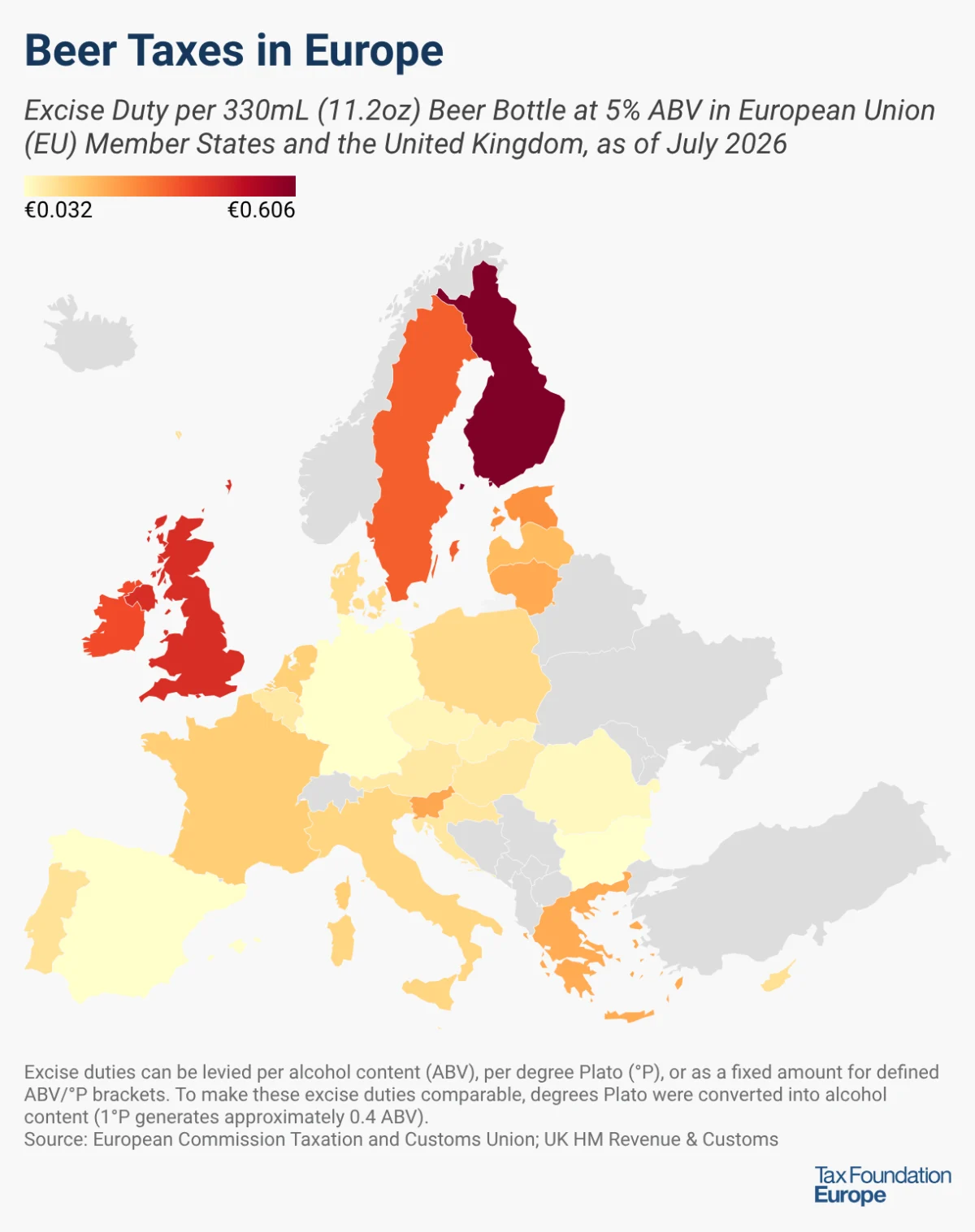
As governments across Europe and beyond look toward significant policy adjustments and administrative updates heading into 2026, the underlying framework of alcohol excise taxation is facing renewed scrutiny. The motivations that have historically driven these levies remain straightforward and deeply rooted in fiscal policy. Governments impose excise taxes on beer and other alcoholic beverages to serve a dual purpose: to discourage excessive consumption for public health reasons, and to generate reliable revenues from products that are widely consumed yet frequently subject to social disapproval. Despite their long-standing presence in modern tax codes, beer taxes remain a remarkably blunt instrument for mitigating alcohol-related harm.
The landscape of European tax treatment regarding alcohol is remarkably fragmented, displaying variations that extend far beyond the specific regulations governing beer alone. When evaluated on a continental scale, beer is generally subjected to heavier tax burdens than wine, with several European jurisdictions levying no excise tax on wine whatsoever. Conversely, beer is taxed much more lightly than distilled spirits, creating a tiered hierarchy of taxation that has persisted for decades. This traditional trichotomy—separating beer, wine, and spirits into distinct legal and fiscal categories—has formed the foundation of alcohol taxation policy for generations.
However, rapid innovation within the global alcohol industry has systematically blurred these once-clear categorical lines. The rise of craft brewing has fundamentally revolutionized the beer sector by introducing an extraordinarily diverse array of flavor profiles and a significantly wider range of alcohol-by-volume content. This surge in variety has exponentially increased the total number of distinct beer products available to consumers worldwide. At the same time, specialized products have emerged that challenge traditional classifications. Malt liquor, defined by its higher alcohol content and brewing process utilizing extra malt, serves as a clear internal stratifier within the beer category itself.
Complicating matters further, the modern marketplace has embraced a massive wave of ready-to-drink cocktails and flavored malt beverages. Many ready-to-drink beverages are fundamentally distilled spirits-based drinks, but once the base spirit is combined with a mixer, the final packaged product available for retail purchase often features an alcohol content that aligns much closer to a standard beer than a traditional bottle of liquor. This convergence of product types exposes the mounting friction between dynamic market realities and static, nineteenth-century tax classifications.
Regulatory approaches to these shifting boundaries vary significantly by jurisdiction. In the European Union, beer is generally taxed in direct relation to its actual alcohol content, whether measured by percentage of alcohol by volume or by degrees Plato. However, this alcohol-by-volume methodology is rarely applied with equal consistency across other categories of alcohol, such as wine or certain fermented products. In stark contrast, the duties levied by the United Kingdom employ an approach that is much more similar and uniform across most product categories, anchoring the tax rate directly to the absolute alcohol content regardless of whether the beverage originates as beer, cider, wine, or spirits.
As the broader alcohol product landscape continues to develop and innovate, the traditional legal and administrative treatment of these overlapping categories is increasingly expected to become more complex, economically inefficient, and costly for both regulatory agencies to administer and businesses to comply with. Tax administrators face growing compliance burdens as manufacturers formulate hybrid products that sit uncomfortably on the boundary lines of traditional definitions. For businesses, navigating differing regulatory frameworks across borders creates friction that can stifle market access and distort competition.
To address these mounting structural challenges, industry analysts and policy experts have increasingly pointed toward the necessity of modernizing alcohol taxation. By discarding clunky, outdated categorical systems in favor of a streamlined tax levied uniformly on absolute alcohol content, governments could effectively equalize the fiscal treatment of different types of alcoholic beverages. Such a reform would render the broader tax system significantly more efficient, economically rational, and transparent for producers, distributors, and consumers alike.
In practice, beer taxes in Europe already tend to be levied per degree of alcohol content, demonstrating that administrative frameworks capable of handling potency-based taxation are entirely feasible. The wide range of tax rates currently observed across different jurisdictions ultimately reflects the diverse outlooks that individual governments maintain regarding their authority to shape consumer behavior, protect public health, and optimize revenue generation through strategic tax policy. As policymakers contemplate the road ahead toward 2026 and beyond, the debate over how to balance public health objectives with economic efficiency in alcohol taxation will undoubtedly remain a critical focal point of fiscal policy discussions.