Global financial markets faced a turbulent session on Wednesday, October 7, 2026, as a convergence of geopolitical tensions, hawkish central bank signals, and a relentless global bond sell-off weighed heavily on risk assets. Crypto markets bore a sharp brunt of the pressure, with bitcoin sliding below key support levels, ether underperforming following a major corporate announcement, and hundreds of millions in leveraged bets being systematically flushed out.
White House Asks Pentagon for Iran Strike Options
Geopolitical anxieties moved to the forefront of market concerns following a report from The Atlantic, which revealed that the White House has asked the Pentagon to develop potential strike options against Iran that could be deployed ahead of next month’s midterm elections. Citing two administration officials, the report highlights a potential pivot from the conventional market wisdom that President Trump was striving to maintain regional stability to bolster Republican electoral prospects.
"The strikes would make the president look like he got a win and that gas prices would start going down," one Republican familiar with the discussions told The Atlantic.
The disclosure immediately rattled energy markets. Reports of renewed Iranian tanker attacks and disruptions near vital shipping lanes diminished hopes of normalized transit, pushing Brent crude above $100 and past $101 a barrel during the session. Diesel and gasoline futures surged correspondingly, rising 4% and 3%, respectively.
The developments also cast doubt on recent international relief measures. While President Trump had previously touted a major G7 agreement for Europe to release upwards of 100 million barrels of its energy reserves to cool prices, a report from Politico poured cold water on the enthusiasm. European officials from France and Germany clarified that the initiative relied almost entirely on unfulfilled pledges originally made back in March, leaving markets questioning the efficacy and availability of these strategic inventories heading into a winter season marked by multi-year low stock levels.
One More Rate Hike Appears Likely This Year: FOMC Minutes
Adding to the macroeconomic headwinds, the Federal Open Market Committee (FOMC) released the minutes from its policy meeting last month, revealing a united front among central bank officials. While the committee featured 12 active voters, all 19 members of the FOMC ultimately favored the central bank’s 25-basis-point rate hike implemented last month.
Furthermore, the minutes indicated that most members believed a subsequent increase in the federal funds rate would remain "appropriate" before the conclusion of the year. The tone aligned closely with recent assertions from Fed officials warning that financial markets had grown overly optimistic by pricing in two consecutive rate cuts or pauses without accounting for persistent inflationary stickiness.
With market pricing suggesting just a 17% probability of an immediate rate hike at the upcoming October 27–28 policy meeting, traders are placing an 85% probability on at least one more rate increase by the end of December. Upcoming September Consumer Price Index (CPI) and Producer Price Index (PPI) reports scheduled for the following week are expected to heavily influence the Federal Reserve’s final path.
Yields Slip Slightly After Strong 10-Year U.S. Government Auction
Despite the overarching narrative of tighter monetary policy, fixed-income markets found temporary relief via a highly anticipated U.S. government auction of 10-year notes. The auction demonstrated robust demand, registering a high yield of 5.30%—substantially higher than September’s auction high of 4.83% but matching prevailing market clearing conditions.
Foreign appetite proved particularly resilient, with indirect bidders absorbing 80.3% of the total offering. Following the auction results, long-dated government bond yields pared some of their earlier intraday spikes, leaving the 10-year Treasury yield relatively flat on the day at 5.27% after touching peaks of 5.37% earlier in the session. Similar pullbacks were observed across European long-dated sovereign debt markets.
Bitcoin Edges Higher from Worst Levels as Yields Pull Back
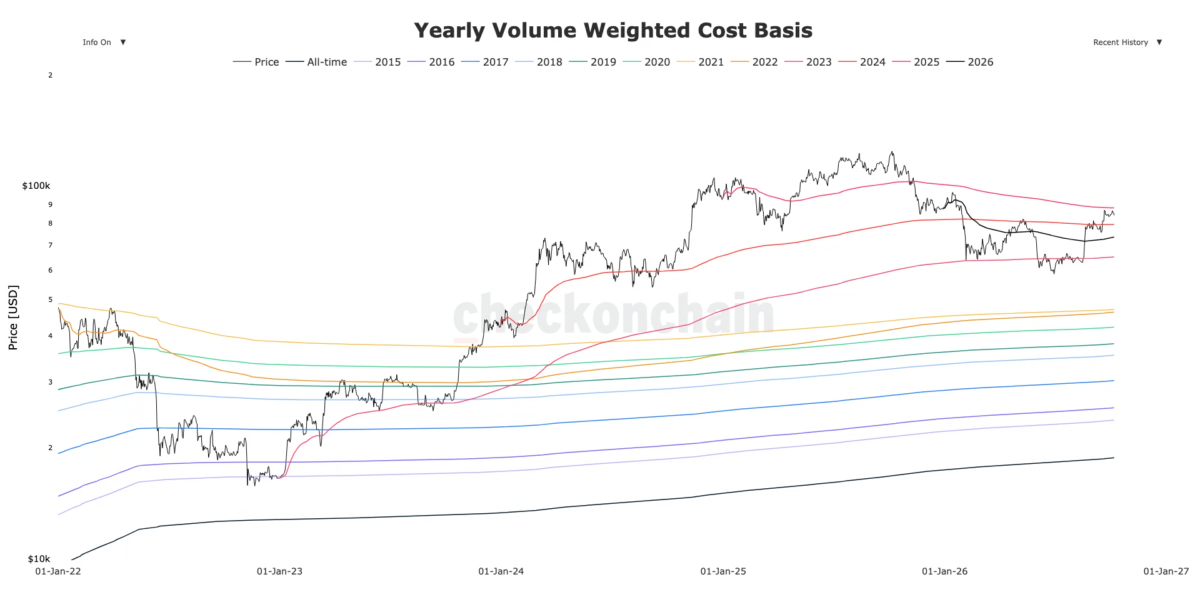
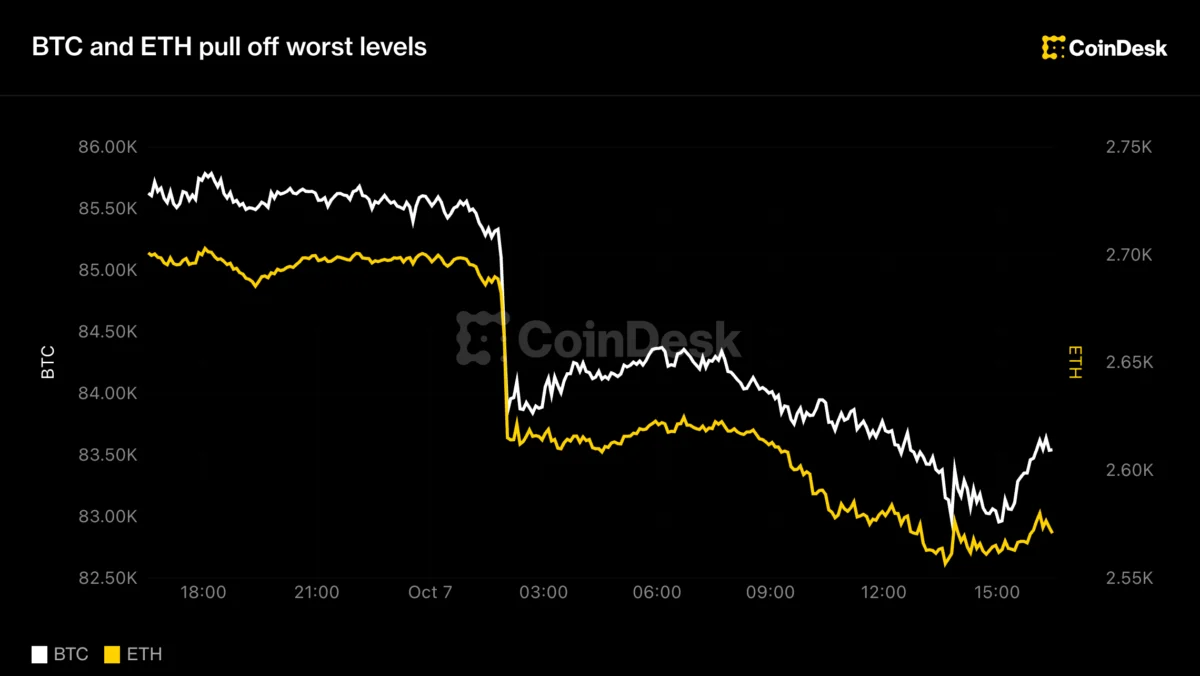
The marginal cooling in Treasury yields provided a brief window of stabilization for risk-on assets during early U.S. afternoon trading hours. Bitcoin recovered modestly from its intraday lows, rising roughly 1% to hover near $83,500 after breaching key psychological supports. Despite the slight rebound, the flagship cryptocurrency remained down approximately 2.6% over a 24-hour window.
Traditional equity indices similarly trimmed their losses. The Nasdaq Composite pared its decline to 0.5%, while the S&P 500 softened its daily drop to 0.3%, attempting to hold ground following a record-setting high achieved earlier in the week.
Has the Bitcoin Conference Curse Finally Reached Token 2049?
The ongoing crypto market downturn also coincided with the kickoff of the TOKEN2049 conference in Singapore. Market observers noted a recurring historical phenomenon often dubbed the "bitcoin conference curse," wherein flagship industry gatherings frequently correlate with localized price declines despite widespread bullish sentiment among attendees.
While TOKEN2049 had historically bucked this trend during its 2024 and 2025 event weeks in Singapore and Dubai—where prices trended upward—the opening day of this year’s conference saw bitcoin retreat by roughly 3% toward the $83,000 threshold, breathing new life into theories regarding the persistent market anomaly.
Crypto Stocks Sharply Lower as Bitcoin Falls Through $83,000
Equities tied directly to the digital asset ecosystem suffered steep losses, weighed down by both falling cryptocurrency prices and a broader macroeconomic equity sell-off driven by rising global interest rates.
Roughly two hours into the U.S. trading session, the Dow Jones Industrial Average dropped 1.5%, while the Nasdaq and S&P 500 fell 0.7% and 0.55%, respectively. The U.S. 10-year yield climbed four basis points to 5.31%, compounding valuation pressures on high-growth sectors.
Crypto-native equities absorbed severe drawdowns. Coinbase fell 4.2%, Gemini dropped 6.1%, Bullish lost 5.5%, Circle declined 5.1%, MARA Holdings slipped 6.5%, Strategy dropped 5.9%, and BitGo fell 2%.
Wintermute Warns Bitcoin Faces More Downside as Macro Risks Return
Market infrastructure and liquidity providers warned that traders should brace for extended downside exposure as macroeconomic and geopolitical forces decisively reassert control over digital asset valuations.
Jasper De Maere, an OTC trader at Wintermute, noted that bitcoin’s sharp descent from $86,600 down to the $84,000 range overnight demonstrated that crypto assets were reacting with heightened sensitivity to geopolitical friction compared to U.S. equities. The swift descent triggered approximately $400 million in leveraged long position liquidations over a 12-hour span.
De Maere emphasized that $82,500 serves as a critical technical threshold for bitcoin; holding this floor would preserve the structural integrity of the asset’s broader uptrend, whereas a decisive break could accelerate downward momentum.
S&P 500 Hits Record, but Most Sectors Are Lower for Past Two Months
Beneath the headline-grabbing record close notched by the S&P 500 earlier in the week, internal market breadth revealed significant underlying weakness across the broader economy. Data compiled by Bespoke Investment Group indicates that only a handful of sectors have participated in the recent rally.
The technology sector led gains with a 6% advance since mid-August, followed by energy up 4.6% and communication services up 3.6%. Conversely, interest-rate-sensitive and cyclical sectors suffered pronounced losses over the same two-month period. Real estate fell 8.3%, industrials dropped 7.6%, financials retreated 7.2%, and utilities lost 6.4%, while consumer discretionary, consumer staples, healthcare, and materials sectors also drifted lower.
Spot Gold Falls More Than 2% to $4,070 an Ounce
Precious metals experienced a sharp risk-off unwinding alongside equities and cryptocurrencies. Spot gold extended its losses by dropping over 2% to $4,070 an ounce, while silver suffered a steeper decline of nearly 3.5%, slipping beneath $60 an ounce.
The pullback occurred even as futures markets largely priced out an imminent October rate hike, though forward-curve pricing continued to account for three additional rate increases extending into mid-2027, bringing the projected federal funds rate target to between 4.50% and 4.75%.
SpaceX Slips on Reported $40 Billion Capital Raise to Buy Nvidia Chips
In corporate finance news, space exploration and satellite communications firm SpaceX experienced a 2% pre-market dip following a report from the Financial Times that the company is in advanced talks to secure a $40 billion debt capital raise.
According to the report, the massive financing package would be divided between bank loans and investment-grade paper, earmarked specifically for purchasing high-performance Nvidia chips. The astronomical figure highlighted the immense capital expenditures required to build out foundational hardware infrastructure supporting the ongoing artificial intelligence boom.
‘Le Spread’ Blowing Out After One-Day Respite
European sovereign debt markets flashed renewed signs of structural stress as the French 10-year OAT yield surged 17.6 basis points to 4.924%, while the German 10-year Bund yield advanced by three basis points to 3.51%.
The divergence widened the OAT-Bund yield differential—widely tracked as "le spread"—back beyond 141 basis points, marking a level not observed since the European debt crisis of 2011. Analysts noted that unlike the previous debt crisis, which primarily impacted peripheral eurozone economies, the current sell-off targets a core member of the monetary union. The euro reacted by falling 0.7% against the U.S. dollar, touching a five-month low at $1.1183.
BitMine to Stop Buying Ether at 5% Hard Cap, Tom Lee Says
In the digital asset sector, BitMine Immersion Technologies announced a self-imposed limitation on its corporate treasury strategy. Speaking during a keynote address at TOKEN2049 in Singapore, Chairman Tom Lee stated that the firm will cease purchasing ether once its holdings reach a hard cap of 5% of the cryptocurrency’s total circulating supply.
"That’s a hard cap. We’re not gonna be accumulating past 5%," Lee told the audience, adding that the company requires roughly another 100,000 ETH purchases to reach the threshold. Ether prices retreated 4.5% to $2,477 following the announcement.
The Global Bond Sell-Off Continues
Global sovereign debt pressures persisted as yields drifted upward across the curve in the United States, Europe, and the United Kingdom. The U.S. 10-year Treasury yield hovered at 5.333%, while the 30-year yield touched a fresh high of 5.715%. In the UK, the 30-year gilt yield breached the 6% threshold to reach 6.014%.
The resurgence of the U.S. Dollar Index (DXY) above 102 added further downward momentum to commodities. West Texas Intermediate (WTI) crude oil surrendered earlier intraday gains driven by Middle Eastern supply fears, slipping below $90 a barrel.
Bitcoin Breaks Below $84,000 as Bullish Bets Get Washed Out
The combination of macroeconomic pressures and geopolitical friction culminated in a heavy liquidation event across digital asset exchanges. Bitcoin fell as much as 2.4% to approximately $83,600, while ether dropped nearly 4% to $2,590. XRP and Solana (SOL) shed 4% and 3%, respectively.
Data from CoinGlass indicated that approximately $550 million in leveraged cryptocurrency positions were liquidated over a 24-hour period, with long positions accounting for the vast majority of the forced closures. Analysts noted that the washout served as a significant leverage purge rather than a structural trend reversal, though vulnerability remained high as markets awaited upcoming U.S. inflation data and Federal Reserve communications.