The United States may already be in the early stages of a national debt crisis, but it is unfolding through a slow and gradual economic squeeze rather than a sudden, dramatic bond market crash. According to Financial Times journalist and author Robin Wigglesworth, the unfolding fiscal situation is quietly eating into the federal budget instead of forcing an immediate, acute default.
This warning comes at a time when the financial realities of government borrowing are becoming increasingly difficult to ignore. In fiscal 2026, US debt servicing costs officially hit a record $1.1 trillion. Rather than triggering a sudden financial cliff, the rising cost of servicing the national debt has turned into a persistent and tightening squeeze on public finances, altering how policymakers will be able to respond to future economic downturns.
US Debt Crisis, Rising Interest Costs And A Slow Economic Squeeze
Wigglesworth, who recently authored A Fabulous Debt, discussed the trajectory of American public finances on The Long View podcast. While he noted that he is more worried about the US debt situation than he used to be, he maintains a perspective that is somewhat less alarmist than some of his peers on Wall Street.
Rather than viewing the situation through the lens of traditional emerging market crises, Wigglesworth described a different reality for the world’s largest economy.
"I think the US is maybe in the early stages of what I’d call a chronic debt crisis. It’s just very slow, very gradual," Wigglesworth said during the podcast appearance.
This gradual erosion is driven largely by the mechanics of government refinancing. Treasury bonds that were originally issued during periods of low interest rates—ranging between 1% and 3%—are now maturing and being rolled over at significantly higher rates, approaching up to 6% in the current market environment. At the same time, the federal budget remains far from balanced, leaving the government heavily reliant on continuous borrowing to meet its ongoing financial obligations.
Why US Debt Servicing Costs Keep Climbing
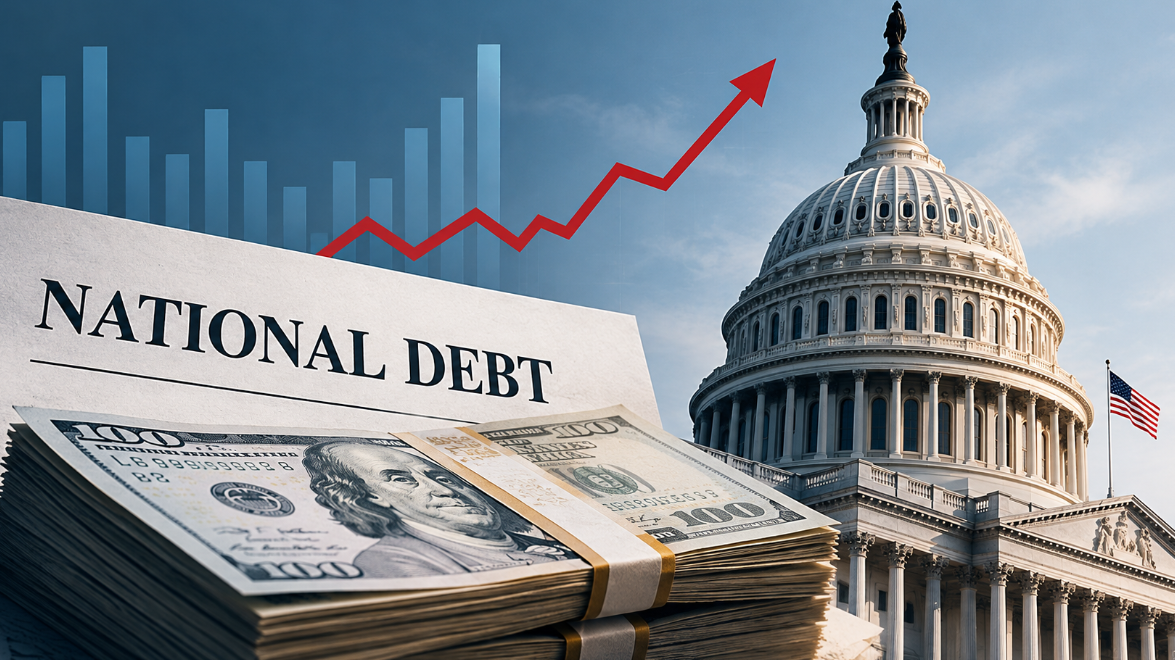
The sheer scale of these interest payments has rewritten the federal ledger. According to estimates from the Committee for a Responsible Federal Budget (CRFB), interest payments hit $1.1 trillion in fiscal 2026. This figure represents a record 3.4% of the United States Gross Domestic Product (GDP), officially making debt service larger than traditional major budget items like national defense or Medicare.
Independent estimates from financial analysts place the current burden slightly higher, between 3.5% and 3.6% of GDP. For economists and budget watchers, this multi-trillion-dollar bill serves as the most tangible evidence of what the modern debt crisis actually looks like in practice. Furthermore, the trajectory of these costs points in only one direction under current fiscal policies.
Wigglesworth noted the long-term outlook for these payments, explaining that the situation is far from ideal.
"And that is not great. And it is definitely going higher, but it still is another decade before it hits kind of 5%-ish," Wigglesworth stated, pointing to a multi-year horizon where interest payments will consume an even larger share of the federal economy.
A Chronic Crisis, Not An Acute One
When the general public or casual observers think of a national debt crisis, they often picture historical precedents from developing or vulnerable economies, such as the dramatic defaults and painful debt restructurings seen in Argentina or Greece. However, financial experts emphasize that the United States operates under a fundamentally different set of rules due to the global dominance of the US dollar.
Addressing the likelihood of a sudden, catastrophic default, Wigglesworth dismissed the comparison.
"I don’t think that happens in a country like the United States that can literally print dollars," he said.
Instead of manifesting as hyperinflation or a sudden, catastrophic runaway spike in bond yields that shuts the government out of international credit markets, the crisis is expected to take a subtler form. Wigglesworth explained that the true cost of the rising debt burden will be felt through a gradual degradation of America’s overall financial health, forcing the government to steadily spend less money on other domestic priorities, public investments, and discretionary programs it might otherwise want to fund.
Despite this measured view, not everyone in the financial community is entirely calm about the current trajectory. With the benchmark 10-year Treasury yield sustaining levels above 5%, CRFB President Maya MacGuineas issued a much sharper and more urgent warning regarding the path of federal borrowing.
"A fiscal crisis, once unthinkable, is now a distinct possibility," MacGuineas stated.
What Venice Teaches About Government Debt
The phenomenon of government borrowing and long-term sovereign debt is far from new. In his research and writing, Wigglesworth traces the origins of the modern bond market back centuries, noting that public debt markets first emerged in Venice in the year 1171. At that time, the Venetian state needed to fund a military fleet and did so by issuing tradable loans that paid a steady 5% return annually. Interestingly, Venice never actually repaid that principal debt in full, yet the historic Rialto market established the foundational mechanics of the global bond market that persists today.
Modern credit rating agencies are also factoring these historical lessons and contemporary metrics into their outlooks. Scope Ratings issued its own evaluation regarding the American fiscal trajectory, maintaining the United States at an AA- rating while projecting that national debt could climb toward roughly 160% of GDP within the span of a single decade.
For everyday investors holding traditional bonds, equities, or even alternative assets like cryptocurrencies, the ongoing fiscal situation presents a complex backdrop. While the US national debt crisis may never erupt into a sudden, explosive market crash, analysts warn that the slow grind of chronic debt accumulation will steadily narrow Washington’s policy flexibility, leaving fewer fiscal tools available when the economy faces its next major downturn.