The cryptocurrency market staged a remarkable comeback during the third quarter, fueled by impressive gains in major digital assets and renewed enthusiasm across the sector. However, as the market looks ahead, analysts warn that persistent macroeconomic headwinds, shifting institutional fund flows, and fluctuating monetary conditions will ultimately determine whether this latest rally can evolve into a full-fledged secular bull market or if it is merely a temporary reprieve ahead of another macro-driven correction.
During the third quarter, Bitcoin posted a substantial gain of approximately 44%, marking its strongest third-quarter performance since 2017. Meanwhile, Ethereum outpaced its larger rival by climbing more than 70%, notching its most dominant quarterly performance on record. These staggering returns have quickly revived debates across the financial industry regarding whether a new digital-asset cycle is actively forming. Yet, despite the enthusiasm generated by these double-digit surges, market participants face a complex economic backdrop characterized by rising real yields, a stubbornly strong U.S. dollar, and shifting levels of global risk appetite that could easily undermine the speculative liquidity driving digital assets.
For the broader crypto ecosystem, the primary challenge moving forward is whether sustained demand for investment products can endure under mounting economic pressure. While price action has successfully recaptured the attention of both retail traders and institutional investors, market analysts emphasize that a true continuation of the rally requires fundamental evidence that extends well beyond short-term spot price movements. Specifically, consistent and robust demand through spot Bitcoin exchange-traded funds (ETFs) will serve as a critical litmus test to demonstrate whether institutional capital is actively reinforcing the upward trend or simply reacting to transient market momentum.
Crypto Boom: Bitcoin and Ethereum’s Third-Quarter Rebound
The sheer scale of the third-quarter gains serves as the most prominent development in recent market history. Bitcoin’s advance of over 40% established a strong operational benchmark, while Ethereum’s 70% surge highlighted a broader wave of capital allocation that extended well beyond the leading cryptocurrency. This relative outperformance by Ethereum suggests that the market’s bullish sentiment was not entirely isolated to a single asset, breathing new life into conversations about a comprehensive digital-asset market cycle.

Even so, two consecutive months of heavy quarterly returns are insufficient on their own to establish that the market has transitioned into a lasting expansion phase. Bitcoin remains the foundational reference point for the entire asset class, while Ethereum’s larger percentage advance indicates a healthy appetite for alternative layer-1 ecosystems and decentralized applications. Observers are closely tracking investment product inflows for both assets to gauge sentiment, though market participants remain cautious about interpreting weekly figures as definitive proof of a multi-year bull run.
The market’s recent behavior highlights a familiar duality: while speculative fervor can rapidly accelerate upward price movements, macroeconomic realities often reassert themselves with equal force. As digital assets attempt to transition from a speculative trading vehicle into an established institutional asset class, their correlation with broader macroeconomic indicators—such as interest rates, currency strength, and global liquidity—remains a vital component of price discovery.
Are ETF Flows Strong Enough to Sustain the Crypto Boom?
Institutional investment vehicles, particularly spot exchange-traded funds, provide one of the clearest and most transparent lenses through which to evaluate institutional participation. A sustained rally driven by spot Bitcoin ETFs would signal that institutional buyers are actively underpinning the market, creating a structural floor for prices rather than relying solely on leveraged retail trading.
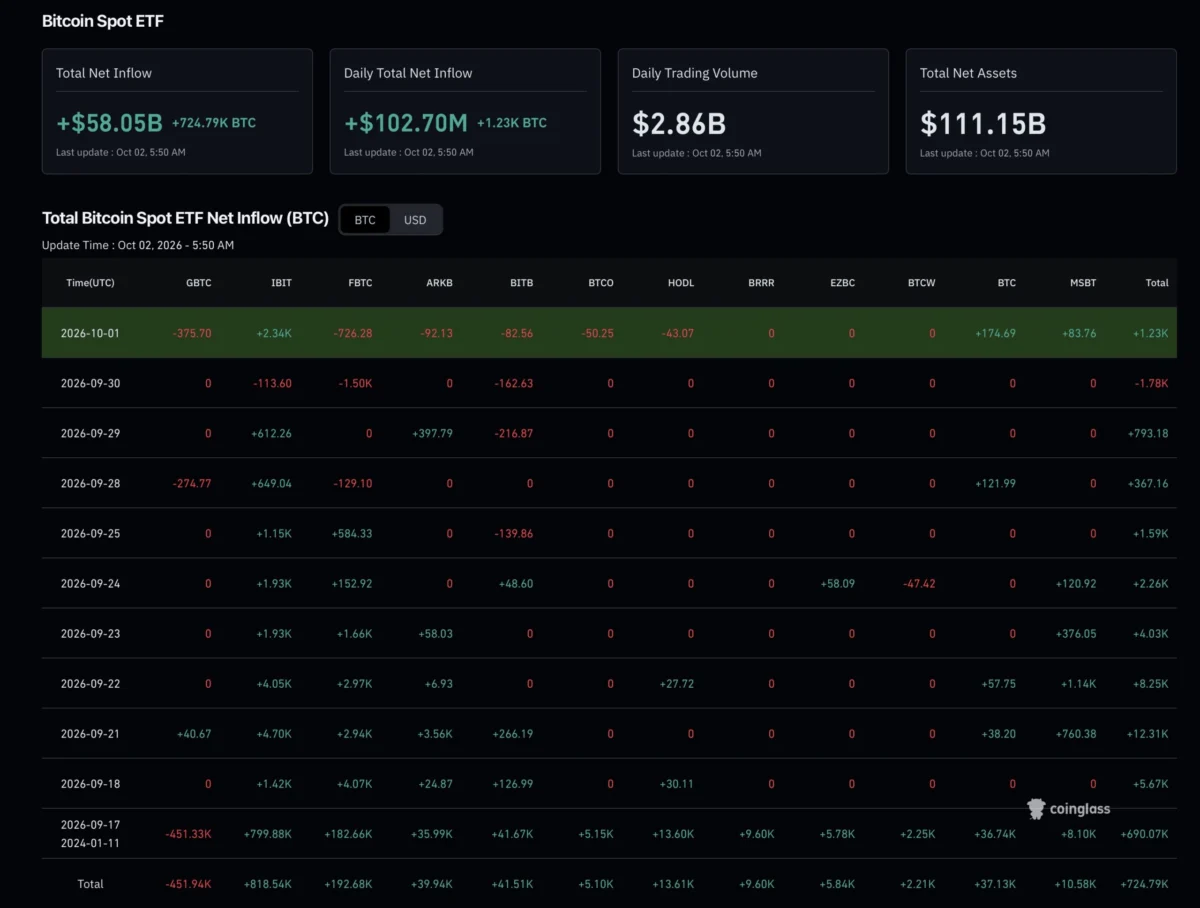
Recent data paints a picture of a market experiencing both intense bursts of demand and sudden cooling periods. According to figures from CoinGlass, U.S. spot Bitcoin ETFs experienced a massive influx of capital between September 21 and 25, taking in approximately $2.39 billion. This represented the largest weekly net inflow total seen since October 2025, signaling a sharp resurgence of institutional interest after a quieter summer period.

However, this momentum proved difficult to maintain. Following the late-September peak, fund flows cooled off dramatically. On September 30, these investment products registered a notable outflow of 1,780 Bitcoin, illustrating how quickly institutional sentiment can shift in response to broader market conditions. The tide turned again almost immediately on October 1, when the funds recorded a net inflow of $102.7 million.
Despite these daily fluctuations, cumulative net inflows into U.S. spot Bitcoin ETFs remain robust, hovering near the $58 billion mark. Financial analysts note that while single-week surges generate significant market optimism, it will take several weeks of steady, uninterrupted inflows to confirm that institutional demand is deep and lasting. Conversely, a prolonged return to net outflows would significantly weaken the structural case for an ongoing market expansion.
Can Fed Liquidity Offset Higher Yields and a Strong Dollar?
Beyond internal crypto market dynamics, external macroeconomic pressures present formidable obstacles to sustained price appreciation. A combination of persistent ETF outflows, rising real yields, a persistently strong U.S. dollar, or any unexpected economic shock could rapidly dampen investor appetite for risk-oriented assets like cryptocurrencies.
The Federal Reserve’s current monetary stance presents a nuanced picture for liquidity-sensitive markets. While the central bank’s ongoing efforts to maintain ample bank reserves provide a degree of underlying financial system stability, policymakers have not embarked on a new round of quantitative easing, meaning that liquidity conditions are far from loose. Federal Reserve balance-sheet data released via the H.4.1 report showed that bank reserves stood at $2.930 trillion for the week ending September 23, marking a decline of $83.6 billion compared to the previous week. While this represents a single weekly snapshot rather than a definitive long-term trend, it underscores the subtle tightening pressures at play within the traditional banking system.

At the same time, traditional fixed-income markets continue to offer stiff competition for capital. The benchmark 10-year U.S. Treasury yield remains elevated above the 5% threshold. Elevated borrowing costs and a firm dollar historically create a challenging environment for non-yielding and speculative assets, as higher risk-free returns draw capital away from equities and digital tokens alike.
The intricate interplay between rising Treasury yields, evolving Federal Reserve policy directives, and institutional Bitcoin ETF flows remains a central narrative for market observers. Whether digital asset demand can successfully withstand a less favorable macroeconomic environment will depend largely on whether institutional inflows can offset the broader liquidity headwinds currently shaping the global financial landscape.