





For educators navigating the complexities of modern multi-tiered systems of support (MTSS), a familiar challenge has emerged: finding a framework that actually matches the reality of today’s classrooms. For districts that have recently switched frameworks, many teachers and administrators report that a significant portion of their student population simply does not fit the traditional triangle model. Students are falling into a frustrating gray area—they are not failing severely enough to automatically land in intensive Tier 3 support, yet they are not entirely thriving under universal Tier 1 instruction either. For buildings that have relied on the traditional pyramid structure for a decade or more, this expanding middle group has left educators searching for answers.
The Triangle Was Never Built for This Many Students
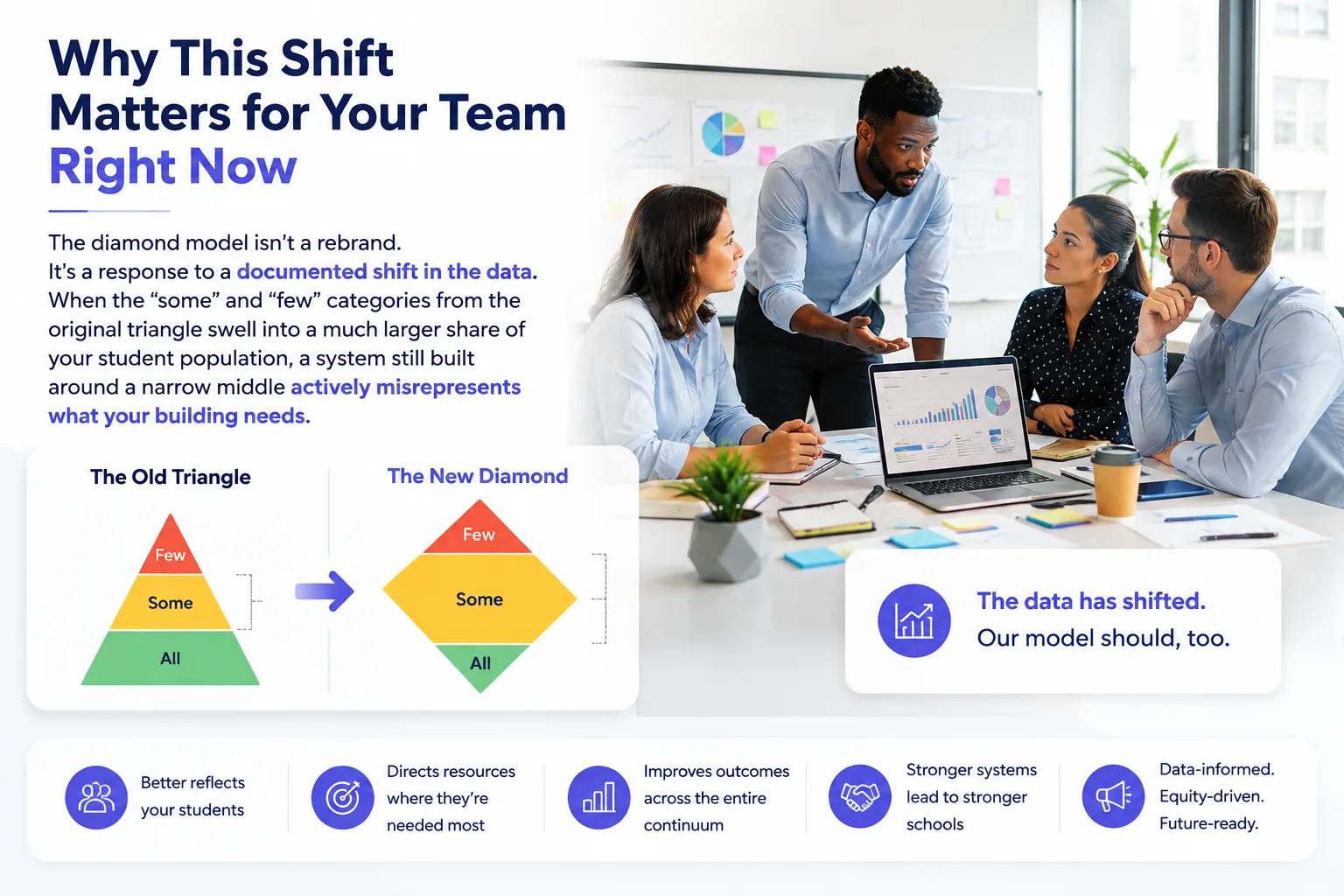
For years, the visualization of MTSS has been anchored by a pyramid. This shape featured a wide base of Tier 1 universal support that narrowed sharply into Tier 2 targeted intervention, eventually culminating in a small, pointed apex of Tier 3 intensive support. This geometric layout told a distinct story: most students need very little extra assistance, while only a few require a substantial amount.
However, data meetings built around that shrinking point at the top have increasingly resulted in the mere sorting of students rather than effectively serving those stuck in the middle. Over recent years, achievement gaps have widened and student growth has slowed across many districts. The population of learners who require something more robust than standard Tier 1 instruction, but who do not yet warrant a full special education evaluation, has grown substantially. The triangle’s narrow middle simply lacks the structural room required to address this demographic.
What the MTSS Diamond Model Actually Changes
To combat these systemic bottlenecks, a growing number of educational frameworks have begun adopting the MTSS diamond model, which changes the visual and functional dynamics of student support. Unlike its predecessor, this newer framework widens in the middle instead of narrowing.
Tier 1 continues to anchor the entire structure by providing high-quality core instruction designed for every student in the building. However, Tier 2 expands significantly to reflect the reality of how many students genuinely require targeted, supplemental support right now. Rather than treating these students as rare exceptions, the expanded middle tier acknowledges supplemental support as an expected, routine operational reality. Tier 3 remains the most intensive layer of the system, strictly reserved for students whose longitudinal data indicates a need for individualized, high-frequency intervention or a formal evaluation.
Crucially, the diamond model also introduces an element that the traditional triangle omitted entirely: a strengths-based, enrichment dimension. Students who have already mastered grade-level content are no longer left idling or under-challenged within Tier 1. Instead, they move fluidly toward academic acceleration and extension, utilizing the exact same institutional structure that supports students who are struggling. Under this model, a student can move downward into intensive support or upward into enrichment as their data evolves, and neither direction is stigmatized or treated as more or less legitimate than the other.
For specialized education teams, Tier 3 within the diamond framework serves as the precise operational bridge where the handoff to a formal evaluation occurs. When rigorous Tier 3 data demonstrates that intensive support is ultimately insufficient to close a persistent achievement gap, that outcome acts as the proper signal for a special education referral, rather than being viewed as an inherent failure of the intervention strategy itself.
Where NASET’s MTSS Diamond Resource Fits
Translating these conceptual changes into daily practice does not require school teams to start from scratch. Organizations such as the National Association of Special Education Teachers (NASET) have developed targeted reference materials, including an MTSS Diamond Model quick reference guide designed to break the framework down into the specific pieces educators actually need during high-stakes data meetings. These tools outline what each tier looks like in everyday classroom practice, how fluid movement between tiers functions operationally, and what essential topics a Tier 3 evaluation conversation should cover.

To complement the diamond framework at the classroom level, professional resources focusing on Tier 2 strategies—such as guidance on utilizing small group interventions to reduce challenging behaviors in elementary settings—provide practical, ready-to-use approaches tailored specifically for the population the diamond model is engineered to serve.
Why This Shift Matters for Your Team Right Now
The transition toward a diamond-shaped framework is much more than a simple administrative rebrand. It represents a direct response to a well-documented shift in educational data. When the categories representing "some" and "few" students within the original triangle swell into a vastly larger share of the total student population, a system built around a narrow middle misrepresents what a school building actually requires to function effectively.
For a diamond model to succeed, its structural tiers—Tier 1, Tier 2, and Tier 3—must remain tightly aligned with a unified instructional vision rather than operating as isolated, disconnected silos. This alignment demands that the school’s MTSS team, general education teachers, and special education case managers all operate from the exact same framework, avoiding conflicting interpretations of what each tier demands.
Federal oversight reinforces this principle. Guidance from the U.S. Department of Education regarding multi-tiered systems of support emphasizes that tiered intervention is only effective when implemented with fidelity and consistency across an entire school, rather than being applied in a piecemeal fashion by individual teachers or fragmented grade-level teams.
Building Your Own MTSS Diamond Practice
Implementing this approach successfully begins inside routine data review meetings. If these collaborative sessions continue to merely sort students into rigid categories rather than generating actionable, specific instructional next steps, it serves as a clear indicator that the team is still operating under a triangle mindset, even if they have adopted diamond terminology.
Bringing the framework to upcoming staff meetings requires a shared reference point, ensuring that all stakeholders—including general education teachers, specialized interventionists, building administrators, and families—understand the bidirectional movement the diamond permits. Furthermore, maintaining rigorous and clean Tier 3 data collection is vital, as special education teams depend heavily on this documentation when formal evaluations become the appropriate next step.
Professional organizations like the National Association of Special Education Teachers continue to build specialized resources to help case managers and MTSS teams bridge the gap between high-level frameworks and daily classroom instruction. Educators seeking deeper training on tiered intervention, data-based decision-making, and the evaluation processes following Tier 3 can access expanded professional communities dedicated to this work.
Ultimately, three core principles define this educational shift. First, the diamond model reflects a permanent, data-backed change in the sheer volume of students requiring supplemental academic and behavioral support. Second, fluid movement between tiers ensures the framework accommodates both struggling learners and advanced students within a single cohesive structure. Third, Tier 3 remains the critical gateway to special education evaluation, where meticulous data collection safeguards the interests of every student who ultimately requires formal intervention.