Every single day, students navigating the complexities of dysorthographia sit in ordinary classrooms where their written work is summarily marked as careless or indicative of low effort. In reality, their brains are working twice as hard just to form a single, coherent sentence. Compounding the issue, most of their educators have never even heard the term. This invisibility is not accidental. It is the entirely predictable result of an educational system designed to screen for what it already knows while routinely overlooking what it does not recognize.
Educators are likely supporting students right now who carry this struggle completely unnamed. Their Individualized Education Programs (IEPs) might address general reading comprehension or classroom behavior, and their writing scores consistently stay low, yet the precise explanation for the gap remains missing. This reality profoundly affects classroom dynamics, leaving case managers, special education teachers, and student advocates searching for answers. The core issue is that dysorthographia is not an obscure clinical curiosity; it is a specific learning disability affecting written spelling and orthographic processing that is entirely distinct from general writing difficulty. Yet, it is sitting quietly in classrooms across the country every day.
The primary obstacle is simply naming the condition. If one searches IEP meeting notes across the vast majority of school districts, the term barely surfaces. Educators who understand dyslexia intimately—those who can describe phonological processing deficits down to the smallest detail—frequently draw a blank when dysorthographia enters the conversation. That awareness gap carries significant consequences, meaning IEP teams are rarely screening for it, failing to name it accurately, and neglecting to build targeted supports around it even when the behavioral and academic symptoms are unmistakably present.
A student who routinely reverses letters, omits vital syllables in written assignments, cannot successfully retrieve spelling patterns under standard time pressure, and produces written output that falls far below their demonstrated verbal ability is signaling something critical. Recognizing this specific behavioral and cognitive profile must precede any meaningful support.
Dyslexia and Dysorthographia: Why Identifying One Is Not Enough
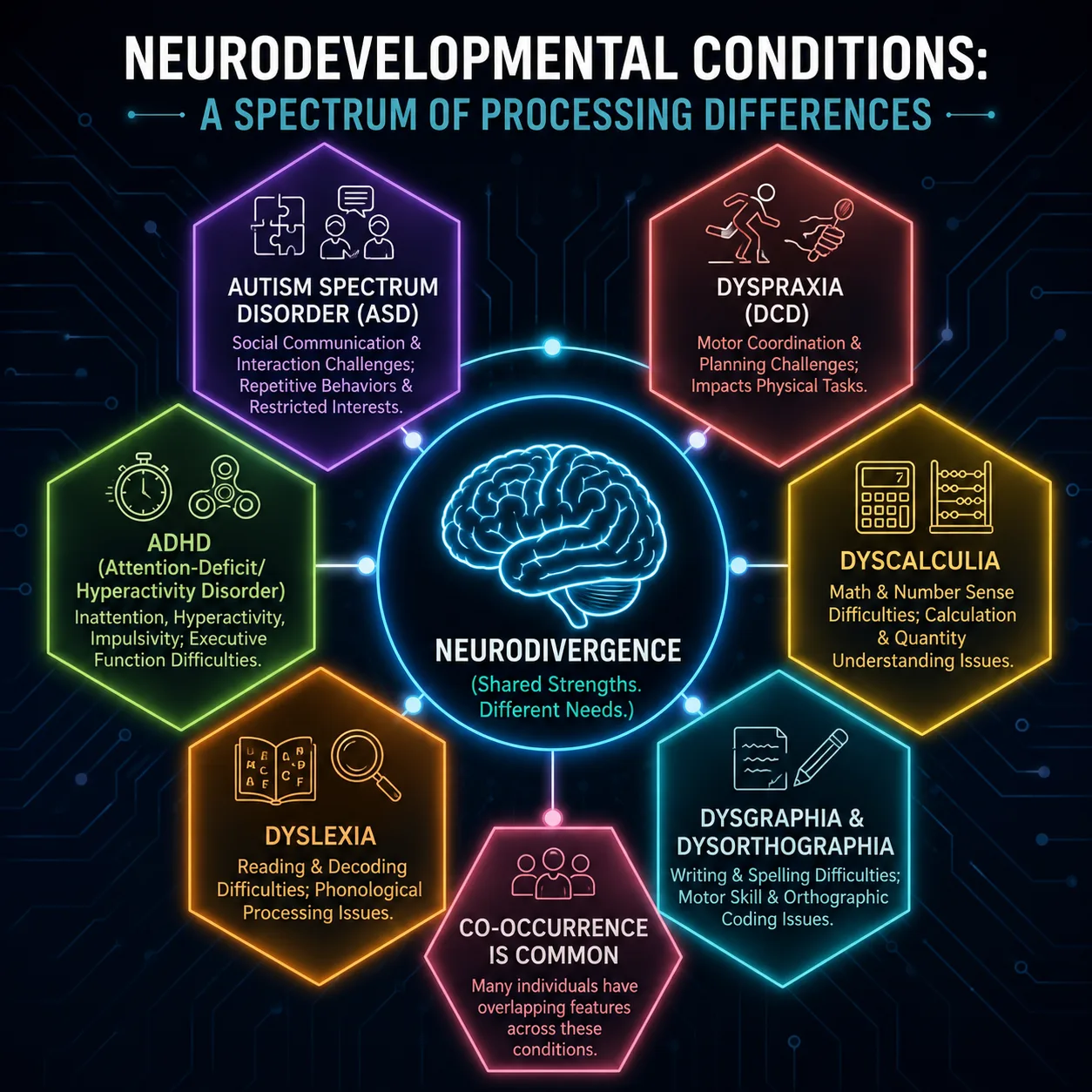
Learning disabilities rarely travel in isolation. Conditions such as dyslexia, dysphasia, dyscalculia, and dysorthographia share deep neurological roots, and their co-occurrence rates within individual students are remarkably high. A student officially identified with dyslexia has a meaningfully higher likelihood of also experiencing concurrent dysorthographia. Yet, school identification systems typically evaluate and address conditions strictly one at a time.
Consider what this partial identification looks like in actual practice. A third-grade student gets identified as having dyslexia, and appropriate phonological decoding supports are promptly put in place. Over time, the student’s reading improves slowly. However, their written work remains entirely chaotic, characterized by misspellings that follow no logical pattern and sentences that collapse under the heavy cognitive load of simply transferring words onto paper. The evaluation team attributes these lingering struggles entirely to the existing dyslexia diagnosis, and the IEP remains unchanged. Consequently, the student reaches the fifth grade equipped with a reading plan but devoid of any writing plan, allowing the widening gap between their robust verbal intelligence and their constrained written output to grow even larger.
This phenomenon of partial identification inevitably creates partial support. For a student wrestling with dysorthographia, partial support frequently feels indistinguishable from having no support at all. The interconnectivity of language-based learning processing systems means that addressing only one facet leaves the student vulnerable in other critical academic domains.
Misclassification Is Costing Students with Dysorthographia Critical Years
Educational data clearly shows that upper elementary school and middle school represent the periods where the academic floor drops out for unidentified students. The demands for written output increase sharply during these transitional years. Essays rapidly replace simple worksheets, and multi-paragraph compositions become the baseline expectation across subjects. For a student struggling with unidentified dysorthographia, this transition is not merely a routine developmental challenge; it is an insurmountable wall, and most school teams fail to see it approaching.

When students hit this wall, educators typically observe distinct behaviors, including task avoidance, incomplete assignments, outright refusal to write, and minimal output on formal assessments. The interpretation of these behaviors is frequently misaligned: the student is labeled as resistant, unmotivated, or simply low-performing. Consequently, behavioral intervention plans get written, and academic expectations are quietly lowered. The student internalizes this damaging label, while the underlying neurological disability remains completely unaddressed.
This period represents a critical window for intervention. A student who was managing adequately in the second grade but is unraveling by the sixth grade is not experiencing a sudden behavioral shift. Instead, they are buckling under the weight of an undiagnosed disability that has finally exceeded their personal ability to compensate. Federal guidelines regarding IEPs are clear that evaluations must thoroughly address all suspected areas of disability, where professional instinct serves as an essential guide.
How to Identify Dysorthographia: A Practical Framework
Proper identification relies not on a single isolated test, but rather on a coherent pattern of evidence that educators are already well-positioned to gather. The process begins by examining the fundamental discrepancy in student performance. Does the student’s written work look significantly weaker than their verbal participation, their reading comprehension, or their performance on oral assessments? This consistent gap constitutes meaningful diagnostic data.
Next, educators must examine the precise nature of the spelling errors. Students with dysorthographia do not make random mistakes; rather, they make predictable errors, such as phonetically plausible but incorrect spellings, omitted unstressed syllables, and persistent letter-order confusion even within highly familiar words. These patterns point directly to orthographic processing failures rather than mere carelessness.
Furthermore, documenting a student’s writing performance under standard time pressure separately from writing completed with extended time yields valuable insights. Students with dysorthographia frequently exhibit dramatic performance differences once the heavy cognitive load of speed is removed, providing clear diagnostic information. When bringing these observations into evaluation conversations, specificity is paramount. Notating the distinct discrepancy between verbal and written output in a formal referral, requesting the assessment of orthographic processing alongside phonological decoding, and advocating for written expression goals that specifically address spelling retrieval rather than general composition quality can fundamentally change the trajectory of an evaluation. Educators do not need to be neuropsychologists to be effective; they simply need to be specific and persistent.
What Happens After You Recognize Dyslexia
Dysorthographia will not spontaneously identify itself. It remains hidden inside low writing scores, frustrated shrugs, and the quiet resignation of students who have heard that they are simply not trying often enough to believe it.
The path forward requires several intentional shifts. First, dysorthographia must be recognized as entirely distinct from dyslexia, requiring accurate naming and active advocacy. Second, when a school identifies one learning disability, teams must actively screen for others within the same family, recognizing that partial identification yields partial outcomes. Third, while middle school presents significant challenges, acknowledging the urgency of the moment allows educators to intervene before the window closes entirely. The professional instincts of educators remain a legitimate and vital component of the evaluation process, ensuring that students currently navigating their academic journeys without a proper name for their struggles finally receive the support they deserve.