





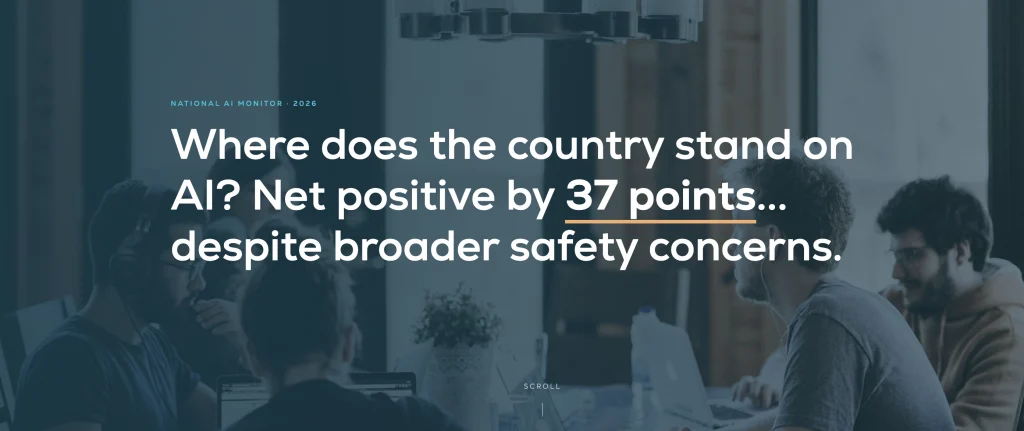
Despite a national discourse frequently dominated by existential warnings and alarmist headlines regarding the future of artificial intelligence, a new report suggests that the reality on the ground is significantly more nuanced. The second edition of the National AI Monitor, released by the research organization Just Capital, indicates that when it comes to the day-to-day integration of AI, the American public remains cautiously optimistic, driven largely by tangible improvements in workplace productivity and personal convenience.
The study, which surveyed over 1,000 U.S. adults, offers a window into the lived experience of citizens as they interact with rapidly evolving technologies. While the headlines often focus on the potential for runaway systems or societal upheaval, the respondents highlighted a more grounded perspective: they are experiencing the benefits of AI in real-time, even as they harbor deep-seated anxieties about the long-term ethical and environmental costs.
The Paradox of AI Sentiment
The findings present a compelling counter-narrative to the prevailing assumption that public sentiment toward AI is inherently negative. According to Martin Whittaker, CEO of Just Capital, the data reveals an underappreciated level of optimism that could serve as a roadmap for corporate and political leaders.
“There’s an assumption that Americans are against AI, but the people we’re hearing from continue to tell a more hopeful story,” Whittaker noted in his assessment of the survey results. “Americans’ optimism may be one of the most underappreciated signals in the AI conversation today. Leaders who listen closely have a real chance to build public trust.”
This trust, however, is not unconditional. The survey data suggests that while the current "experience" of AI is generally positive, the "outlook" for the future is tempered by significant concerns. This divide between immediate utility and future worry is particularly pronounced among specific demographics, including women, lower-income Americans, and older adults, who appear to be more sensitive to the potential negative externalities of a technology-driven economy.
Productivity as the Engine of Positivity
When asked what drives their positive experiences with AI, the primary answer from the workforce is clear: efficiency. For many employees, AI is not viewed as a replacement for human intellect but as a powerful force multiplier.
One 59-year-old male respondent, who identified himself as middle-income, noted that AI serves as a bridge for his daily professional tasks. “AI takes care of the structured and logical work; this allows me time for bringing human expertise to bear,” he explained. This sentiment reflects a common theme in the data: the belief that AI can strip away the mundane, repetitive elements of a job, allowing workers to focus on higher-level problem-solving and creativity.
For others, the benefits are rooted in professional empowerment. A 39-year-old male, categorized as upper-income, reported that the technology allows him to significantly scale his output. “I can do 10x the work I used to do, and can more confidently work in areas I don’t have as much experience in,” he said. This suggests that for many, AI is functioning as a skill-leveler, enabling workers to venture into new disciplines with greater speed and confidence than previously possible.
Beyond the office, the convenience factor is a major driver of positive sentiment. Consumers are increasingly appreciating the seamlessness that AI brings to their digital interactions. A 42-year-old female respondent highlighted this dual reality: she enjoys the benefits of personalized services, such as faster customer support and tailored recommendations, but remains deeply concerned about the underlying privacy implications. “As a customer, I think companies’ use of AI makes products and services more convenient and personalised,” she noted. “It helps me get faster customer support, better recommendations, and quicker answers to my questions. At the same time, I am concerned about privacy and want companies to use my personal information responsibly.”
Furthermore, for some, the rise of AI has manifested in direct financial benefits. The intersection of AI and personal finance has created a sense of optimism for investors, with one 34-year-old male respondent noting, “My 401k is doing pretty well and AI is driving the market.”
The Shadows of Innovation: Environmental and Ethical Concerns
Despite the immediate utility and economic upside, the National AI Monitor also captured significant apprehension. The "negative experience" drivers identified in the report are often tied to the physical and societal costs of supporting such massive technological infrastructure.
Environmental concerns are particularly acute among those who are beginning to grapple with the reality of what powers these models. The energy demands of large data centers—including water consumption for cooling, electricity usage, and the resulting strain on local power grids—are becoming a focal point of public anxiety. One 50-year-old male respondent expressed frustration regarding these systemic costs: “Water waste, water pollution, energy waste, the drain on resources of communities too poor to fight back against them.”
This sense of inequity extends to the broader issue of trust. A 65-year-old female respondent expressed a sentiment that reflects a deeper, foundational skepticism of the companies driving this transition. “I do not trust AI or the makers. I don’t think it can be controlled,” she stated.
Perhaps the most visceral concern, however, remains the potential for job displacement and the ethical implications of how AI uses personal data. For younger workers, the impact is personal. A 19-year-old female respondent voiced deep concern over the erosion of individual agency in the digital age, noting, “It’s very sad to see that AI is quite literally taking people’s jobs and copying people’s content and reusing their face and videos without their knowledge or consent.” This highlights a growing awareness of the lack of regulatory safeguards surrounding digital identity and creative rights.
Future Outlook and Demographic Variance
While Americans generally maintain a positive view of the impact of AI to date, the report indicates that this optimism wanes when looking toward the future. The uncertainty of how these technologies will evolve, coupled with the potential for unforeseen consequences, creates a "wait and see" attitude among a significant portion of the population.
These attitudes are not uniform across the American public. The research underscores that demographics play a pivotal role in how AI is perceived. Factors such as gender, income level, and age serve as lenses through which the societal impact of AI is filtered. Lower-income individuals, for example, often express higher levels of concern regarding job security, while older adults may be more wary of the rapid pace of change and the trustworthiness of new systems.
Methodology and Context
The data for this report was gathered through a comprehensive online survey conducted by The Harris Poll on behalf of Just Capital between September 30 and October 2, 2026. With a sample size of 1,010 U.S. adults aged 18 and older, the study carries a margin of error of +/- 3.6 percentage points at a 95% confidence level.
To ensure the integrity of the results, the researchers employed a methodology that discouraged neutral, non-committal answers. Respondents were asked to weigh in on seven key questions covering AI’s effect on various stakeholders—workers, customers, communities, the environment, and shareholders—using a five-point scale. Crucially, the "I don’t know" option was provided as a distinct choice, and these responses were excluded from the final scoring to ensure that the data reflected genuine, informed opinions rather than artificial neutrality.
The resulting scores, which range from -100 to +100, were calculated by subtracting the percentage of negative responses from the percentage of positive responses. The consistency of these scores between August and September suggests that public sentiment is currently stable, even if the national conversation around the topic remains volatile.
Ultimately, the National AI Monitor suggests that the "AI conversation" is far from settled. As the technology continues to integrate into every facet of American life, the challenge for companies and policymakers will be to reconcile the tangible, daily benefits that citizens clearly appreciate with the legitimate, long-term fears regarding employment, the environment, and the ethical use of information. For those at the helm of the AI revolution, the message from the public is clear: there is a path toward widespread acceptance, but it requires addressing the very real anxieties that exist alongside the optimism.