NEW YORK, NY – September 16, 2026 – As artificial intelligence continues its rapid integration into the fabric of daily life, the debate surrounding its societal impact has largely been defined by the dueling narratives of industry optimists and technological alarmists. While AI developers and corporate leaders make sweeping promises of productivity and innovation, the public has been left to navigate these changes with little empirical guidance. Recognizing this critical disconnect, the non-profit organization Just Capital has launched the National AI Monitor, a new, recurring research initiative designed to provide a granular, objective assessment of how Americans are experiencing the AI revolution in real time.
For leaders in the boardroom, the halls of government, and the frontier labs of Silicon Valley, the current discourse on AI is often too abstract to be useful. Decisions regarding the deployment of generative models, automated workflows, and algorithmic decision-making are being made at an unprecedented scale, yet there has been a notable lack of actionable data regarding how these technologies affect the average citizen as a worker, a consumer, an investor, and a member of society. The National AI Monitor seeks to bridge this gap by collecting monthly quantitative and qualitative data to reveal the human reality behind the technological transformation.
Bridging the Gap Between Innovation and Public Trust
The launch of the Monitor comes at a pivotal moment in the development of artificial intelligence. According to Just Capital Founder Paul Tudor Jones II, the technology represents the most consequential issue of the current era. "Understanding how the American people are experiencing it is critical to building public trust and making more informed decisions on future deployment," Jones said in a statement. "This new Monitor from Just Capital is filling that essential need. Leaders across the AI labs, business, markets, government, and civil society can rely on it every month to give an unbiased, objective assessment of whether AI is living up to its promises or taking us down the wrong path."
The initiative is designed to serve as a compass for stakeholders who are struggling to reconcile the immense promise of AI with the mounting concerns regarding its ethical and societal footprint. By capturing the sentiment of a representative cross-section of the American public, Just Capital aims to provide the necessary feedback loop to ensure that the deployment of AI is not merely driven by technical capability, but by a commitment to the public good.
Just Capital CEO Martin Whittaker emphasized that the organization’s primary mission remains consistent: to amplify the voice of the American public to encourage smarter, more responsible corporate and policy decisions. "As frontier labs, corporate leaders, and policymakers work to bridge public trust and technological transformation, this research aims to help them deploy AI in ways that drive innovation and support an economy and society that works for all," Whittaker stated.
Early Insights from the August 2026 Findings
The inaugural edition of the National AI Monitor, conducted in August 2026, offers a nuanced picture of an American public that is tentatively optimistic but increasingly wary of the long-term consequences of AI. The findings suggest that while individuals are beginning to see the benefits of AI-driven productivity in their daily lives, those gains are being weighed against significant anxieties regarding job security, system safety, and the environmental cost of the massive computing power required to fuel these models.
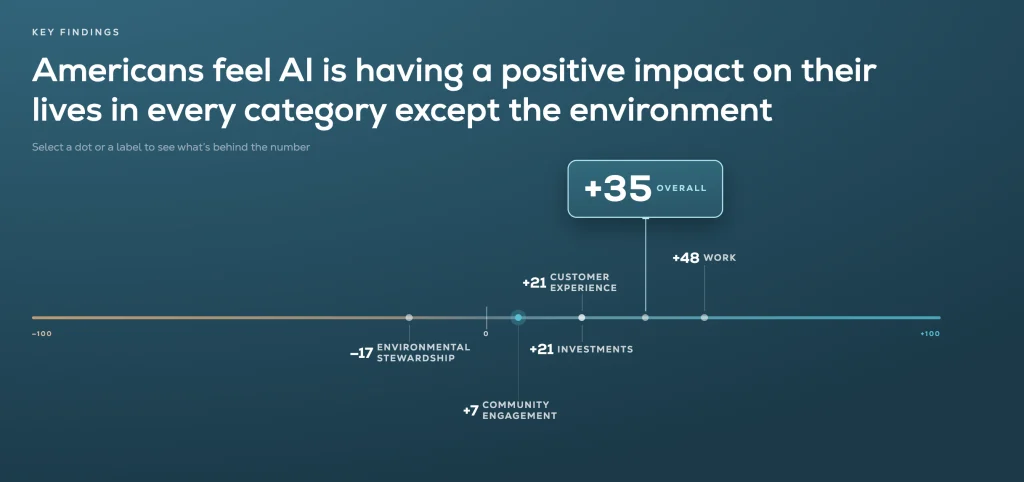
Overall, the survey found that positive experiences currently outweigh negative ones. However, the data highlights a clear divide between immediate, personal utility and broader, systemic concerns. The most pronounced positive effects reported by respondents were found in the workplace, where AI tools are increasingly seen as facilitators of productivity and efficiency. Workers are finding that, when implemented effectively, AI can streamline tasks and enhance their professional output, providing a tangible benefit to their daily work lives.
In contrast, the customer experience remains mixed. While some Americans are benefiting from more personalized or efficient services, there is a clear preference for the "human touch." Consumers are signaling that while they appreciate the speed that AI can provide, they are not willing to sacrifice human interaction and accountability in the services they receive. This serves as a critical warning to businesses that prioritizing automation at the expense of customer service may lead to dissatisfaction.
Perhaps most revealing is the state of public awareness regarding the financial and community-level impacts of AI. Many respondents reported that they are unsure how AI is currently impacting their local communities, suggesting that the "AI revolution" has yet to manifest in a way that is visible or meaningful to the average person at a neighborhood level. Even more striking is the financial sphere: the majority of Americans are not aware of whether they are experiencing any tangible financial gains—or losses—from AI in their investments or savings. This lack of transparency or realization could pose a challenge for companies looking to communicate the economic value of their AI investments to shareholders and the public alike.
Perhaps most concerning for stakeholders is the environmental lens. In the August survey, the environment was the only category that produced a net negative effect. As the public becomes more aware of the immense energy requirements and hardware waste associated with large-scale AI infrastructure, they are signaling a growing discomfort with the ecological price of the current technological trajectory.
Finally, the survey revealed a subtle but significant trend toward pessimism regarding the future. While people are generally positive about how AI is helping them today, their outlook grows more skeptical when they project those impacts into the future. For business leaders and policymakers, this represents a significant challenge: how to demonstrate that an AI-powered economy will be an inclusive and sustainable one. Whittaker noted that for leaders attempting to help Americans see their place in this new economy, the data provided by the Monitor should be viewed as a essential roadmap.
Methodology and Approach
The National AI Monitor is designed to be a statistically robust instrument for tracking sentiment. The August 2026 edition was conducted online by The Harris Poll on behalf of Just Capital between August 13 and August 17, 2026. The sample included 1,008 U.S. adults aged 18 and older. To ensure the reliability of the data, the sampling precision is measured using a Bayesian credible interval, with the results for this study being accurate to within +/- 3.5 percentage points at a 95% confidence level.
The research methodology is anchored in Just Capital’s established framework, which evaluates the impact of corporations and technologies across five primary stakeholder groups: workers, customers, communities, the environment, and shareholders. Respondents were asked seven specific questions, including one regarding their overall experience with AI to date, five questions covering each of the stakeholder groups, and a final forward-looking question regarding their level of optimism for the future.
Each question utilizes a five-point scale, ranging from "very negative" to "very positive." Importantly, the survey provides a "don’t know" option to ensure that uncertainty is not misconstrued as neutrality, providing a more accurate reflection of public engagement with the technology. Furthermore, every question—with the exception of the forward-looking inquiry—is followed by an open-ended "why" prompt. These qualitative responses are synthesized to provide a diagnostic tool for companies, helping them understand exactly what drives public sentiment and where their deployment strategies may be failing or succeeding.
Scores are calculated by subtracting the percentage of negative responses from the percentage of positive responses, creating a net score ranging from -100 to +100. By excluding "don’t know" responses from the net score calculation, Just Capital ensures that the final figures reflect the views of those who feel they have enough experience with AI to form an opinion.
As the National AI Monitor moves into its subsequent months, the data will continue to serve as a vital resource for anyone tasked with guiding the integration of AI into the American economy. By providing a consistent, objective pulse on the public mood, the Monitor aims to ensure that the development of this transformative technology remains aligned with the needs and values of the people it is intended to serve. For further information regarding the methodology, including specific weighting variables and subgroup details, interested parties may reach out directly to Just Capital. Media inquiries regarding the ongoing research should be directed to Evangeline DiMichele at [email protected].