The U.S. government has transferred roughly $1.5 billion in Bitcoin to institutional custody and trading platform Coinbase Prime over a span of three days, sparking widespread speculation and anxiety across the digital asset markets. On-chain blockchain trackers first flagged the massive movements just as Bitcoin experienced a sharp 6.9% price correction, leading traders, analysts, and market participants to question whether Washington was preparing a massive sell-off. As of yet, no official government agency or exchange route has confirmed an actual liquidation.
According to data compiled by on-chain analytics platform Lookonchain, wallets associated with the United States government deposited 17,733 Bitcoin—valued at approximately $1.48 billion—along with 750 Wrapped Bitcoin (WBTC) worth roughly $62 million, into Coinbase Prime accounts over the three-day window. Coinbase Prime serves as the exchange’s specialized institutional arm, offering advanced custody solutions, over-the-counter trading, and execution services. Federal agencies, including the U.S. Marshals Service, have historically utilized Coinbase Prime and similar institutional platforms to securely store, manage, and occasionally liquidate digital assets seized during criminal investigations and civil forfeitures.
Bitfinex Seizure History Meets Reserve Policy
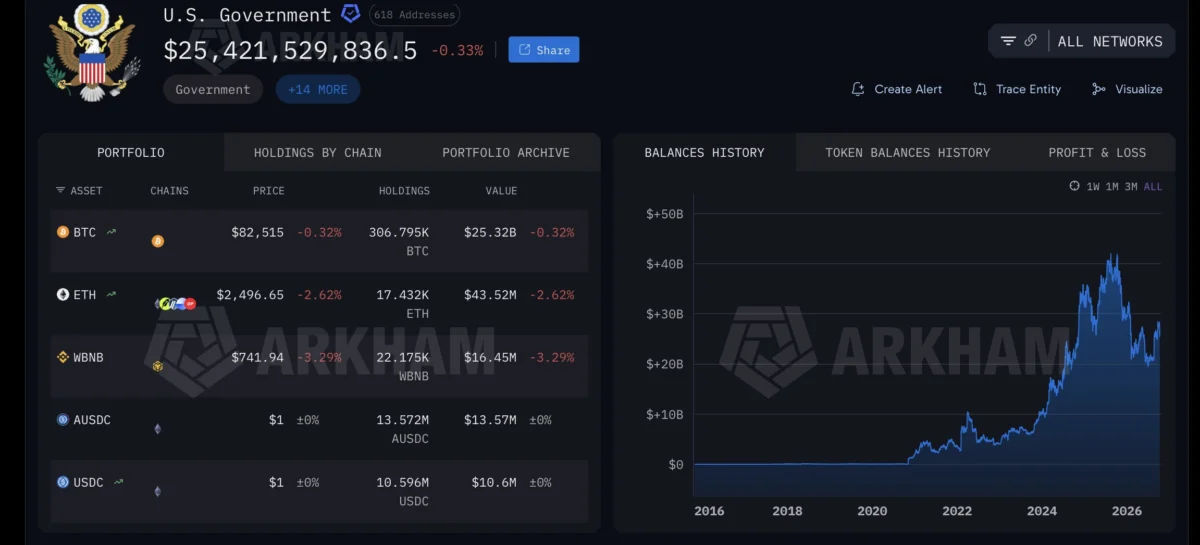
The coins involved in these latest high-value transfers are widely believed to originate from prominent federal asset seizures, including those tied to the infamous 2016 Bitfinex hack, the dismantling of the Silk Road darknet marketplace, and the Prince Group financial fraud case. Entity profiles maintained by blockchain intelligence firm Arkham indicate that the U.S. government continues to maintain a massive digital asset treasury, holding approximately 306,795 Bitcoin valued at roughly $25.32 billion, alongside smaller holdings of Ethereum, Wrapped BNB, and various stablecoins.
The total estimated value of these government-held digital assets has declined significantly from a previous peak above $40 billion down to approximately $25 billion, a drop driven primarily by broader downward movements in cryptocurrency valuations rather than deliberate mass liquidations by federal authorities.

This complex asset management landscape operates under the framework of a March 2025 executive order, which formally established the Strategic Bitcoin Reserve. The policy dictates that Bitcoin deposited directly into the reserve should generally be retained rather than sold on the open market. However, the legislation permits certain specific exceptions, such as court-ordered distributions and legally mandated victim restitution programs.
While this executive order provides a crucial regulatory backdrop for how federal digital holdings are categorized, it does not explicitly clarify whether these specific coins were incorporated into the reserve, nor does it shed light on the exact operational purpose behind the October transfers. The intersection of large-scale criminal seizures and government asset recovery has consistently brought institutional custody and legal accountability to the forefront of the digital asset sector, echoing previous challenges faced during the tracing, confiscation, and judicial handling of funds linked to major cyberattacks and illicit operations.
Bitcoin Moved to Coinbase Prime: Is This a Sale?
A foundational rule in on-chain analysis is that an exchange deposit does not automatically equate to a sell order. Moving substantial amounts of digital currency to a platform like Coinbase Prime can signify a wide range of administrative actions, including routine internal custody adjustments, standard legal seizure processing, preparations for court-sanctioned distribution, or an active intention to execute a trade. To date, federal authorities have issued no public statements, press releases, or official explanations regarding the motive behind the transactions.
The market sensitivity to these movements stems largely from the unfortunate timing, which coincided with a 6.9% downward slide in Bitcoin’s spot price. During the same trading window, Bitcoin briefly tested lows around $80,500, triggering an estimated $1.14 billion in total market liquidations across derivatives exchanges, with long positions accounting for approximately $930 million of those forced closures. Large-scale inflows to centralized exchanges traditionally amplify psychological fears of impending selling pressure among retail and institutional investors alike, frequently causing leveraged traders to experience severe margin squeezes as prices breach critical technical support levels.

Nevertheless, financial analysts point out that crypto-specific exchange transfers were not the sole catalyst for the broader market downturn. Concurrently, traditional financial markets were contending with a 5.34% yield on U.S. Treasury securities, a strengthening U.S. dollar, and climbing global oil prices—macroeconomic headwinds that exerted broad pressure across risk-on asset classes, including equities and digital assets. Consequently, market observers note that an unconfirmed transfer to an institutional prime broker is insufficient on its own to fully explain the depth of the price correction.
For the time being, the multi-billion-dollar transfers remain a significant on-chain signal to monitor rather than definitive proof of a government sell-off. Clear confirmation of an actual liquidation would typically require an official government disclosure, subsequent outward flows from the exchange into active order books, or observable shifts in sustained sell-side pressure across major trading venues.