
For decades, the American dental industry has operated on a deeply entrenched, reactive economic model. Practices are fundamentally incentivized to repair decay rather than prevent it, a dynamic driven forward by complex insurance reimbursement rules and aggressive private equity consolidation. The downstream effect of this systemic design is glaring: while more than 80 percent of American adults state that they desire more frequent and proactive dental care, only 40 percent actually visit a dentist each year. For the majority who stay away, the deterrents are well-documented—surprise medical bills, rushed appointments, and the unmistakable, often painful discomfort of traditional metal scraping.
Enter Wally, a preventative, subscription-based oral healthcare company aiming to fundamentally rewire how people think about and access dental services. By completely bypassing traditional insurance and leveraging advanced technology like Swiss AIRFLOW cleaning systems and proprietary AI platforms, Wally is carving out a disruptive path in the nearly $200 billion U.S. dental market.
AlleyWatch recently sat down with Wally cofounder and CEO Tyler Burnett to discuss the company’s business model, its aggressive future growth plans, and a recent funding milestone that brings its total capital raised to $28.1 million.
Who Were Your Investors and How Much Did You Raise?
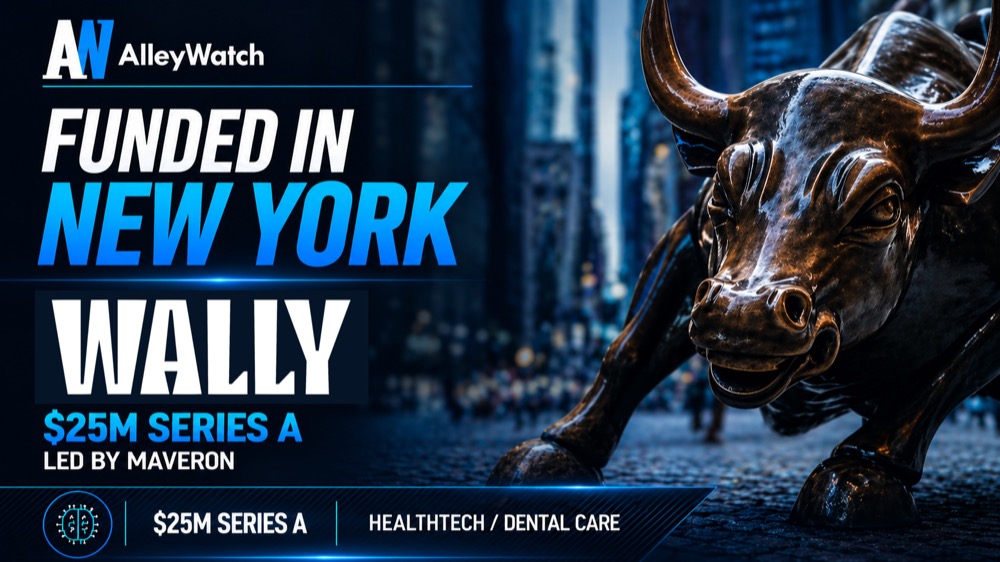
To fuel its next phase of national expansion, Wally successfully raised a $25 million Series A funding round. The investment was led by Maveron, with participation from Bling Capital alongside a roster of notable angel investors, including Jack Abraham, the cofounder of Hims.
The fresh injection of capital follows a period of rapid traction for the company, which now counts more than 50,000 active members spread across major metropolitan areas including New York, New Jersey, Pennsylvania, and Illinois. With its current footprint spanning 15 physical locations, the company has set its sights on an ambitious trajectory to scale up to 100 studios by the end of 2027.
Tell Us About the Product or Service That Wally Offers
At its core, Wally offers a preventative, direct-to-consumer subscription membership designed to strip away the friction of modern healthcare. For a flat annual fee of $249, members receive unlimited preventative hygiene cleanings, comprehensive exams, advanced diagnostics, and professional whitening—all without ever interacting with traditional insurance providers.
To differentiate the patient experience from conventional dental offices, Wally utilizes Swiss AIRFLOW cleaning technology. This innovative approach eliminates harmful bacteria and surface stains using a pressurized stream of air, warm water, and fine powder, entirely replacing the traditional, dreaded metal scraping tools.
Furthermore, the company incorporates digital X-rays, 3D intraoral scans, and AI-powered detection systems, allowing patients to view and understand their own objective health data in real time. Beyond routine preventative care, Wally also provides popular auxiliary procedures and services, such as non-invasive cavity reversal, clear aligners, and custom nightguards, at a fraction of the cost charged by standard traditional competitors.
What Inspired the Start of Wally?
The inception of Wally was born from a combination of personal frustration and a rare insider perspective on the inner workings of the dental sector. Years ago, after relocating from Canada to the United States, Burnett visited a new dentist who informed him that he required eight cavities filled. Skeptical of the sudden diagnosis, Burnett sought second and third opinions, ultimately discovering that seven of those recommended fillings were completely unnecessary.
Around that same period, Burnett was dating his now-wife, who had recently graduated from dental school, granting him a firsthand look at the structural pressures defining the industry. Alongside his cofounders, Stipe Latkovic and Chelsea Patel, Burnett realized that the U.S. dental system was trapped within an insurance framework that compelled practices to maximize procedural reimbursements rather than prioritize long-term patient health. This realization catalyzed the mission to build a company that derives its business success from preventing decay rather than profiting from its repair.
How Is Wally Different?
Wally’s primary differentiator is its decision to take insurance completely out of the equation. Traditional dentistry relies heavily on a reactive cycle: get a patient in the dental chair, identify something to fix, perform an invasive procedure, and bill the insurance company.
Wally, by contrast, operates on a proactive and fully transparent model. By charging a straightforward flat membership fee, the company aligns its business incentives directly with the actual health and well-being of the patient.

Operational efficiency also sets the brand apart. Wally strategically places its studios inside co-working spaces rather than traditional standalone offices, allowing a new location to be built out and opened in a matter of weeks. Additionally, a proprietary AI platform manages scheduling and back-end operations while actively guiding clinicians through each appointment. This technological integration reduces administrative burdens for dental professionals, a major factor contributing to Wally’s impressive 97 percent hygienist retention rate.
What Market Does Wally Target and How Big Is It?
Wally targets the massive U.S. dental market, which is valued at close to $200 billion. Despite the sheer size of the industry, market participation remains remarkably low on an annual basis, with only 40 percent of American adults visiting a dentist each year.
The disconnect, Burnett notes, lies in consumer demand: more than 80 percent of people express a desire for more frequent dental care, but they actively avoid it due to financial opacity, complex insurance bureaucracy, and the physical anxiety associated with traditional clinical environments. Wally specifically targets this underserved demographic of Americans who are fatigued by surprise bills and the discomfort of the dental chair.
What’s Your Business Model?
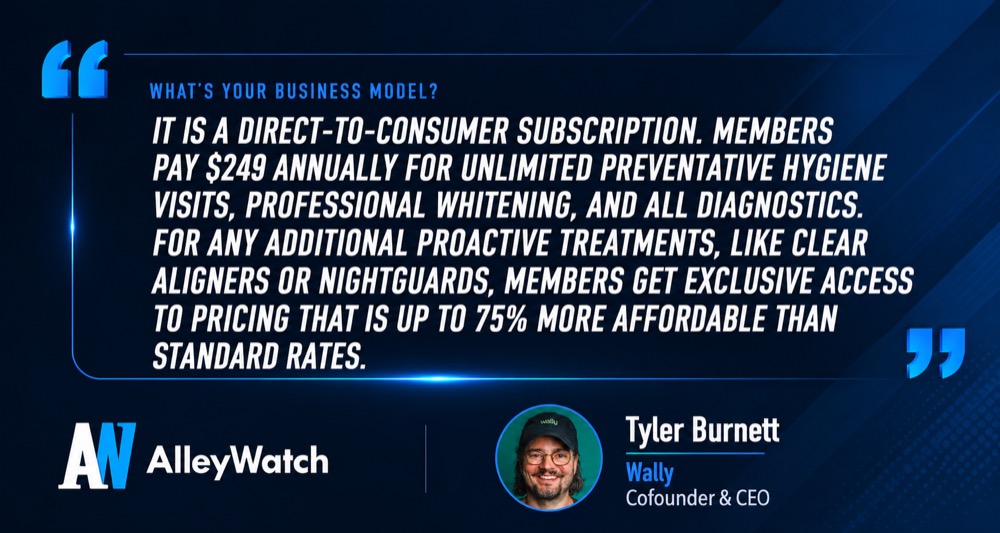
Wally operates on a direct-to-consumer subscription model. Members pay an annual fee of $249, which grants them unlimited preventative hygiene visits, professional whitening treatments, and all necessary diagnostics. For members seeking additional proactive treatments, such as clear aligners or custom nightguards, the company provides exclusive pricing that is up to 75 percent more affordable than standard industry rates.
How Are You Preparing for a Potential Economic Slowdown?
In the event of an economic downturn, consumer behavior naturally shifts toward a search for value, predictability, and price transparency. Burnett believes Wally’s business model is inherently insulated against macroeconomic headwinds.
At $249 a year, the membership is frequently more affordable than standard monthly dental insurance premiums and copays combined. By completely eliminating surprise bills and expensive, unnecessary invasive procedures, Wally provides households with a highly cost-effective avenue to maintain their healthcare regimens even as household budgets tighten.
What Was the Funding Process Like?
Raising capital for Wally proved to be a complex undertaking. Building a nationwide consumer healthcare brand in an industry dominated by insurance monopolies and deep fragmentation is a formidable challenge that has rarely been accomplished successfully.
To convince investors, Burnett and his team had to provide concrete evidence that their vision, technological infrastructure, and unit economics were viable and ready for scale. Fortunately, the operational data spoke for itself. Surpassing 50,000 members—who visit the studios an average of three times a year—alongside maintaining a stellar 4.9-star rating, proved to investors that Wally had struck a powerful chord in the market.
What Are the Biggest Challenges That You Faced While Raising Capital?
The primary hurdle during the fundraising process was overcoming initial skepticism from investors regarding whether consumers would willingly pay out-of-pocket for a dental membership when many technically hold some form of traditional dental insurance.
The founding team had to actively educate the market, reframing the conversation around the reality that traditional dental insurance functions more like a discount card for emergency procedures than true, holistic healthcare. Once investors witnessed firsthand how enthusiastically patients embraced the pain-free experience and transparent pricing model, that initial skepticism quickly dissolved.
What Factors About Your Business Led Your Investors to Write the Check?
Jason Stoffer, a partner at lead investor Maveron, highlighted the unique positioning of the company during the funding process, noting that Wally successfully accomplishes what no other dental brand has managed: pain-free cleanings executed in half the time, powered by a single AI-driven platform that streamlines scheduling, operations, and clinical guidance. Stoffer emphasized that dentistry has historically lacked a consumer brand that people genuinely enjoy interacting with, and Maveron views Wally as the definitive brand capable of changing that dynamic, supported by durable hardware, diagnostics, and proprietary AI.
What Are the Milestones You Plan to Achieve in the Next Six Months?
Over the upcoming six-month period, Wally is establishing waitlists and laying the groundwork to introduce its subscription model to several key new metropolitan hubs, including Washington, D.C., Atlanta, Austin, and Miami. To support this geographic expansion, the company plans to hire aggressively across all departments, bringing on top-tier clinical talent and operational leaders to power its growth.

What Advice Can You Offer Companies in New York That Do Not Have a Fresh Injection of Capital in the Bank?
For early-stage companies operating out of New York without fresh capital reserves, Burnett advises leveraging the unique environment of the city. New York offers access to a massive, diverse population of consumers who are willing to provide direct, unfiltered feedback. Founders operating leanly should lean into this dynamic by engaging with customers obsessively, iterating products based on blunt feedback, and focusing relentlessly on core unit economics to prove that their business model works organically before attempting to scale artificially.
Where Do You See the Company Going Now Over the Near Term?
Wally’s immediate priority is scaling its physical footprint. The company currently operates 15 locations distributed across New York City, Philadelphia, Jersey City, and Chicago. Armed with its latest round of capital, Wally aims to expand that network to 100 locations by the end of 2027, bringing its technology-driven, proactive oral care experience to a significantly broader audience across the United States.