Morgan Stanley has reaffirmed its bullish stance on SpaceX, maintaining a $300 per share price target alongside an Overweight rating in a note published by analyst Adam Jonas. The financial institution’s ambitious valuation arrives as the aerospace and connectivity giant navigates a period of heightened market activity, coinciding directly with confirmed discussions between Elon Musk and Taiwan Semiconductor Manufacturing Company (TSMC) regarding a potential chip venture.
The reaffirmation from Wall Street comes as the broader aerospace and technology sectors closely monitor upcoming technological milestones and corporate developments from Musk’s enterprises. With institutional interest running high and a slate of critical operational tests on the horizon, market participants are actively reassessing the growth trajectory of the private space leader as it pushes deeper into advanced manufacturing, connectivity infrastructure, and artificial intelligence integration.
SpaceX Stock Target, $300 Forecast and TSMC Talks Explained
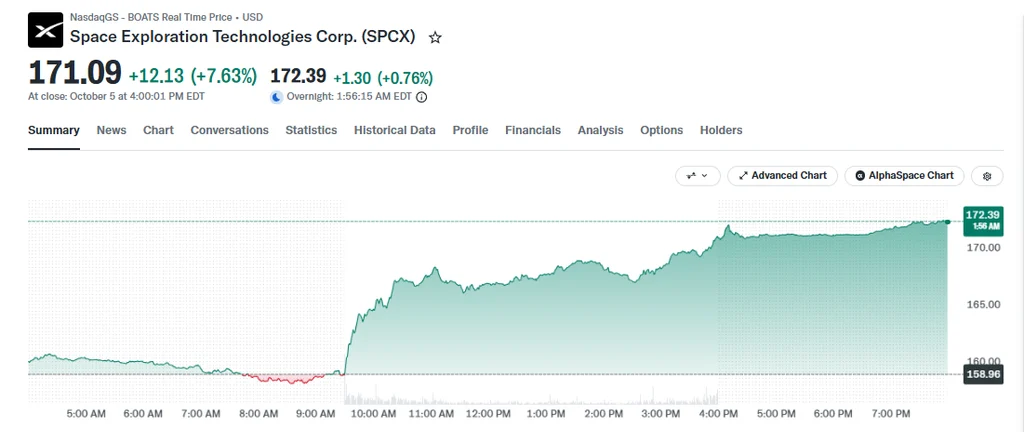
The latest commentary from Morgan Stanley highlights a substantial potential upside from current trading levels. SpaceX stock recently closed a regular trading session at $171.09, registering a notable 7.63% single-session gain. In subsequent overnight trading sessions, the equity has fluctuated around $172.21, moving within a daily range between $158.62 and $172.47.
Trading volume during these sessions spiked significantly, with approximately 134.4 million shares changing hands, comfortably outpacing the stock’s average daily volume of 91.3 million shares.
The $300 price target issued by Morgan Stanley stands considerably higher than the broader Wall Street consensus. Current one-year consensus estimates hover around $227.44 per share, while the stock’s 52-week high is recorded at $225.64. Other major financial institutions have also weighed in on the valuation landscape for the company. Needham has established a price target of $250, Bernstein sits at $248, and Bank of America maintains a target of $235. Meanwhile, newer coverage entered the fray when TD Cowen initiated its assessment with a Buy rating and a $200 price target, introducing a more conservative benchmark into the ongoing valuation discourse.
Why Morgan Stanley Keeps Its SpaceX Stock Target At $300
In his detailed research note, titled "SPCX $159: Cheap and Getting Cheaper," Adam Jonas argued that recent market pullbacks have created an unusually attractive entry point for investors. Evaluating the equity at the $159 level, Jonas calculated that the shares were trading at approximately 30 times estimated 2028 enterprise value to earnings before interest and taxes (EV/EBIT). By comparison, he noted that mega-cap artificial intelligence enablers trade at roughly 16 times on a similar basis. However, when adjusted for anticipated growth rates, that valuation metric drops to approximately 0.3 times, placing the stock roughly 40% below the median valuation of its peer group.
Emphasizing the tactical timing of the investment thesis, Jonas wrote in the note that investors can take advantage of a unique opportunity to acquire shares that appear unusually inexpensive over the coming weeks, specifically pointing to the window ahead of upcoming flight tests.
A crucial component of the Morgan Stanley valuation model involves a sum-of-the-parts breakdown. The bank currently assigns a valuation of $127 per share exclusively to the core Space and Connectivity units, which leaves approximately $32 per share attributed to the company’s emerging artificial intelligence initiatives at a $159 share price. This strategic weighting forms the bedrock of the firm’s overarching argument, implying that realizing the full $300 price target will depend heavily on the successful execution and commercial delivery of the AI-driven segments of the business.
SpaceX TSMC Talks Bring A New Chip Angle
The release of Morgan Stanley’s upgraded analysis coincided with public confirmations regarding supply chain maneuvers. Musk confirmed via a social media post on X that Terafab—an ambitious chip manufacturing venture backed jointly by SpaceX and Tesla—is currently engaged in early-stage discussions with TSMC. The proposed foundry project aims to produce specialized semiconductors tailored to the operational demands of SpaceX, Tesla, and xAI.
Addressing the preliminary nature of the negotiations, Musk noted that these were strictly initial discussions, though he added that something meaningful could eventually materialize from the talks.
At this juncture, industry analysts emphasize that no formal contracts, operational timelines, or financial commitments have been finalized, and TSMC management has largely refrained from providing extensive public commentary on the matter. Consequently, market observers view the early-stage dialogue between SpaceX and TSMC as an exploratory bonus rather than a foundational pillar required to support the existing $300 stock target.
Starship Flight 15 Is The Next Big Test
Looking ahead, Morgan Stanley points to several specific operational catalysts that could serve to bridge the gap between current market prices and the $300 valuation objective. Jonas identified future AI product releases, continued progress on the Starship development program, and additional neocloud contracts maintaining pricing structures around $30 to $50 per watt as key upward drivers for the equity.
Attention is now sharply focused on the impending execution of Starship Flight 15, which is anticipated to take place in late October or early November. Jonas suggested that a successful technological milestone, such as the successful mechanical catch of the returning rocket booster, could represent the most significant positive catalyst for the company since its initial public offering.
These upcoming operational tests intersect closely with financial reporting cycles, as third-quarter earnings disclosures are scheduled for early November. While trailing earnings per share remain negative at -$1.10—underscoring that the $300 price target relies heavily on projected multi-year profitability—the interplay between rigorous flight test campaigns, corporate chip ventures, and broader institutional support continues to dictate the immediate trajectory of the stock as it navigates a highly dynamic market environment.