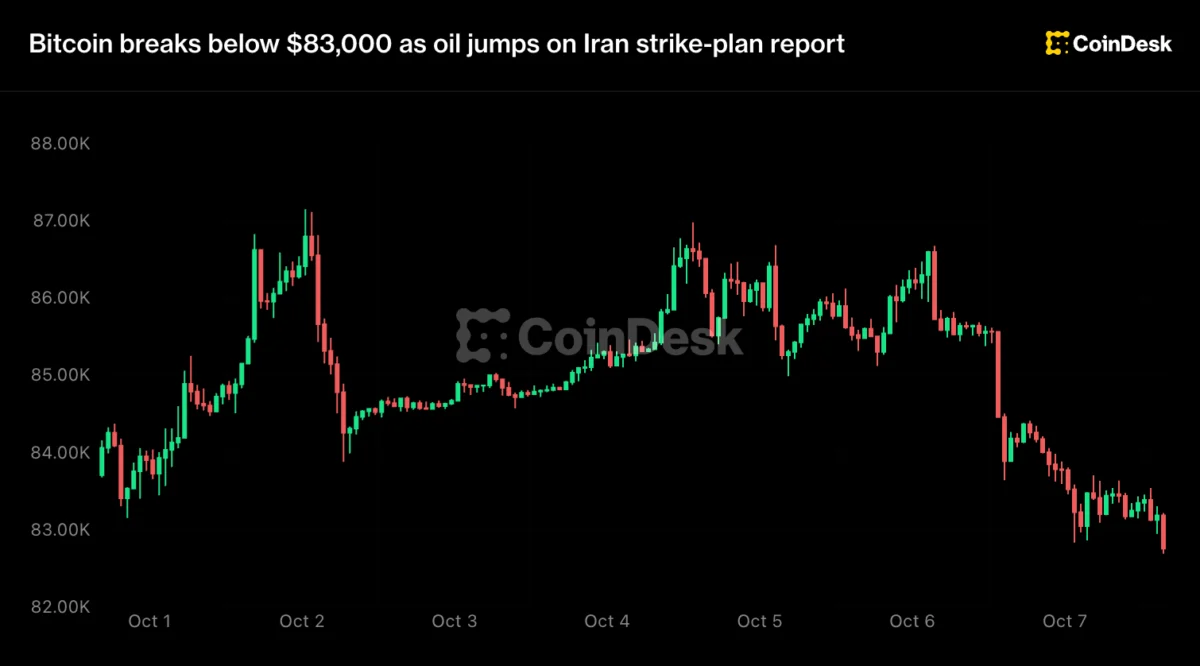
Bitcoin dropped 1.6% to trade just under $82,800 during Thursday’s Asian morning hours, breaching a critical technical threshold that market analysts warn could accelerate further losses toward the $80,000 mark. The digital asset’s downward trajectory coincided with a sharp rally in global crude prices, which surged following reports of escalating geopolitical tensions in the Middle East, subsequently pushing U.S. Treasury yields back toward multi-decade highs not seen since 2002.
The broader cryptocurrency market mirrored bitcoin’s weakness, experiencing widespread liquidations and downward pressure across major tokens. XRP led the declines among large-cap digital assets, tumbling nearly 4% to approximately $1.42. Meanwhile, Dogecoin (DOGE) slid 3% to trade just beneath 9 cents, and ether (ETH) fell 3% to hover around $2,570. Other prominent tokens also suffered, with HYPE and SOL each recording losses in excess of 2%, while ZEC managed a more modest decline of less than 1%. Bucking the broader market trend, BNB and TRX emerged as the sole gainers among major digital currencies, each posting marginal gains of less than 1%, according to data compiled by CoinDesk.
The latest pullback breaks bitcoin decisively below the $83,000 support level. Earlier in the week, trading firm FxPro highlighted this specific threshold as a critical line in the sand, noting that a breakdown would confirm that bearish sellers had firmly seized control of market momentum. The firm explicitly cautioned that breaching this support could open up a "quick path" for bitcoin to slide toward $80,000.
This technical failure arrives on the heels of a massive market flush. Just a day prior, approximately $550 million in leveraged cryptocurrency derivative positions were wiped out across the ecosystem. According to data from CoinGlass, the vast majority of these liquidations befell unsuspecting traders who had placed leveraged bets anticipating higher prices, exacerbating the downward spiral as forced position closures cascaded through the market.
Macroeconomic pressures outside the digital asset ecosystem heavily influenced the crypto sell-off, driven primarily by a dramatic spike in energy markets. Brent crude jumped 2% to climb above $102 a barrel, fueling renewed inflationary concerns among global investors. The surge in oil prices was catalyzed by multiple compounding factors, most notably a troubling report that the White House had requested potential military strike options from the Pentagon against Iran.
Simultaneously, energy supplies faced physical disruptions as a severe storm forced the temporary shutdown of notable U.S. offshore oil production facilities. Compounding the supply anxiety in the Middle East, Iran-backed Houthi rebels launched attacks striking two airports in Saudi Arabia, resulting in the tragic deaths of three people and heightening fears of a wider regional conflict that could choke off vital crude transit routes.
The sudden and aggressive jump in crude oil prices had an immediate and severe knock-on effect on the fixed-income market. Yields on U.S. government debt climbed sharply, with the benchmark 10-year Treasury yield advancing two basis points to settle at 5.31%. This ascent brings yields uncomfortably close to their highest levels since 2002, tightening global financial conditions and drawing capital away from risk-sensitive assets like equities and cryptocurrencies.
Traditional equity markets also reacted swiftly to the confluence of geopolitical strain and tightening bond yields, pulling back significantly from recent record territory. Wall Street benchmarks suffered notable losses on Wednesday, retreating sharply just a day after closing at all-time highs. The negative sentiment quickly bled over into international markets, where Asian shares followed Wall Street’s lead with a broad decline of roughly 1%.
Broader global equity barometers reflected the widespread risk-off sentiment. MSCI’s All Country World Index dropped 0.2%, pushing the global benchmark further away from the historic milestone it had approached earlier in the week, when it came within just 1.5% of an all-time record high.
Market observers noted a clear correlation in recent trading sessions, pointing out that bitcoin’s last two consecutive losing days coincided precisely with periods when crude oil prices climbed and Treasury yields advanced. For digital asset bulls looking for a stabilization or a resumption of the previous upward trend, market analysts suggest that a relief in macroeconomic pressures—specifically a retreat in Brent crude back below the psychological $100-per-barrel threshold where it traded earlier in the week—will be a necessary prerequisite to take the relentless upward pressure off yields and restore confidence to risk assets.