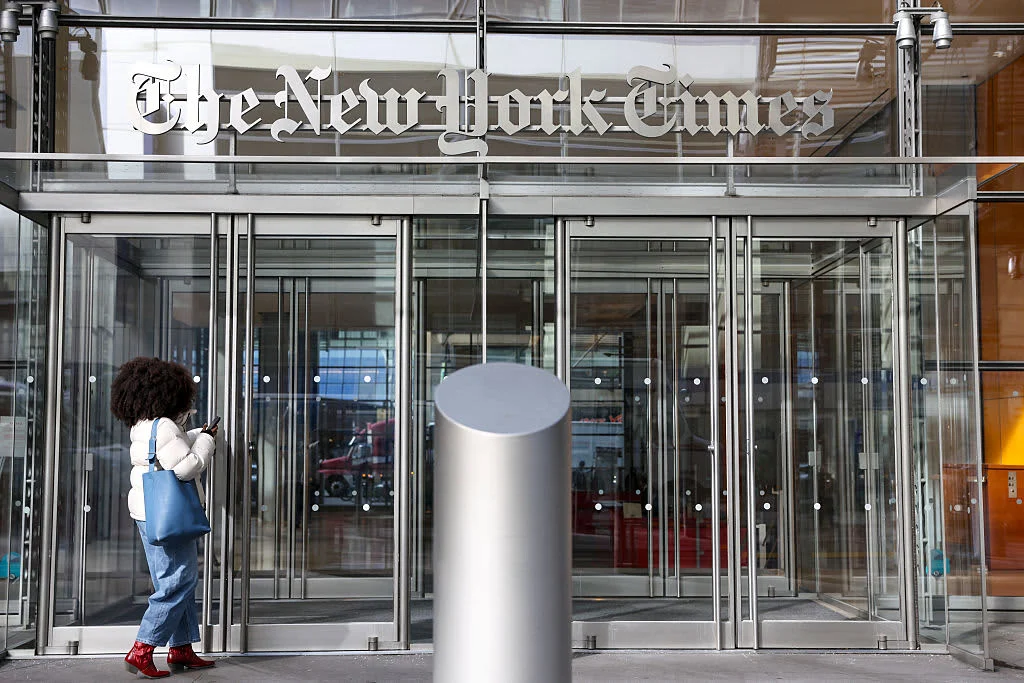
While political clashes continue to dominate daily news cycles, a far more consequential battle over the fundamental economics of journalism is quietly unfolding inside a Lower Manhattan courtroom. The high-stakes legal confrontation between major media publishers and leading artificial intelligence developers is beginning to capture the intense scrutiny of options traders, who are positioning themselves for potential financial volatility as crucial evidence comes to light.
On a recent Friday, newly unsealed court documents revealed statements from executives at Microsoft and OpenAI that severely threaten the central "fair-use" defense central to their legal strategy in an ongoing high-profile lawsuit filed by The New York Times. The core of the fair-use doctrine requires defendants to demonstrate that their accused product does not serve as a direct substitute for, or a commercial competitor to, the original source material.
According to the newly released material, an OpenAI executive allegedly acknowledged in internal discussions that their conversational AI chatbots represented precisely that: an "existential threat" to the publishing industry. These tools deliver summarized or synthesized information directly to the user, thereby bypassing the traditional mechanism of sending traffic to the publisher via a click-through link. Additional revelations from the unsealed court records indicate that OpenAI allegedly copied millions of copyrighted articles to train its foundational models, potentially exploiting specialized technical workarounds or hacks to retrieve restricted content.
Meanwhile, internal commentary from Microsoft’s director of applied science, Brent Hecht, reportedly described the massive data scraping and model training process as "the largest theft of labor in human history," according to records reviewed by the Washington Post. At the same time, internal data compiled by the technology companies themselves demonstrated that referral traffic and click-through rates to The New York Times plummeted precipitously as AI adoption grew.
The historical record of corporate communications surrounding the technology’s development has also come under sharper focus. OpenAI co-founder Greg Brockman reportedly wrote in a 2017 message that he was "deeply motivated by the gazillions" he anticipated earning through the commercialization of artificial intelligence. Furthermore, records indicate he allegedly responded with a casual "ah nice" when informed by an employee that a technical method had been successfully deployed to bypass The New York Times paywall.
Legal and market observers note that these emerging findings significantly elevate the probability of two potential outcomes. Either the litigation will culminate in a massive financial settlement and comprehensive licensing agreements between the tech giants and publishers, or, failing an amicable resolution, a decisive victory for The New York Times at trial could prove catastrophic for the defendants while delivering extraordinarily lucrative payouts for the plaintiff.

Complicating the landscape for the media company, however, is a notable intervention from federal regulators. On September 1st, a statement of interest filed by the Department of Justice asked the presiding court to establish that training artificial intelligence models on copyrighted works constitutes fair use, invoking arguments centered on national security. The government’s perspective suggests that if foreign adversaries and geopolitical competitors are permitted to train their systems on any accessible data by any available means, restricting domestic U.S. technology systems could risk ceding an insurmountable strategic lead on the global stage.
Given the staggering economic and strategic stakes involved in the litigation, observers might reasonably expect the ongoing legal theater to command intense, widespread attention from everyday equity investors. Yet, shares of The New York Times Company have remained remarkably subdued, trading flat for the year to date and registering barely any movement following Friday’s wave of unsealed disclosures.
By contrast, activity within the options market has heated up considerably as sophisticated traders attempt to front-run a definitive legal turning point. The primary volume of options flow centered on the purchase of roughly 4,400 October call spreads with strike prices set at $72.50 and $77.50, executed for a modest debit of $92.5 cents. This strategic position risks a mere fraction of Friday’s closing price to capture a potential gain of at least 4.6 percent by the October expiration date, with the possibility of achieving a return of 10 percent or more should the underlying equity move toward the consensus average analyst target of $77.73. Concurrent trading volume observed in the October $62.50 and $65 puts suggests that the trader may have successfully defrayed the initial capital outlay by selling downside protection just below the previous August lows.
The selection of an October expiration date implies a growing market expectation that a crucial summary judgment ruling from the court, or alternatively a negotiated settlement between the warring parties, could materialize within a matter of weeks—a timeline that the sudden release of damaging internal emails has made increasingly plausible.
For market participants weighing directional risks, the situation presents a classic structural puzzle. If the primary risk involves a negative legal surprise that could drive the stock toward new multi-month lows, and if the near-term analyst price target already aligns closely with current trading levels, alternative strategies naturally emerge. Rather than attempting to guess whether broader options premia are overpriced, underpriced, or fairly valued, some market participants favor utilizing defined-risk structures that lower capital requirements while offering asymmetric upside participation. For instance, a wider call spread structure can offer substantial capital appreciation against a tightly controlled downside risk profile, requiring only a de minimis outlay of extrinsic premium.
Put simply, this trading approach relies on deploying less capital while maintaining defined risk parameters and an asymmetric payout potential. As the legal proceedings in Lower Manhattan continue to develop, the interplay between judicial rulings, regulatory interventions, and sophisticated options positioning will likely remain a focal point for those monitoring the intersection of artificial intelligence and media economics.