Nearly half of all special education directors report that school-parent conflict is actively increasing across districts nationwide. For any educator who has ever sat across from a frustrated parent demanding immediate programmatic changes that cannot legally be made on the spot, that statistic represents more than just a data point—it is a typical Tuesday afternoon. The escalating tension surrounding contentious Individualized Education Program (IEP) meetings carries profound real-world consequences, ranging from stalled student services and heightened legal exposure to widespread educator burnout and an exodus of talented professionals from the field.
IEP dispute resolution is rarely understood as a last resort reserved exclusively for irreparably broken relationships. Instead, it forms a deliberate procedural framework built directly into the Individuals with Disabilities Education Act (IDEA) specifically to manage moments of intense disagreement. Understanding these mechanisms thoroughly often serves as the defining margin between feeling completely cornered in a high-stakes conference room and maintaining professional competence under pressure.
Why IEP Conflict Is Escalating Across School Districts
Rising friction between schools and families is not merely a localized perception problem or an isolated interpersonal challenge. Recent data highlights that nearly 50% of special education directors view mounting school-parent tension as a defining operational challenge. This trend reflects deep structural shifts rather than isolated personality clashes. Heightened policy uncertainty at the federal level, the rapid expansion and professionalization of parent advocacy organizations, and intense post-pandemic scrutiny regarding how services are delivered have collectively raised the stakes for every participant seated at the IEP table.
Experienced case managers feel this atmospheric shift acutely in their daily routines. Professionals note an undeniable increase in sharper, more adversarial email correspondence, the frequent presence of legal representation during routine annual reviews, and parents arriving armed with printed legal citations and compliance manuals. Effective preparation used to center primarily on compiling robust student progress data. Today, however, preparation requires case managers to understand their procedural footing before anyone even enters the room, largely because parents and their advocates increasingly understand theirs.
Mastering parental rights under IDEA has shifted from a recommended professional development exercise to an absolute operational necessity for modern educators.
IDEA Dispute Resolution Pathways and Their Practical Implications
Federal law provides three distinct pathways for resolving disputes within the IEP process. Educators frequently conflate these options or mistakenly skip straight to due process in their strategic thinking. Each pathway carries vastly different timelines, financial implications, and long-term consequences for the collaborative relationship between the school and the family.
The first option involves filing a formal state complaint. Under this mechanism, a parent or an external organization submits a written allegation to the State Education Agency detailing a specific violation of IDEA. The state agency is then mandated to investigate the claims and issue a formal resolution within 60 calendar days. This pathway relies heavily on factual and procedural evidence, operating entirely without a formal hearing officer. School districts with documentation gaps or failures regarding prior written notice requirements remain particularly vulnerable to this avenue.
The second pathway is IEP mediation. Structured as a voluntary process for both schools and families, mediation introduces a trained, impartial third-party mediator to facilitate a mutually agreeable resolution. Compared to formal litigation, mediation moves significantly faster, preserves the working relationship between parents and educators, and frequently resolves disagreements before they spiral into formal legal battles. Despite its effectiveness, many families remain unaware that they can request mediation, and numerous case managers overlook their ability to suggest it proactively, leaving an underutilized tool sitting on the table precisely when it is needed most.
The third and most formal pathway is the due process hearing. This mechanism closely mirrors a judicial trial, involving formal legal hearings, mandatory legal representation, and binding legal decisions handed down by an officer. Education professionals universally agree that due process should remain the absolute last resort rather than an initial reaction to disagreement.

IDEA at 50: Re-examining the Legal Framework
The milestone 50th anniversary of IDEA has prompted national education organizations, including the American Association of School Administrators (AASA), to closely examine whether the current dispute resolution mechanisms continue to adequately serve students, parents, and schools. These broad national conversations signal that the foundational procedural rules relied upon by case managers for decades are facing rigorous public and legislative scrutiny.
These discussions carry significant practical implications for the immediate future. If legislative reauthorization debates accelerate, crucial timelines, compliance thresholds, and procedural requirements could shift significantly. Educators who maintain a deep comprehension of the current IEP dispute resolution framework will adapt far more rapidly to these changes than those who understand the rules only superficially. The ultimate objective is not for educators to act as attorneys, but rather to achieve procedural fluency—recognizing precisely what federal law mandates so they can immediately identify when a proposal during a meeting crosses established legal boundaries.
The Growing Cost of Procedural Missteps
State education agencies are increasingly unwilling to wait for federal legislative action to tighten compliance standards. States such as New Jersey and Virginia have actively moved to reinforce their special education oversight requirements. These regulatory changes point toward a broader national trend where state oversight is intensifying and the acceptable margin for procedural error is shrinking rapidly.
In practice, a procedural misstep often looks deceptively minor: missing a required prior written notice deadline, failing to properly document a parent’s receipt of their procedural safeguards, or conducting an IEP team meeting without securing the required attendance configuration. These oversights frequently occur when overworked case managers attempt to manage overwhelming caseloads under severe time constraints. Unfortunately, these are precisely the administrative vulnerabilities that surface during state compliance investigations and formal complaints.
Familiarizing oneself with parental rights and dispute resolution options is not about treating parents as adversaries. Instead, it establishes the rigorous procedural discipline necessary to protect every participant in the room, including the student, the family, and the educator. Case managers who master these frameworks are considerably harder to catch off guard, easier for families to trust, and far better equipped to de-escalate volatile situations.
Navigating Conflict When It Erupts in the Room
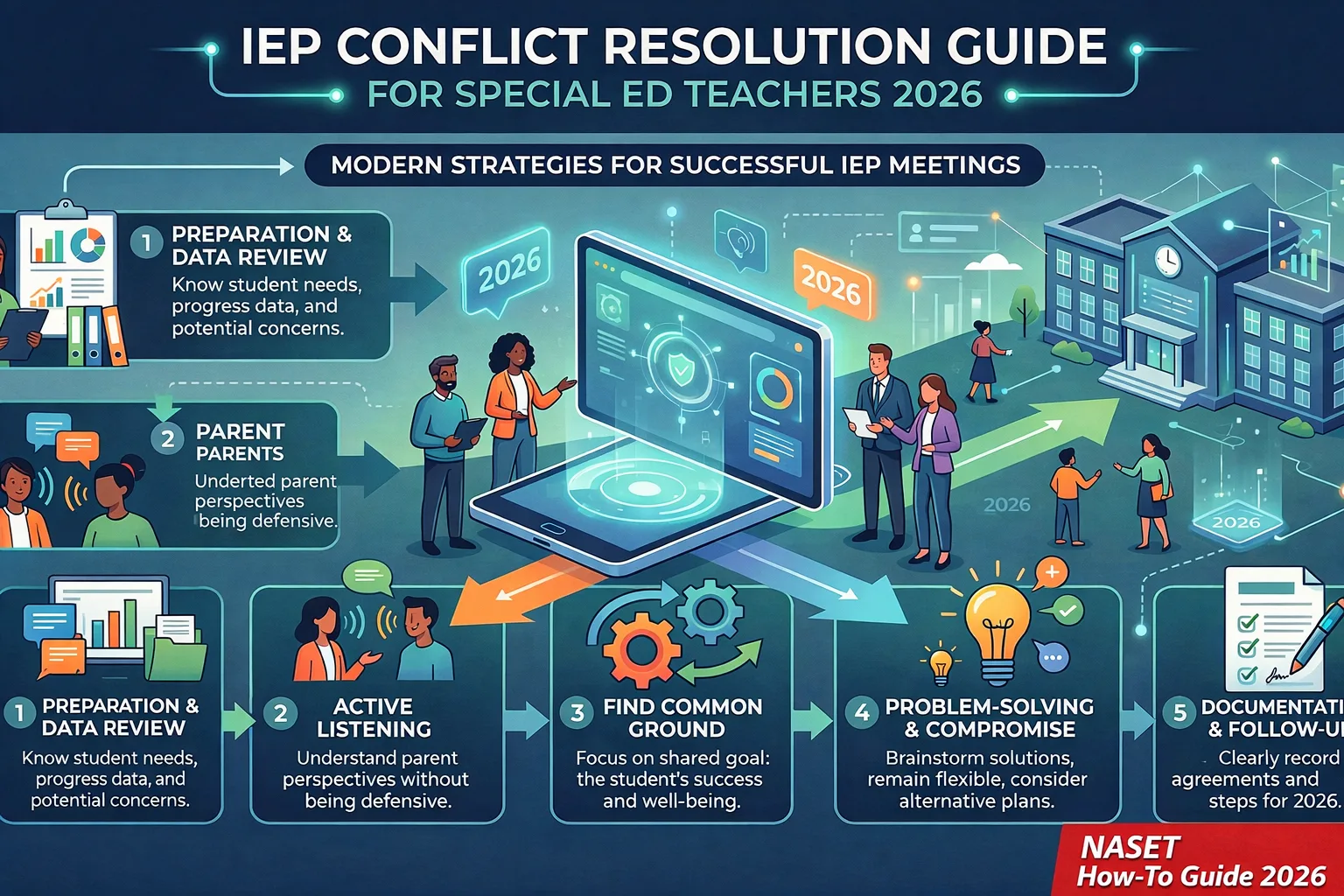
No procedural framework can entirely eliminate the intense moment when a meeting abruptly turns contentious and frustrations boil over. When conflict erupts in real-time, professionals must rely on steady communication strategies. Naming the disagreement clearly and directly—rather than attempting to deflect or minimize the tension—provides a grounding foundation for the room. Slowing the pace of the meeting allows participants to pause, regroup, or reconvene at a later date, ensuring that critical decisions are never forced through under undue emotional pressure.
Furthermore, calmly outlining formal pathways such as mediation or state complaints when appropriate can actually help rebuild trust by demonstrating transparency and adherence to due process. Comprehensive documentation of these discussions immediately following the meeting ensures that the factual record remains clear as time passes.
Ultimately, maintaining composure and keeping the focus squarely on the individualized needs of the student allows educators to navigate regulatory complexities, protect procedural integrity, and foster collaborative educational environments even amidst challenging circumstances.